

chronically infected individuals the normal transparent lens
becomes whitish due to proliferation of lens epithelium;
capsular rupture and detachment of the retina may impair
host vision. This occurs as results of the active migration of
cercaria to the anterior chamber, retina, vitreous body and
lens, mostly through subcutaneous connective tissue and
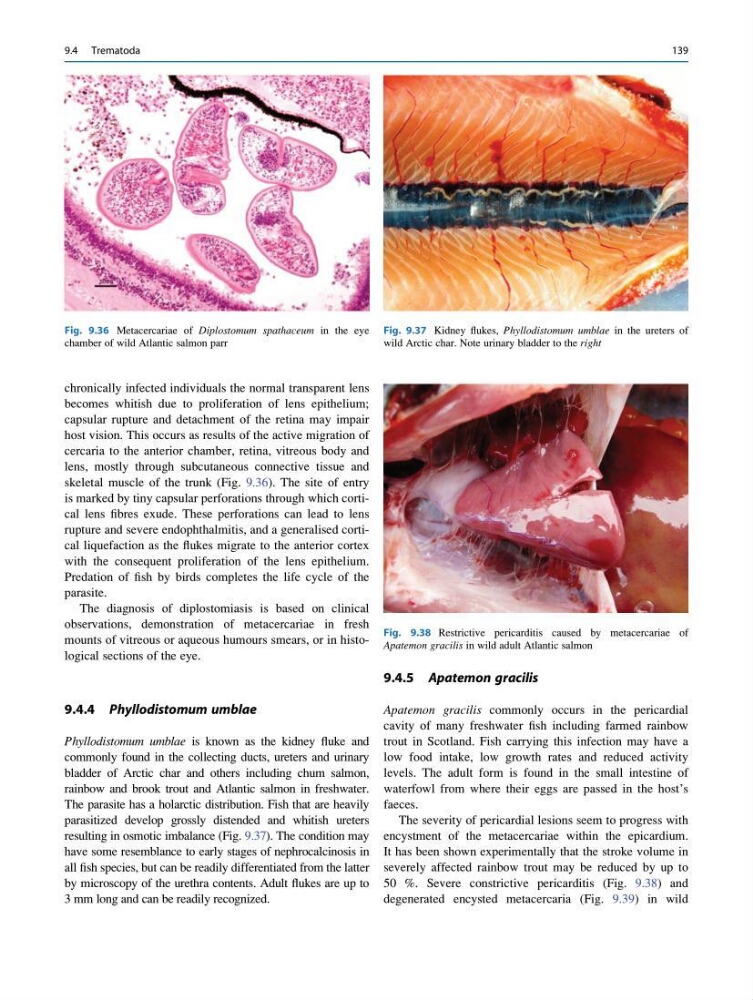
skeletal muscle of the trunk (Fig. 9.36). The site of entry
is marked by tiny capsular perforations through which cortical lens fibres exude. These perforations can lead to lens
rupture and severe endophthalmitis, and a generalised cortical liquefaction as the flukes migrate to the anterior cortex
with the consequent proliferation of the lens epithelium.
Predation of fish by birds completes the life cycle of the
parasite.
The diagnosis of diplostomiasis is based on clinical
observations, demonstration of metacercariae in fresh
mounts of vitreous or aqueous humours smears, or in histological sections of the eye.
9.4.4 Phyllodistomum umblae
Phyllodistomum umblae is known as the kidney fluke and
commonly found in the collecting ducts, ureters and urinary
bladder of Arctic char and others including chum salmon,
rainbow and brook trout and Atlantic salmon in freshwater.
The parasite has a holarctic distribution. Fish that are heavily
parasitized develop grossly distended and whitish ureters
resulting in osmotic imbalance (Fig. 9.37). The condition may
have some resemblance to early stages of nephrocalcinosis in
all fish species, but can be readily differentiated from the latter
by microscopy of the urethra contents. Adult flukes are up to
3 mm long and can be readily recognized.
9.4.5 Apatemon gracilis
Apatemon gracilis commonly occurs in the pericardial
cavity of many freshwater fish including farmed rainbow
trout in Scotland. Fish carrying this infection may have a
low food intake, low growth rates and reduced activity
levels. The adult form is found in the small intestine of
waterfowl from where their eggs are passed in the host’s
faeces.
The severity of pericardial lesions seem to progress with
encystment of the metacercariae within the epicardium.
It has been shown experimentally that the stroke volume in
severely affected rainbow trout may be reduced by up to
50 %. Severe constrictive pericarditis (Fig. 9.38) and
degenerated encysted metacercaria (Fig. 9.39) in wild
Fig. 9.36 Metacercariae of Diplostomum spathaceum in the eye
chamber of wild Atlantic salmon parr
Fig. 9.37 Kidney flukes, Phyllodistomum umblae in the ureters of
wild Arctic char. Note urinary bladder to the right
Fig. 9.38 Restrictive pericarditis caused by metacercariae of
Apatemon gracilis in wild adult Atlantic salmon
9.4 Trematoda
139
becomes whitish due to proliferation of lens epithelium;
capsular rupture and detachment of the retina may impair
host vision. This occurs as results of the active migration of
cercaria to the anterior chamber, retina, vitreous body and
lens, mostly through subcutaneous connective tissue and
skeletal muscle of the trunk (Fig. 9.36). The site of entry
is marked by tiny capsular perforations through which cortical lens fibres exude. These perforations can lead to lens
rupture and severe endophthalmitis, and a generalised cortical liquefaction as the flukes migrate to the anterior cortex
with the consequent proliferation of the lens epithelium.
Predation of fish by birds completes the life cycle of the
parasite.
The diagnosis of diplostomiasis is based on clinical
observations, demonstration of metacercariae in fresh
mounts of vitreous or aqueous humours smears, or in histological sections of the eye.
9.4.4 Phyllodistomum umblae
Phyllodistomum umblae is known as the kidney fluke and
commonly found in the collecting ducts, ureters and urinary
bladder of Arctic char and others including chum salmon,
rainbow and brook trout and Atlantic salmon in freshwater.
The parasite has a holarctic distribution. Fish that are heavily
parasitized develop grossly distended and whitish ureters
resulting in osmotic imbalance (Fig. 9.37). The condition may
have some resemblance to early stages of nephrocalcinosis in
all fish species, but can be readily differentiated from the latter
by microscopy of the urethra contents. Adult flukes are up to
3 mm long and can be readily recognized.
9.4.5 Apatemon gracilis
Apatemon gracilis commonly occurs in the pericardial
cavity of many freshwater fish including farmed rainbow
trout in Scotland. Fish carrying this infection may have a
low food intake, low growth rates and reduced activity
levels. The adult form is found in the small intestine of
waterfowl from where their eggs are passed in the host’s
faeces.
The severity of pericardial lesions seem to progress with
encystment of the metacercariae within the epicardium.
It has been shown experimentally that the stroke volume in
severely affected rainbow trout may be reduced by up to
50 %. Severe constrictive pericarditis (Fig. 9.38) and
degenerated encysted metacercaria (Fig. 9.39) in wild
Fig. 9.36 Metacercariae of Diplostomum spathaceum in the eye
chamber of wild Atlantic salmon parr
Fig. 9.37 Kidney flukes, Phyllodistomum umblae in the ureters of
wild Arctic char. Note urinary bladder to the right
Fig. 9.38 Restrictive pericarditis caused by metacercariae of
Apatemon gracilis in wild adult Atlantic salmon
9.4 Trematoda
139