

9.3.2 Diphyllobothrium spp.
Several species within this group have fish as their intermediate
host and plerocercoids of D. dendriticum, D. latum and
D. ditremum are present in several salmonid species.
D. latum has been found in whitefish and other salmonids in
northern Scandinavia, Western Russia, the Baltic area and the
Pacific north and south west of North and South America.
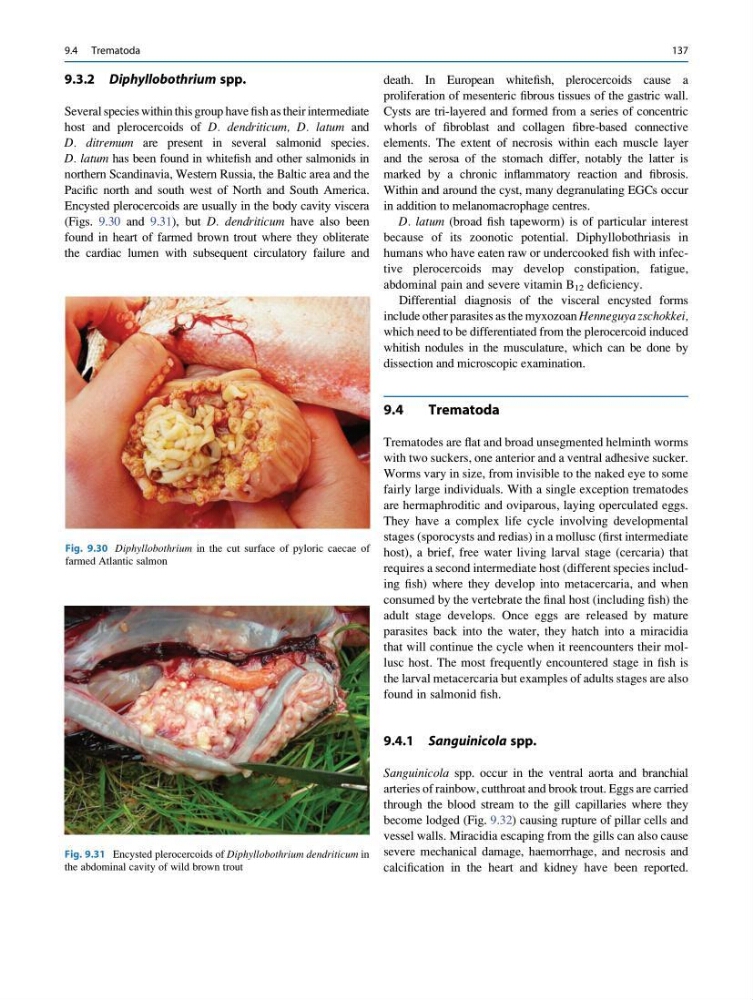
Encysted plerocercoids are usually in the body cavity viscera
(Figs. 9.30 and 9.31), but D. dendriticum have also been
found in heart of farmed brown trout where they obliterate
the cardiac lumen with subsequent circulatory failure and
death. In European whitefish, plerocercoids cause a
proliferation of mesenteric fibrous tissues of the gastric wall.
Cysts are tri-layered and formed from a series of concentric
whorls of fibroblast and collagen fibre-based connective
elements. The extent of necrosis within each muscle layer
and the serosa of the stomach differ, notably the latter is
marked by a chronic inflammatory reaction and fibrosis.
Within and around the cyst, many degranulating EGCs occur
in addition to melanomacrophage centres.
D. latum (broad fish tapeworm) is of particular interest
because of its zoonotic potential. Diphyllobothriasis in
humans who have eaten raw or undercooked fish with infective plerocercoids may develop constipation, fatigue,
abdominal pain and severe vitamin B 12 deficiency.
Differential diagnosis of the visceral encysted forms
include other parasites as the myxozoan Henneguya zschokkei,
which need to be differentiated from the plerocercoid induced
whitish nodules in the musculature, which can be done by
dissection and microscopic examination.
9.4
Trematoda
Trematodes are flat and broad unsegmented helminth worms
with two suckers, one anterior and a ventral adhesive sucker.
Worms vary in size, from invisible to the naked eye to some
fairly large individuals. With a single exception trematodes
are hermaphroditic and oviparous, laying operculated eggs.
They have a complex life cycle involving developmental
stages (sporocysts and redias) in a mollusc (first intermediate
host), a brief, free water living larval stage (cercaria) that
requires a second intermediate host (different species including fish) where they develop into metacercaria, and when
consumed by the vertebrate the final host (including fish) the
adult stage develops. Once eggs are released by mature
parasites back into the water, they hatch into a miracidia
that will continue the cycle when it reencounters their mollusc host. The most frequently encountered stage in fish is
the larval metacercaria but examples of adults stages are also
found in salmonid fish.
9.4.1 Sanguinicola spp.
Sanguinicola spp. occur in the ventral aorta and branchial
arteries of rainbow, cutthroat and brook trout. Eggs are carried
through the blood stream to the gill capillaries where they
become lodged (Fig. 9.32) causing rupture of pillar cells and
vessel walls. Miracidia escaping from the gills can also cause
severe mechanical damage, haemorrhage, and necrosis and
calcification in the heart and kidney have been reported.
Fig. 9.30 Diphyllobothrium in the cut surface of pyloric caecae of
farmed Atlantic salmon
Fig. 9.31 Encysted plerocercoids of Diphyllobothrium dendriticum in
the abdominal cavity of wild brown trout
9.4 Trematoda
137
Several species within this group have fish as their intermediate
host and plerocercoids of D. dendriticum, D. latum and
D. ditremum are present in several salmonid species.
D. latum has been found in whitefish and other salmonids in
northern Scandinavia, Western Russia, the Baltic area and the
Pacific north and south west of North and South America.
Encysted plerocercoids are usually in the body cavity viscera
(Figs. 9.30 and 9.31), but D. dendriticum have also been
found in heart of farmed brown trout where they obliterate
the cardiac lumen with subsequent circulatory failure and
death. In European whitefish, plerocercoids cause a
proliferation of mesenteric fibrous tissues of the gastric wall.
Cysts are tri-layered and formed from a series of concentric
whorls of fibroblast and collagen fibre-based connective
elements. The extent of necrosis within each muscle layer
and the serosa of the stomach differ, notably the latter is
marked by a chronic inflammatory reaction and fibrosis.
Within and around the cyst, many degranulating EGCs occur
in addition to melanomacrophage centres.
D. latum (broad fish tapeworm) is of particular interest
because of its zoonotic potential. Diphyllobothriasis in
humans who have eaten raw or undercooked fish with infective plerocercoids may develop constipation, fatigue,
abdominal pain and severe vitamin B 12 deficiency.
Differential diagnosis of the visceral encysted forms
include other parasites as the myxozoan Henneguya zschokkei,
which need to be differentiated from the plerocercoid induced
whitish nodules in the musculature, which can be done by
dissection and microscopic examination.
9.4
Trematoda
Trematodes are flat and broad unsegmented helminth worms
with two suckers, one anterior and a ventral adhesive sucker.
Worms vary in size, from invisible to the naked eye to some
fairly large individuals. With a single exception trematodes
are hermaphroditic and oviparous, laying operculated eggs.
They have a complex life cycle involving developmental
stages (sporocysts and redias) in a mollusc (first intermediate
host), a brief, free water living larval stage (cercaria) that
requires a second intermediate host (different species including fish) where they develop into metacercaria, and when
consumed by the vertebrate the final host (including fish) the
adult stage develops. Once eggs are released by mature
parasites back into the water, they hatch into a miracidia
that will continue the cycle when it reencounters their mollusc host. The most frequently encountered stage in fish is
the larval metacercaria but examples of adults stages are also
found in salmonid fish.
9.4.1 Sanguinicola spp.
Sanguinicola spp. occur in the ventral aorta and branchial
arteries of rainbow, cutthroat and brook trout. Eggs are carried
through the blood stream to the gill capillaries where they
become lodged (Fig. 9.32) causing rupture of pillar cells and
vessel walls. Miracidia escaping from the gills can also cause
severe mechanical damage, haemorrhage, and necrosis and
calcification in the heart and kidney have been reported.
Fig. 9.30 Diphyllobothrium in the cut surface of pyloric caecae of
farmed Atlantic salmon
Fig. 9.31 Encysted plerocercoids of Diphyllobothrium dendriticum in
the abdominal cavity of wild brown trout
9.4 Trematoda
137