

salmon and in sea trout. External features of affected vents can
be mild to severe and include protrusion and swelling, scale
loss, skin breakdown, petechial or widespread haemorrhage,
and bleeding in severe cases. Occasionally, larvae can be
seen with the naked eye just beneath the skin surface in
the vent region. At examination, both encapsulated and nonencapsulated larvae can be seen around the hind gut, within the
discrete space towards the skin, between the hindgut and the
genital cavity, and between this region and the urethra
(Fig. 9.26). Anisakis have also been recorded deep within the
skeletal musculature above the vent area and sometimes
within the lumen of the genital cavity.
Histologically, severely affected tissues of the vent show
scale loss and absence or a detached epidermal layer, however
evidence of epidermal healing and scale regeneration has been
observed after fish enter and remain in freshwater. Capillary
dilation, blood congestion, haemorrhage and moderate to
severe dermal inflammation associated to non-encapsulated
migrating larvae has been reported. The inflammatory reaction
is dominated by EGCs, but melanomacrophages and multinucleated giant cells have also been described.
RVS does not seem to prevent fish form spawning or is
inducing mortality at least in those that have been examined
or stripped artificially. The condition has also been reported
from Canada, Iceland, Ireland and Norway, and is therefore
considered to have a north Atlantic distribution.
9.3
Cestoda
The Cestoda or tapeworms have a wide geographical distribution, but usually a high degree of host specificity.
Salmonids can act both as intermediate host for larval stages
or final host of adult individuals, from infections by different
species. Generally, when fish act as intermediate host the
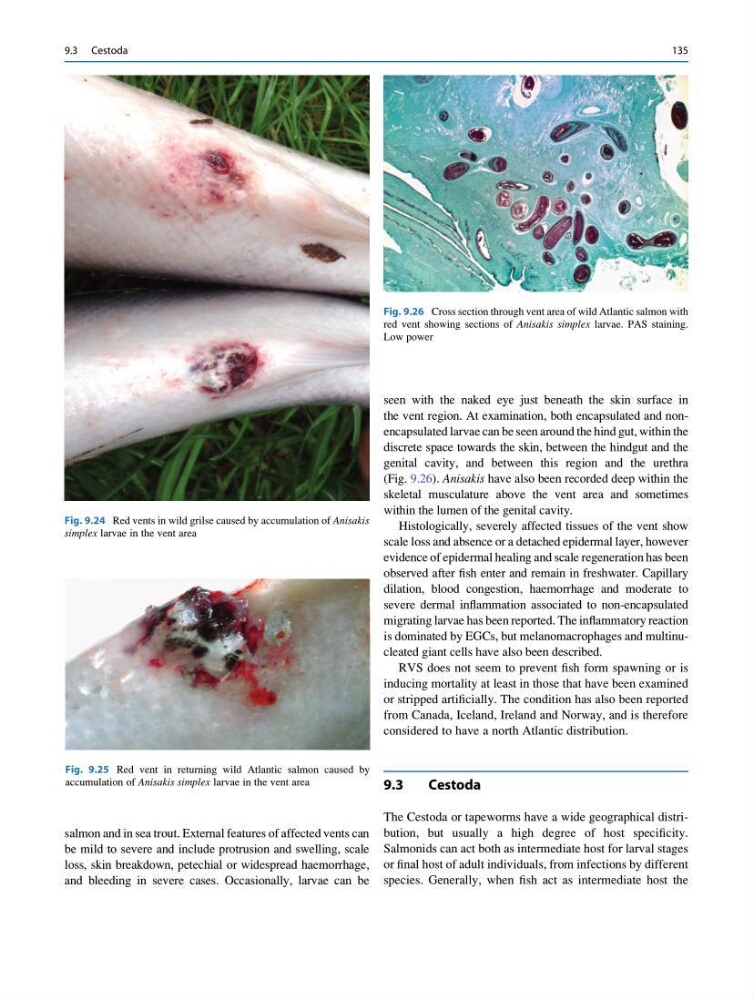
Fig. 9.24 Red vents in wild grilse caused by accumulation of Anisakis
simplex larvae in the vent area
Fig. 9.25 Red vent in returning wild Atlantic salmon caused by
accumulation of Anisakis simplex larvae in the vent area
Fig. 9.26 Cross section through vent area of wild Atlantic salmon with
red vent showing sections of Anisakis simplex larvae. PAS staining.
Low power
9.3 Cestoda
135
be mild to severe and include protrusion and swelling, scale
loss, skin breakdown, petechial or widespread haemorrhage,
and bleeding in severe cases. Occasionally, larvae can be
seen with the naked eye just beneath the skin surface in
the vent region. At examination, both encapsulated and nonencapsulated larvae can be seen around the hind gut, within the
discrete space towards the skin, between the hindgut and the
genital cavity, and between this region and the urethra
(Fig. 9.26). Anisakis have also been recorded deep within the
skeletal musculature above the vent area and sometimes
within the lumen of the genital cavity.
Histologically, severely affected tissues of the vent show
scale loss and absence or a detached epidermal layer, however
evidence of epidermal healing and scale regeneration has been
observed after fish enter and remain in freshwater. Capillary
dilation, blood congestion, haemorrhage and moderate to
severe dermal inflammation associated to non-encapsulated
migrating larvae has been reported. The inflammatory reaction
is dominated by EGCs, but melanomacrophages and multinucleated giant cells have also been described.
RVS does not seem to prevent fish form spawning or is
inducing mortality at least in those that have been examined
or stripped artificially. The condition has also been reported
from Canada, Iceland, Ireland and Norway, and is therefore
considered to have a north Atlantic distribution.
9.3
Cestoda
The Cestoda or tapeworms have a wide geographical distribution, but usually a high degree of host specificity.
Salmonids can act both as intermediate host for larval stages
or final host of adult individuals, from infections by different
species. Generally, when fish act as intermediate host the
Fig. 9.24 Red vents in wild grilse caused by accumulation of Anisakis
simplex larvae in the vent area
Fig. 9.25 Red vent in returning wild Atlantic salmon caused by
accumulation of Anisakis simplex larvae in the vent area
Fig. 9.26 Cross section through vent area of wild Atlantic salmon with
red vent showing sections of Anisakis simplex larvae. PAS staining.
Low power
9.3 Cestoda
135