

Diagnosis of Philonema occurs at necropsy and is based
upon the detection of a filiform worm up to 10 cm in length
(female) with a rounded anterior end and a posterior tail
tapering to a sharp point.
9.2.2 Cystidicola farionis
Cystidicola farionis is relatively common, particularly in
wild salmonids, but also reported from farmed fish within
Europe and North America. Adult males and females live in
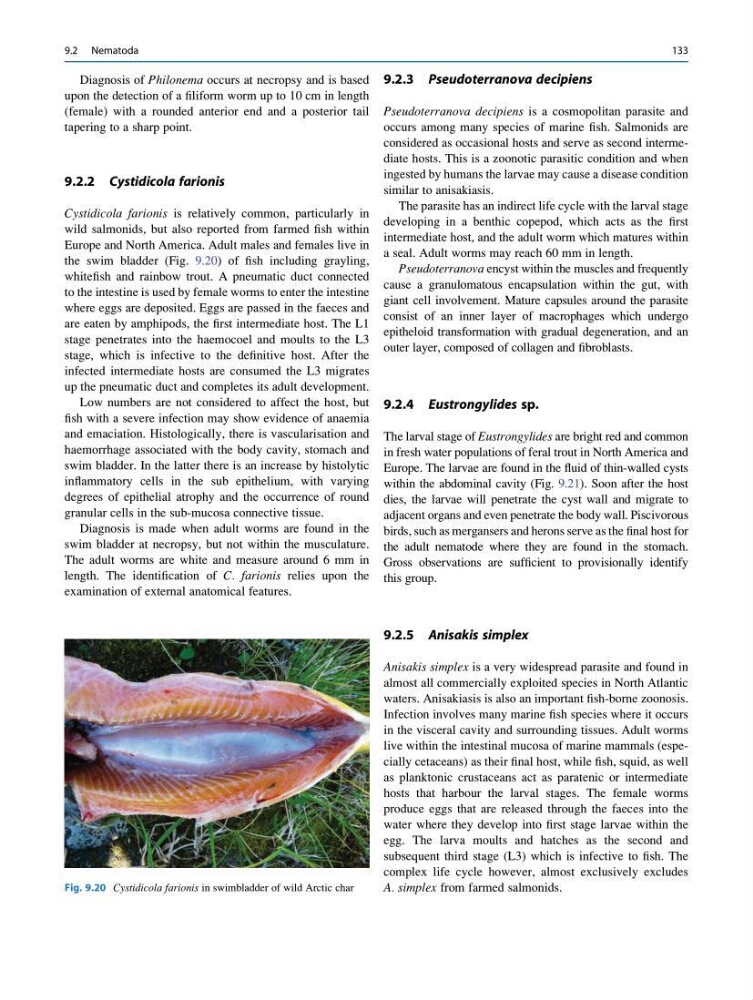
the swim bladder (Fig. 9.20) of fish including grayling,
whitefish and rainbow trout. A pneumatic duct connected
to the intestine is used by female worms to enter the intestine
where eggs are deposited. Eggs are passed in the faeces and
are eaten by amphipods, the first intermediate host. The L1
stage penetrates into the haemocoel and moults to the L3
stage, which is infective to the definitive host. After the
infected intermediate hosts are consumed the L3 migrates
up the pneumatic duct and completes its adult development.
Low numbers are not considered to affect the host, but
fish with a severe infection may show evidence of anaemia
and emaciation. Histologically, there is vascularisation and
haemorrhage associated with the body cavity, stomach and
swim bladder. In the latter there is an increase by histolytic
inflammatory cells in the sub epithelium, with varying
degrees of epithelial atrophy and the occurrence of round
granular cells in the sub-mucosa connective tissue.
Diagnosis is made when adult worms are found in the
swim bladder at necropsy, but not within the musculature.
The adult worms are white and measure around 6 mm in
length. The identification of C. farionis relies upon the
examination of external anatomical features.
9.2.3 Pseudoterranova decipiens
Pseudoterranova decipiens is a cosmopolitan parasite and
occurs among many species of marine fish. Salmonids are
considered as occasional hosts and serve as second intermediate hosts. This is a zoonotic parasitic condition and when
ingested by humans the larvae may cause a disease condition
similar to anisakiasis.
The parasite has an indirect life cycle with the larval stage
developing in a benthic copepod, which acts as the first
intermediate host, and the adult worm which matures within
a seal. Adult worms may reach 60 mm in length.
Pseudoterranova encyst within the muscles and frequently
cause a granulomatous encapsulation within the gut, with
giant cell involvement. Mature capsules around the parasite
consist of an inner layer of macrophages which undergo
epitheloid transformation with gradual degeneration, and an
outer layer, composed of collagen and fibroblasts.
9.2.4 Eustrongylides sp.
The larval stage of Eustrongylides are bright red and common
in fresh water populations of feral trout in North America and
Europe. The larvae are found in the fluid of thin-walled cysts
within the abdominal cavity (Fig. 9.21). Soon after the host
dies, the larvae will penetrate the cyst wall and migrate to
adjacent organs and even penetrate the body wall. Piscivorous
birds, such as mergansers and herons serve as the final host for
the adult nematode where they are found in the stomach.
Gross observations are sufficient to provisionally identify
this group.
9.2.5 Anisakis simplex
Anisakis simplex is a very widespread parasite and found in
almost all commercially exploited species in North Atlantic
waters. Anisakiasis is also an important fish-borne zoonosis.
Infection involves many marine fish species where it occurs
in the visceral cavity and surrounding tissues. Adult worms
live within the intestinal mucosa of marine mammals (especially cetaceans) as their final host, while fish, squid, as well
as planktonic crustaceans act as paratenic or intermediate
hosts that harbour the larval stages. The female worms
produce eggs that are released through the faeces into the
water where they develop into first stage larvae within the
egg. The larva moults and hatches as the second and
subsequent third stage (L3) which is infective to fish. The
complex life cycle however, almost exclusively excludes
A. simplex from farmed salmonids.
Fig. 9.20 Cystidicola farionis in swimbladder of wild Arctic char
9.2 Nematoda
133
upon the detection of a filiform worm up to 10 cm in length
(female) with a rounded anterior end and a posterior tail
tapering to a sharp point.
9.2.2 Cystidicola farionis
Cystidicola farionis is relatively common, particularly in
wild salmonids, but also reported from farmed fish within
Europe and North America. Adult males and females live in
the swim bladder (Fig. 9.20) of fish including grayling,
whitefish and rainbow trout. A pneumatic duct connected
to the intestine is used by female worms to enter the intestine
where eggs are deposited. Eggs are passed in the faeces and
are eaten by amphipods, the first intermediate host. The L1
stage penetrates into the haemocoel and moults to the L3
stage, which is infective to the definitive host. After the
infected intermediate hosts are consumed the L3 migrates
up the pneumatic duct and completes its adult development.
Low numbers are not considered to affect the host, but
fish with a severe infection may show evidence of anaemia
and emaciation. Histologically, there is vascularisation and
haemorrhage associated with the body cavity, stomach and
swim bladder. In the latter there is an increase by histolytic
inflammatory cells in the sub epithelium, with varying
degrees of epithelial atrophy and the occurrence of round
granular cells in the sub-mucosa connective tissue.
Diagnosis is made when adult worms are found in the
swim bladder at necropsy, but not within the musculature.
The adult worms are white and measure around 6 mm in
length. The identification of C. farionis relies upon the
examination of external anatomical features.
9.2.3 Pseudoterranova decipiens
Pseudoterranova decipiens is a cosmopolitan parasite and
occurs among many species of marine fish. Salmonids are
considered as occasional hosts and serve as second intermediate hosts. This is a zoonotic parasitic condition and when
ingested by humans the larvae may cause a disease condition
similar to anisakiasis.
The parasite has an indirect life cycle with the larval stage
developing in a benthic copepod, which acts as the first
intermediate host, and the adult worm which matures within
a seal. Adult worms may reach 60 mm in length.
Pseudoterranova encyst within the muscles and frequently
cause a granulomatous encapsulation within the gut, with
giant cell involvement. Mature capsules around the parasite
consist of an inner layer of macrophages which undergo
epitheloid transformation with gradual degeneration, and an
outer layer, composed of collagen and fibroblasts.
9.2.4 Eustrongylides sp.
The larval stage of Eustrongylides are bright red and common
in fresh water populations of feral trout in North America and
Europe. The larvae are found in the fluid of thin-walled cysts
within the abdominal cavity (Fig. 9.21). Soon after the host
dies, the larvae will penetrate the cyst wall and migrate to
adjacent organs and even penetrate the body wall. Piscivorous
birds, such as mergansers and herons serve as the final host for
the adult nematode where they are found in the stomach.
Gross observations are sufficient to provisionally identify
this group.
9.2.5 Anisakis simplex
Anisakis simplex is a very widespread parasite and found in
almost all commercially exploited species in North Atlantic
waters. Anisakiasis is also an important fish-borne zoonosis.
Infection involves many marine fish species where it occurs
in the visceral cavity and surrounding tissues. Adult worms
live within the intestinal mucosa of marine mammals (especially cetaceans) as their final host, while fish, squid, as well
as planktonic crustaceans act as paratenic or intermediate
hosts that harbour the larval stages. The female worms
produce eggs that are released through the faeces into the
water where they develop into first stage larvae within the
egg. The larva moults and hatches as the second and
subsequent third stage (L3) which is infective to fish. The
complex life cycle however, almost exclusively excludes
A. simplex from farmed salmonids.
Fig. 9.20 Cystidicola farionis in swimbladder of wild Arctic char
9.2 Nematoda
133