

considered contributory to the multifactorial, maybe end
stage condition known as proliferative gill inflammation
(PGI) in Atlantic salmon.
6.22 Candidatus arthromitus
Rainbow trout gastroenteritis (RTGE) is an emerging condition in trout culture in Europe and linked to the presence of
large numbers of a segmented filamentous bacterium
Candidatus arthromitus in the distal intestine and/or pyloric
caeca of the digestive tract, suggesting this is preferred site
for these bacteria. Affected fish show lethargy, reduced
appetite and accumulation of mucoid faeces particularly in
the summer months, with diffuse haemorrhage (Fig. 6.52).
Histopathological changes include enterocyte detachment
and congestion of the lamina propria and adventitial layers
(Fig. 6.53). The bacteria are not always adjacent to the areas
with pathological changes, suggesting that if these
organisms play a role in the pathogenesis, extracellular
products, T cells or apoptosis may also be involved in the
development and pathogenesis of RTGE. Ultrastructural
changes included loss of microvillar structure, membrane
blebbing, hydropic mitochondrial damage and basal
hydropic degeneration of enterocytes. The exposure of
large areas of the lamina propria probably results in a
compromised osmotic balance and facilitates the entry of
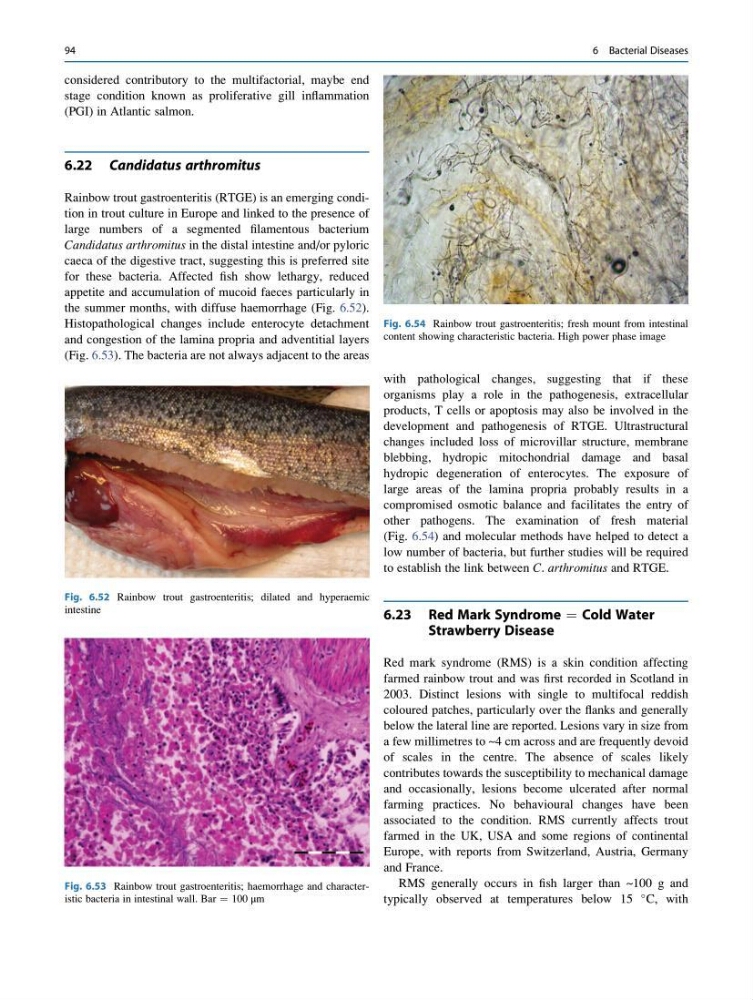
other pathogens. The examination of fresh material
(Fig. 6.54) and molecular methods have helped to detect a
low number of bacteria, but further studies will be required
to establish the link between C. arthromitus and RTGE.
6.23 Red Mark Syndrome ¼ Cold Water
Strawberry Disease
Red mark syndrome (RMS) is a skin condition affecting
farmed rainbow trout and was first recorded in Scotland in
2003. Distinct lesions with single to multifocal reddish
coloured patches, particularly over the flanks and generally
below the lateral line are reported. Lesions vary in size from
a few millimetres to ~4 cm across and are frequently devoid
of scales in the centre. The absence of scales likely
contributes towards the susceptibility to mechanical damage
and occasionally, lesions become ulcerated after normal
farming practices. No behavioural changes have been
associated to the condition. RMS currently affects trout
farmed in the UK, USA and some regions of continental
Europe, with reports from Switzerland, Austria, Germany
and France.
RMS generally occurs in fish larger than ~100 g and
typically observed at temperatures below 15
C, with
Fig. 6.52 Rainbow trout gastroenteritis; dilated and hyperaemic
intestine
Fig. 6.53 Rainbow trout gastroenteritis; haemorrhage and characteristic bacteria in intestinal wall. Bar ¼ 100 μm
Fig. 6.54 Rainbow trout gastroenteritis; fresh mount from intestinal
content showing characteristic bacteria. High power phase image
94
6 Bacterial Diseases
stage condition known as proliferative gill inflammation
(PGI) in Atlantic salmon.
6.22 Candidatus arthromitus
Rainbow trout gastroenteritis (RTGE) is an emerging condition in trout culture in Europe and linked to the presence of
large numbers of a segmented filamentous bacterium
Candidatus arthromitus in the distal intestine and/or pyloric
caeca of the digestive tract, suggesting this is preferred site
for these bacteria. Affected fish show lethargy, reduced
appetite and accumulation of mucoid faeces particularly in
the summer months, with diffuse haemorrhage (Fig. 6.52).
Histopathological changes include enterocyte detachment
and congestion of the lamina propria and adventitial layers
(Fig. 6.53). The bacteria are not always adjacent to the areas
with pathological changes, suggesting that if these
organisms play a role in the pathogenesis, extracellular
products, T cells or apoptosis may also be involved in the
development and pathogenesis of RTGE. Ultrastructural
changes included loss of microvillar structure, membrane
blebbing, hydropic mitochondrial damage and basal
hydropic degeneration of enterocytes. The exposure of
large areas of the lamina propria probably results in a
compromised osmotic balance and facilitates the entry of
other pathogens. The examination of fresh material
(Fig. 6.54) and molecular methods have helped to detect a
low number of bacteria, but further studies will be required
to establish the link between C. arthromitus and RTGE.
6.23 Red Mark Syndrome ¼ Cold Water
Strawberry Disease
Red mark syndrome (RMS) is a skin condition affecting
farmed rainbow trout and was first recorded in Scotland in
2003. Distinct lesions with single to multifocal reddish
coloured patches, particularly over the flanks and generally
below the lateral line are reported. Lesions vary in size from
a few millimetres to ~4 cm across and are frequently devoid
of scales in the centre. The absence of scales likely
contributes towards the susceptibility to mechanical damage
and occasionally, lesions become ulcerated after normal
farming practices. No behavioural changes have been
associated to the condition. RMS currently affects trout
farmed in the UK, USA and some regions of continental
Europe, with reports from Switzerland, Austria, Germany
and France.
RMS generally occurs in fish larger than ~100 g and
typically observed at temperatures below 15
C, with
Fig. 6.52 Rainbow trout gastroenteritis; dilated and hyperaemic
intestine
Fig. 6.53 Rainbow trout gastroenteritis; haemorrhage and characteristic bacteria in intestinal wall. Bar ¼ 100 μm
Fig. 6.54 Rainbow trout gastroenteritis; fresh mount from intestinal
content showing characteristic bacteria. High power phase image
94
6 Bacterial Diseases