

269: D10DONTIDAE (BURRFISHES & PORCUPINEFISHES)
3a All spines (except a few around gill opening, 0
base, and on C peduncle) erectile ...................... ........... Diodon
3b Most spines on head and belly erectile, those
on back and sides fixed ....................................... Lophodiodon
(Dicotylichthys punctulallls Kaup, 1855 has been reported from southern Africa (Smith, SFSA No, 1185) but is apparently an Australian
endemic. This species will key here if it is indeed present in South
Africa; it can be distinguished from Lophodiodon calori by its lack of
2-4 forward-pointing spines between the nostrils.)
Genus Chilomycterus (Bibron, ms.)
Brisout de Barneville, 1846
Monotypic.
269.1 Chilomycterus reticulatus
(Linnaeus, 1758)
Spotfin burrfish
Kolvin-klitsvis
Diodon reticulatlls Linnaeus, 1758: 334 (India). Diodon tigrinus Cuvier,
1818: 127, PI. 6, Fig. 2 (locality not given). Chilomycterus reticulallls: Poll,
1959: 352.
012-14; A 11-14; P 19-22; 8-10 spines from snout to 0 base. No fleshy
tentacles.
Pelagic stage blue dorsally with pupil-size dark spots
descending onto belly; benthic adults grey to brown with a
black gular band and small black spots on upper surfaces
and fins. Attains 55 cm. Young oceanic in surface waters
until about 20 cm; adults trawled in less than 100 m. Only
juveniles reported in our area from Cape to Salt Vlei, but
apt to be found on all coasts. Worldwide in warm temperate
waters.
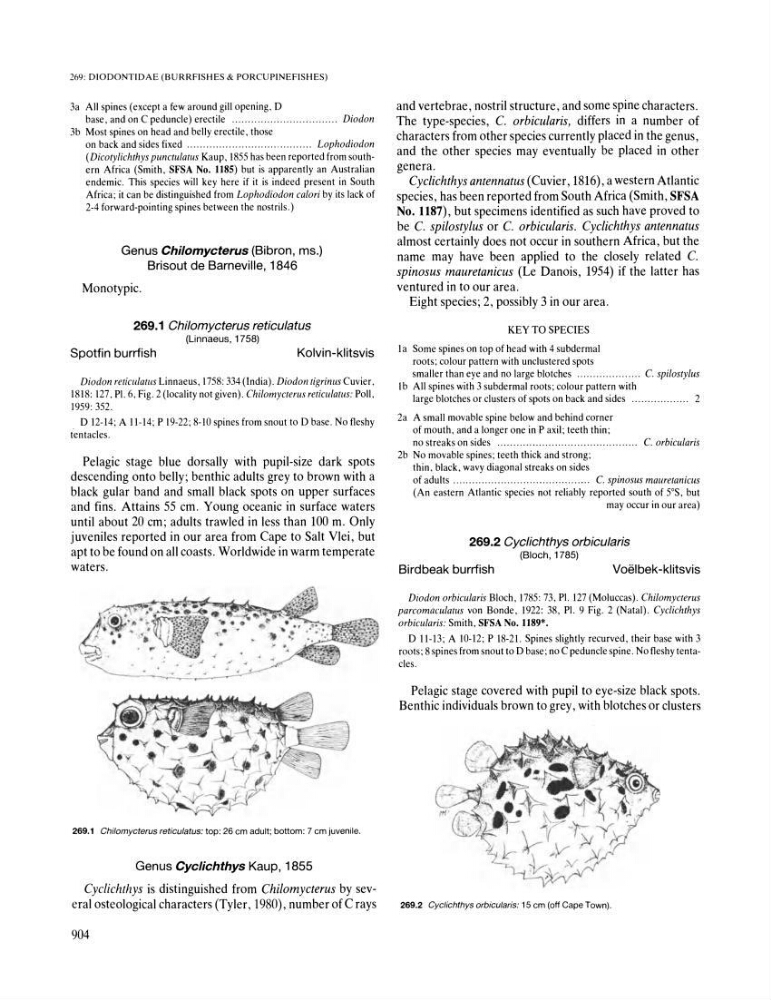
269.1 Chilomycterus reticulatus: top: 26 em adult; bottom: 7 em juvenile.
Genus Cyclichthys Kaup, 1855
Cyclichthys is distinguished from Chilomycterus by several osteological characters (Tyler, 1980), number of Crays
904
and vertebrae, nostril structure, and some spine characters.
The type-species, C. orbicularis, differs in a number of
characters from other species currently placed in the genus,
and the other species may eventually be placed in other
genera.
Cyclichthys antennatus (Cuvier, 1816), a western Atlantic
species, has been reported from South Africa (Smith, SFSA
No. 1187), but specimens identified as such have proved to
be C. spilostylus or C. orbicularis. Cyclichthys antennatus
almost certainly does not occur in southern Africa, but the
name may have been applied to the closely related C.
spinosus mauretanicus (Le Danois, 1954) if the latter has
ventured in to our area.
Eight species; 2, possibly 3 in our area.
KEY TO SPECIES
1a Some spines on top of head with 4 subdermal
roots; colour pattern with unclustered spots
smaller than eye and no large blotches .................... C. spilostylus
Ib All spines with 3 subdermal roots; colour pattern with
large blotches or clusters of spots on back and sides ....... .. .. ....... 2
2a A small movable spine below and behind corner
of mouth, and a longer one in P axil; teeth thin;
no streaks on sides ............................................ C. orbicularis
2b No movable spines; teeth thick and strong;
thin, black, wavy diagonal streaks on sides
of adults ........................................... C. spinosus mauretanicus
(An eastern Atlantic species not reliably reported south of 5 0 S, but
may occur in our area)
269.2 Cyclichthys orbicularis
(Bloch, 1785)
Birdbeak burrfish
Voelbek-klitsvis
Diodon orbicularis Bloch, 1785: 73, PI. 127 (Moluccas). Chilomycterus
parcomaculatus von Bonde, 1922: 38, PI. 9 Fig. 2 (Natal). Cyclichthys
orbicularis: Smith, SFSA No. 1189*.
011-13; A 10-12; P 18-21. Spines slightly recurved, their base with 3
roots; 8 spines from snout to 0 base; no C peduncle spine. No fleshy tentacles.
Pelagic stage covered with pupil to eye-size black spots.
Benthic individuals brown to grey, with blotches or clusters
269.2 Cyclichthys orbicularis: 15 em (off Cape Town).