

of black spots on back and sides. Attains 14cm. Continental
shelf from Knysna to South China Sea, Philippines and
Australia.
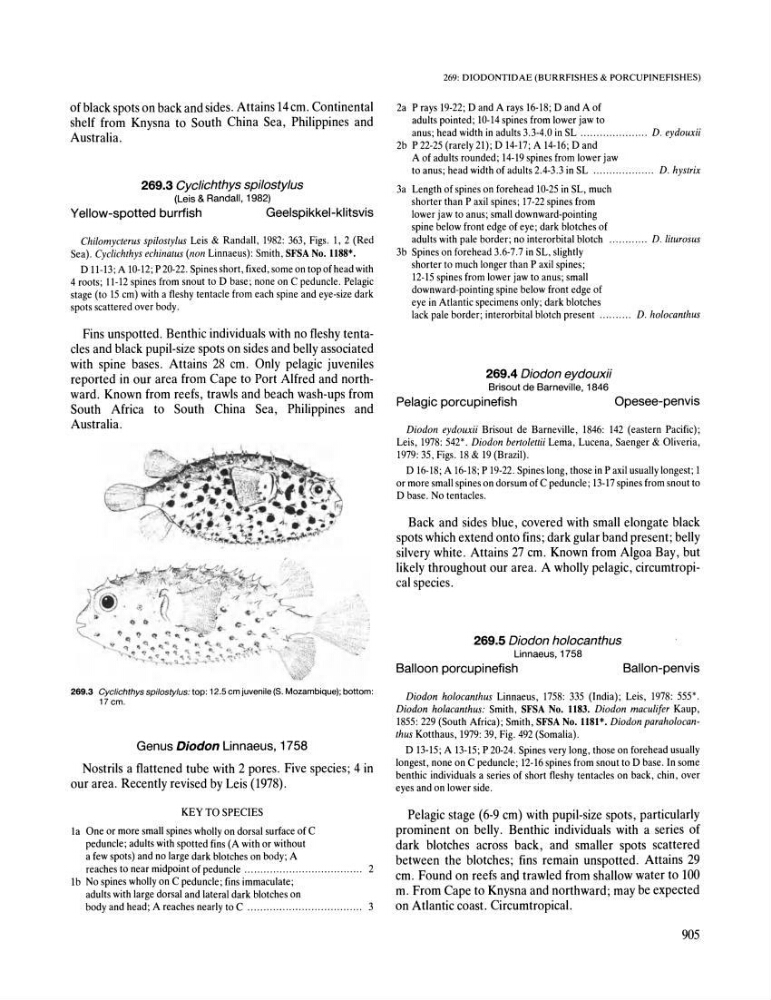
269.3 Cyclichthys spilosty/us
(Leis & Randall, 1982)
Yellow-spotted burrfish
Geelspikkel-klitsvis
Chilomycterus spilostylus Leis & Randall, 1982: 363, Figs. 1,2 (Red
Sea). Cyclichthys echinatus (non Linnaeus): Smith, SFSA No. 1188*.
011-13; A 10-12; P 20-22. Spines short, fixed, some on top of head with
4 roots; 11-12 spines from snout to 0 base; none on C peduncle. Pelagic
stage (to 15 cm) with a fleshy tentacle from each spine and eye-size dark
spots scattered over body.
Fins unspotted. Benthic individuals with no fleshy tentacles and black pupil-size spots on sides and belly associated
with spine bases. Attains 28 cm. Only pelagic juveniles
reported in our area from Cape to Port Alfred and northward. Known from reefs, trawls and beach wash-ups from
South Africa to South China Sea, Philippines and
Australia.
'(
.
269.3 Cyclichthys spilostylus: top: 12.5 em juvenile (S. Mozambique); bottom:
17 em.
Genus Diodon Linnaeus, 1758
Nostrils a flattened tube with 2 pores. Five species; 4 in
our area. Recently revised by Leis (1978).
KEY TO SPECIES
la One or more small spines wholly on dorsal surface of C
peduncle; adults with spotted fins (A with or without
a few spots) and no large dark blotches on body; A
reaches to near midpoint of peduncle ..................................... 2
Ib No spines wholly on C peduncle; fins immaculate;
adults with large dorsal and lateral dark blotches on
body and head; A reaches nearly to C .......................... .......... 3
269: DIODONTIDAE (BURRFISHES & PORCUPINEFISHES)
2a Prays 19-22; 0 and A rays 16-18; 0 and A of
adults pointed; 10-14 spines from lower jaw to
anus; head width in adults 3.3-4.0 in SL ..................... D. eydouxii
2b P 22-25 (rarely 21); 014-17; A 14-16; 0 and
A of adults rounded; 14-19 spines from lower jaw
to anus; head width of adults 2.4-3.3 in SL ................... D. hystrix
3a Length of spines on forehead 10-25 in SL, much
shorter than P axil spines; 17-22 spines from
lower jaw to anus; small downward-pointing
spine below front edge of eye; dark blotches of
adults with pale border; no interorbital blotch ............ D. liturosus
3b Spines on forehead 3.6-7.7 in SL, slightly
shorter to much longer than P axil spines;
12-15 spines from lower jaw to anus; small
downward-pointing spine below front edge of
eye in Atlantic specimens only; dark blotches
lack pale border; interorbital blotch present .......... D. holocanthus
269.4 Diodon eydouxii
Brisout de Barneville, 1846
Pelagic porcupinefish
Opesee-penvis
Diodon eydouxii Brisout de Barneville, 1846: 142 (eastern Pacific);
Leis, 1978: 542*. Diodon bertolettii Lema, Lucena, Saenger & Oliveria,
1979: 35, Figs. 18 & 19 (Brazil).
o 16-18; A 16-18; P 19-22. Spines long, those in P axil usually longest; 1
or more small spines on dorsum of C peduncle; 13-17 spines from snout to
o base. No tentacles.
Back and sides blue, covered with small elongate black
spots which extend onto fins; dark gular band present; belly
silvery white. Attains 27 cm. Known from Algoa Bay, but
likely throughout our area. A wholly pelagic, circumtropical species.
269.5 Diodon h%canthus
Linnaeus, 1758
Balloon porcupinefish
Ballon-penvis
Diodon holocanthus Linnaeus, 1758: 335 (India); Leis, 1978: 555*.
Diodon holacanthus: Smith, SFSA No. 1183. Diodon maculifer Kaup,
1855: 229 (South Africa); Smith, SFSA No. 1181*. Diodon paraholocanthus Kotthaus, 1979: 39, Fig. 492 (Somalia).
013-15; A 13-15; P 20-24. Spines very long, those on forehead usually
longest, none on C peduncle; 12-16 spines from snout to 0 base. In some
benthic individuals a series of short fleshy tentacles on back, chin, over
eyes and on lower side.
Pelagic stage (6-9 cm) with pupil-size spots, particularly
prominent on belly. Benthic individuals with a series of
dark blotches across back, and smaller spots scattered
between the blotches; fins remain unspotted. Attains 29
cm. Found on reefs and trawled from shallow water to 100
m. From Cape to Knysna and northward; may be expected
on Atlantic coast. Circum tropical.
905