

Dorsal surface dark brown with pale greenish spots, separated from white ventral surface by a pale yellow zone.
Attains 10 cm. Indo-West Pacific from Knysna to Samoa.
Not common in our area.
268.28 Torquigener sp.
Slender blaasop
Siank blaasop
D 8-9; A 7; P 14; spinulesacross belly between Pbases9-11. Lower edge
of gill opening with a cartilaginous spur covered by several long, skincovered spinules.
Colour in alcohol: dorsal surface greyish brown, with
small pale spots and much smaller pale dots; white stripe
along posterior part of upper LL; belly and fins white.
Attains 11 + cm. Known in our area from only 2 specimens
collected off Durban from a sand dredger.
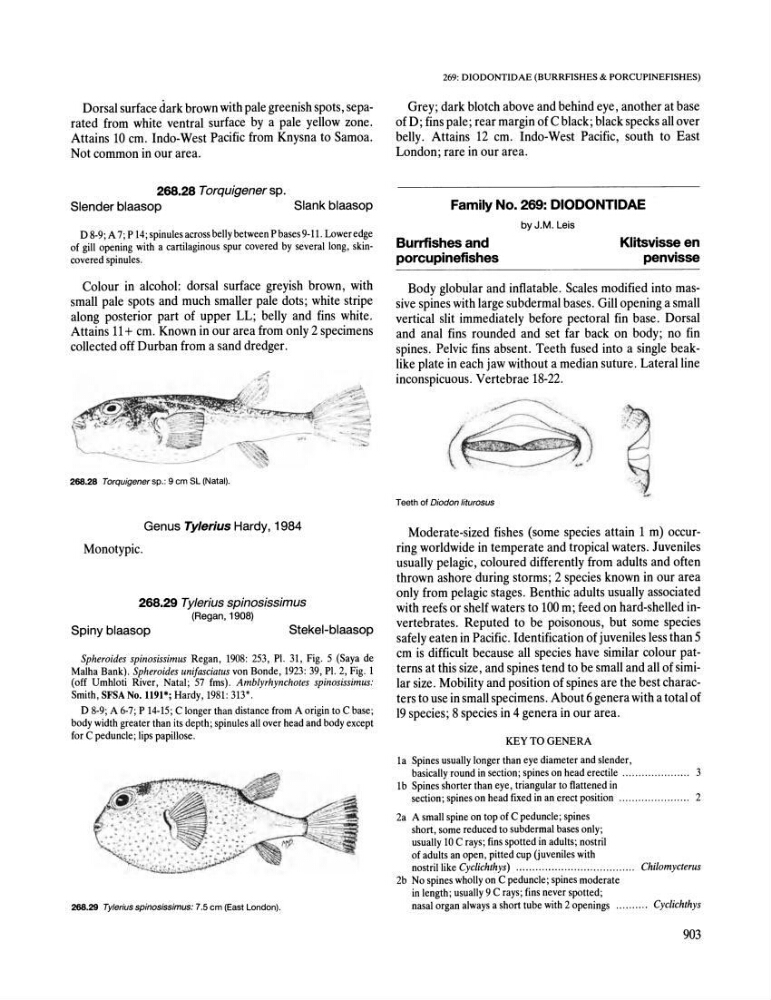
268.28 Torquigenersp .: 9 em SL (Natal).
Genus Ty/erius Hardy, 1984
Monotypic.
268.29 Ty/erius spinosissimus
(Regan, 1908)
Spiny blaasop
Stekel-blaasop
Spheroides spinosissimus Regan, 1908: 253, PI. 31 , Fig. 5 (Saya de
Malha Bank). Spheroides unifasciatus von Bonde , 1923: 39 , PI. 2, Fig. 1
(off Umhloti River, Natal; 57 fms). Amblyrhynchotes spinosissimus:
Smith, SFSA No. 1191*; Hardy, 1981: 313* .
D 8-9; A 6-7; P 14-15; C longer than distance from A origin to C base;
body width greater than its depth ; spinules all over head and body except
for C peduncle ; lips papillose.
268.29 Tylerius spinosissimus: 7.5 em (East London).
269: DIODONTIDAE (BURRFISHES & PORCUPINEFISHES)
Grey; dark blotch above and behind eye, another at base
of D; fins pale; rear margin of C black; black specks all over
belly. Attains 12 cm. Indo-West Pacific, south to East
London; rare in our area.
Family No. 269: DIODONTIDAE
byJ.M. Leis
Burrfishes and
porcupinefishes
Klitsvisse en
penvisse
Body globular and inflatable. Scales modified into massive spines with large subdermal bases. Gill opening a small
vertical slit immediately before pectoral fin base. Dorsal
and anal fins rounded and set far back on body; no fin
spines. Pelvic fins absent. Teeth fused into a single beaklike plate in each jaw without a median suture. Lateral line
inconspicuous. Vertebrae 18-22 .
.. ~
Teeth of Diodon liturosus
Moderate-sized fishes (some species attain 1 m) occurring worldwide in temperate and tropical waters. Juveniles
usually pelagic, coloured differently from adults and often
thrown ashore during storms; 2 species known in our area
only from pelagic stages. Benthic adults usually associated
with reefs or shelf waters to 100m; feed on hard-shelled invertebrates. Reputed to be poisonous, but some species
safely eaten in Pacific. Identification of juveniles less than 5
cm is difficult because all species have similar colour patterns at this size, and spines tend to be small and all of similar size. Mobility and position of spines are the best characters to use in small specimens. About 6 genera with a total of
19 species; 8 species in 4 genera in our area.
KEY TO GENERA
1 a Spines usually longer than eye diameter and slender,
basically round in section ; spines on head erectile .. .. ................. 3
1 b Spines shorter than eye, triangular to flattened in
section; spines on head fixed in an erect position ...... .......... .. .... 2
2a A small spine on top of C peduncle; spines
short, some reduced to subdermal bases only;
usually 10 C rays; fins spotted in adults; nostril
of adults an open, pitted cup (juveniles with
nostril like Cyclichthys) ... ......... .. ...... ... .... ... .. .... . Chilomycterus
2b No spines wholly on C peduncle; spines moderate
in length; usually 9 C rays; fins never spotted;
nasal organ always a short tube with 2 openings .. ...... .. Cyclichthys
903