

TETRAODONTIFORMES
5a Pelvic fins present, each with a long stout spine and
lor 2 smaller soft-rays; dorsal fin with 6 spines, the
posterior spines sometimes rudimentary and barely
visible ................................ TRIACANTHODIDAE (No. 265)
5b Pelvic fins absent; spinous dorsal fin absent or with
2 or 3 spines ..................................................................... 6
6a Body oval to oblong, compressed; two dorsal fins,
the first of at least 1 spine ..................................................... 7
6b Body robust, encased in a hard bony armour of
hexagonal plates fused to form a solid box; single
dorsal fin of a few soft-rays ................ OSTRACIIDAE (No. 266)
266
7a Body covered with hard, plate-like, bony scales;
second dorsal fin spine more than IS length of first
spine; upper and lower jaws each with 8 (outer)
teeth ............................................... BALISTIDAE (No. 263)
7b Body covered with minute scales bearing 1 or more
slender, microscopic spinules; second dorsal spine
less than IS length of first spine; upper jaw
with 6, lower jaw with 4 or 6 (outer)
teeth ..................................... MONACANTHIDAE (No. 264)
264
876
@
la
Family No. 263: BALISTIDAE
by M.M. Smith & P.C. Heemstra
Triggerfishes
Snellervisse
Body compressed, covered with strong, rough, plate-like
scales in regular series; pelvic fins reduced to a rudiment;
first dorsal fin of 3 spines, first spine strong, can be locked in
upright position by second D spine; the third spine is small
and usually insignificant. Second dorsal and anal fins similar
and consist of branched rays; caudal fin with usually 10
branched rays, one above and one below being simple; pectoral fin with uppermost ray rudimentary (and not included
in the counts). Upper jaw not protractile; each jaw has 8
strong incisors, the upper with 6 -smaller inner teeth; gill
opening a small slit in front of pectoral fin base; vertebrae
7+ 11 == 18.
Most species occur on coral reefs where these fishes often
dart for shelter into crevices and lock their dorsal spines and
erect the pelvic girdle to make it impossible to dislodge the
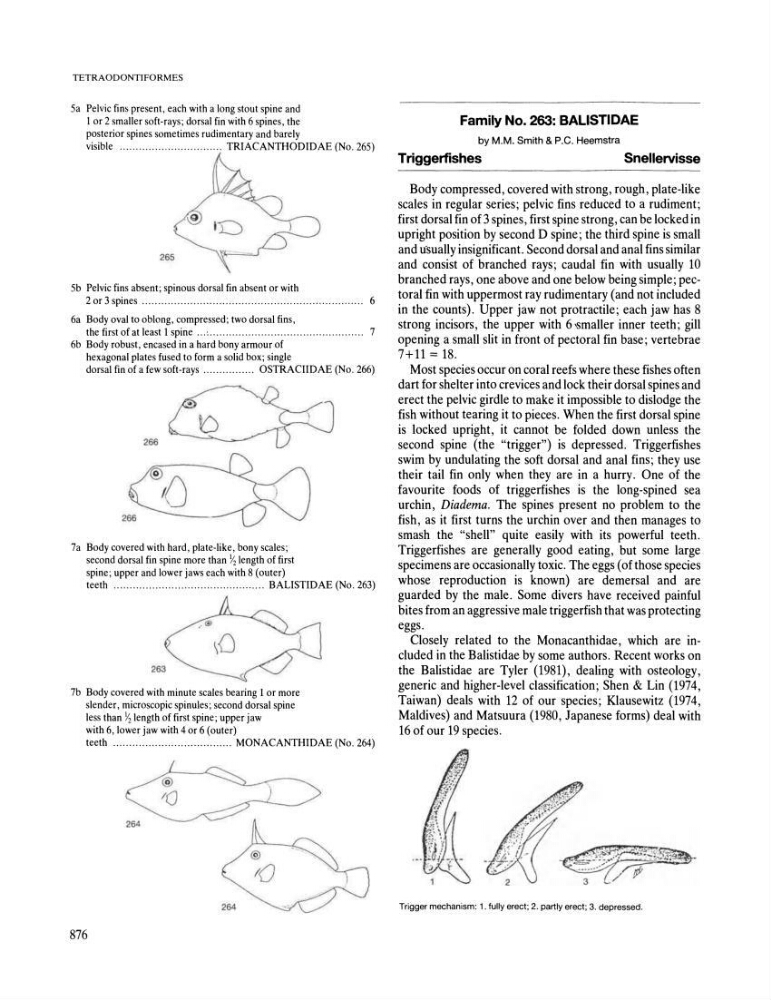
fish without tearing it to pieces. When the first dorsal spine
is locked upright, it cannot be folded down unless the
second spine (the "trigger") is depressed. Triggerfishes
swim by undulating the soft dorsal and anal fins; they use
their tail fin only when they are in a hurry. One of the
favourite foods of triggerfishes is the long-spined sea
urchin, Diadema. The spines present no problem to the
fish, as it first turns the urchin over and then manages to
smash the "shell" quite easily with its powerful teeth.
Triggerfishes are generally good eating, but some large
specimens are occasionally toxic. The eggs (of those species
whose reproduction is known) are demersal and are
guarded by the male. Some divers have received painful
bites from an aggressive male triggerfish that was protecting
eggs.
Closely related to the Monacanthidae, which are included in the Balistidae by some authors. Recent works on
the Balistidae are Tyler (1981), dealing with osteology,
generic and higher-level classification; Shen & Lin (1974,
Taiwan) deals with 12 of our species; Klausewitz (1974,
Maldives) and Matsuura (1980, Japanese forms) deal with
16 of our 19 species.
Trigger mechanism: 1. fully erect; 2. partly erect; 3. depressed.