

Order TETRAODONTI FORM ES
Gill openings restricted to lateral slits; opercular bones
and branchiostegal rays covered by thick skin or bony hexagonal scale plates. Parietals, nasals and circumorbital bones
absent; no sensory canals in the skull bones; branched
caudal fin rays 7-10 (except in Molidae, which lack a proper
caudal fin); anal fin spines absent.
The Tetraodontiformes (also known as the Plectognathi)
are a morphologically diverse and highly specialised group
of teleosts. Rosen (1984) has added the Zeiformes to Tetraodontiformes, but until his work is given a critical evaluation, we shall retain these two taxa as separate orders. Tyler
(1980) has produced a profusely illustrated and comprehensive work on the osteology and higher classification of the
tetraodontiforms. This classification agrees fairly well with
that proposed by Winterbottom (1974), based on the myology of 46 species. There are some 330 species arranged in 8
or 9 families. The Monacanthidae are included in the Balistidae by some authors (e.g. Nelson, 1984), but in this book
we have kept them separate. Eight families are represented
in our area. Triacanthids are known from the northern
Indian Ocean, but have yet to be found in our area.
KEY TO FAMILIES
1a Teeth fused to one another and to jaw bones to form
sharp-edged dental plates; left and right halves of
jaws (dentaries and/or premaxillae) often fused to
their opposite members ...................................................... 2
Ib Teeth separate, protruding from sockets in the jaws;
dentaries and premaxillae not fused to their opposite
members ......................................................................... 5
2a Body orbicular or elongate-oval, compressed,
truncate posteriorly, as if the rear end were chopped
off; caudal fin replaced by a thick, rudder-like
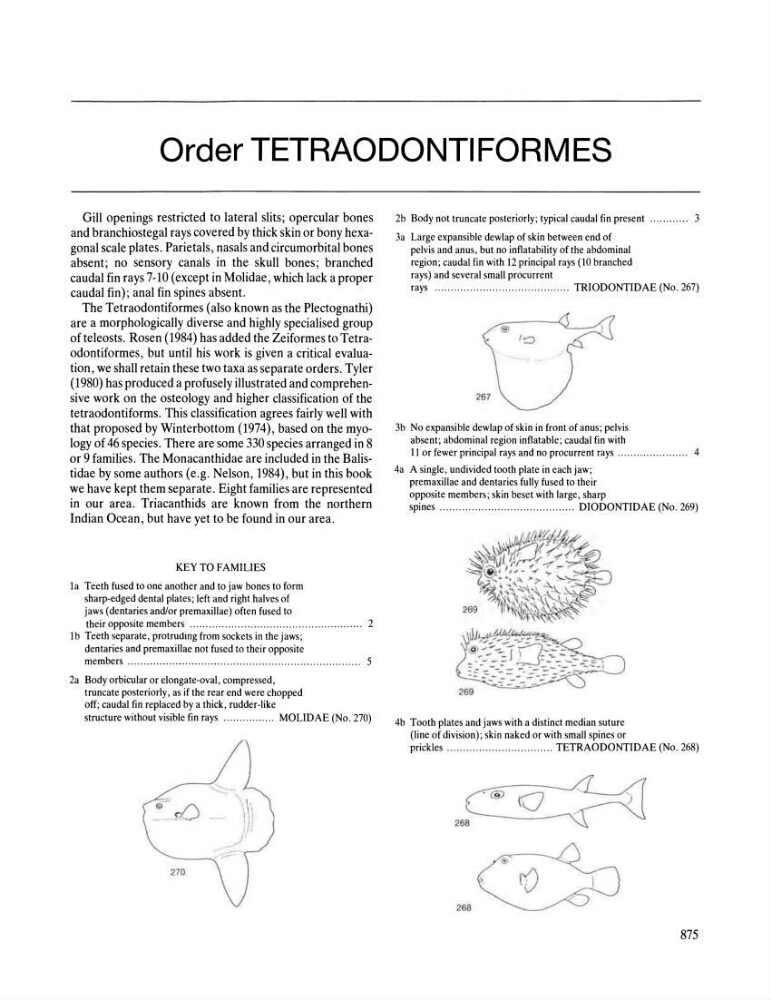
structure without visible fin rays ................ MOLIDAE (No. 270)
270
2b Body not truncate posteriorly; typical caudal fin present ............ 3
3a Large expansible dewlap of skin between end of
pelvis and anus, but no inflatability of the abdominal
region; caudal fin with 12 principal rays (10 branched
rays) and several small procurrent
rays .......................................... TRIODONTIDAE (No. 267)
3b No expansible dewlap of skin in front of anus; pelvis
absent; abdominal region inflatable; caudal fin with
11 or fewer principal rays and no procurrent rays...................... 4
4a A single, undivided tooth plate in each jaw;
premaxillae and dentaries fully fused to their
opposite members; skin beset with large, sharp
spines .......................................... DIODONTIDAE (No. 269)
4b Tooth plates and jaws with a distinct median suture
(line of division); skin naked or with small spines or
prickles ................................. TETRAODONTIDAE (No. 268)
268
268
875