

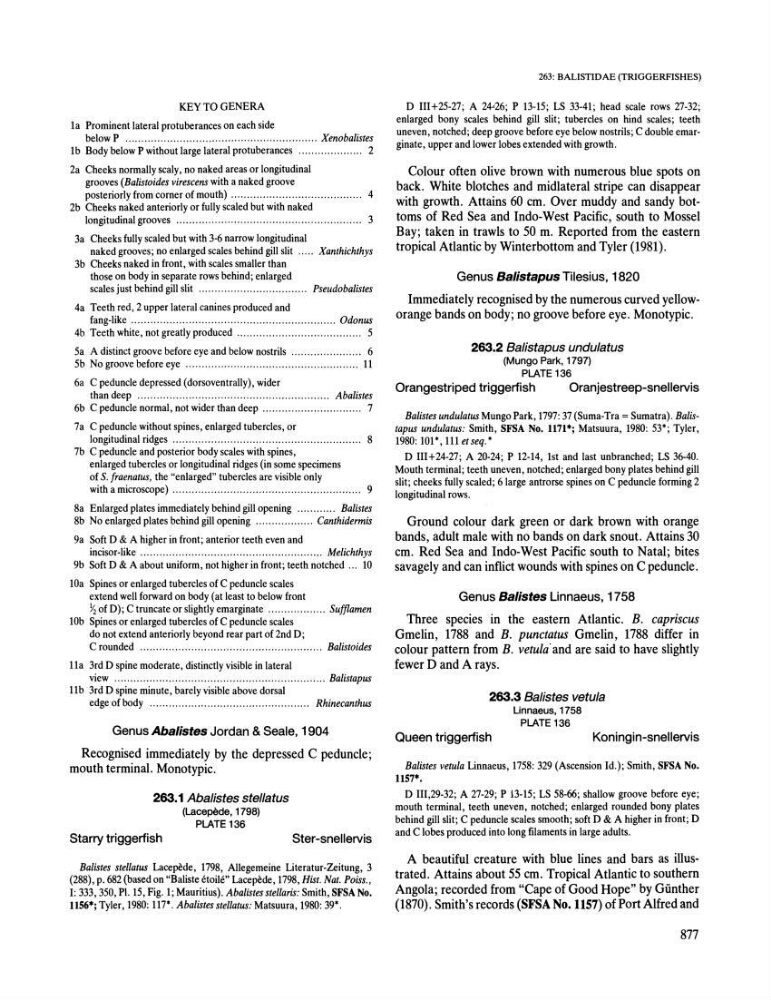
KEY TO GENERA
1a Prominent lateral protuberances on each side
below P ............................................................ Xenobalistes
1b Body below P without large lateral protuberances .................... 2
2a Cheeks normally scaly, no naked areas or longitudinal
grooves (Balistoides virescens with a naked groove
posteriorly from comer of mouth) ......................................... 4
2b Cheeks naked anteriorly or fully scaled but with naked
longitudinal grooves .......................................................... 3
3a Cheeks fully scaled but with 3-6 narrow longitudinal
naked grooves; no enlarged scales behind gill slit ..... Xanthichthys
3b Cheeks naked in front, with scales smaller than
those on body in separate rows behind; enlarged
scales just behind gill slit .................................. Pseudobalistes
4a Teeth red, 2 upper lateral canines produced and
fang-like ................................................................ Odonus
4b Teeth white, not greatly produced ....................................... 5
5a A distinct groove before eye and below nostrils ...................... 6
5b No groove before eye ...................................................... 11
6a C peduncle depressed (dorsoventrally), wider
than deep ............................................................ Abalistes
6b C peduncle normal, not wider than deep ............................... 7
7a C peduncle without spines, enlarged tubercles, or
longitudinal ridges ........................................................... 8
7b C peduncle and posterior body scales with spines,
enlarged tubercles or longitudinal ridges (in some specimens
of S. fraenatus, the "enlarged" tubercles are visible only
with a microscope) ........................................................... 9
8a Enlarged plates immediately behind gill opening ............ Balistes
8b No enlarged plates behind gill opening .................. Canthidermis
9a Soft D & A higher in front; anterior teeth even and
incisor-like ......................................................... Melichthys
9b Soft D & A about uniform, not higher in front; teeth notched... 10
lOa Spines or enlarged tubercles of C peduncle scales
extend well forward on body (at least to below front
l ' 2 of D); C truncate or slightly emarginate .................. Suff/amen
lOb Spines or enlarged tubercles of C peduncle scales
do not extend anteriorly beyond rear part of 2nd D;
C rounded ......................................................... Balistoides
11a 3rd D spine moderate, distinctly visible in lateral
view .................................................................. Balistapus
11b 3rd D spine minute, barely visible above dorsal
edge of body .. .. .. . . . .. . .. . .. .. .. ... .. . .. ... .. .. ... .. . .. .. . ... Rhinecanthus
Genus Abalistes Jordan & Seale, 1904
Recognised immediately by the depressed C peduncle;
mouth terminal. Monotypic.
263.1 Abalistes stellatus
(Lacepede, 1798)
PLATE 136
Starry triggerfish
Ster-snellervis
Balistes stellatus Lacepede, 1798, Allegemeine Literatur-Zeitung, 3
(288), p. 682 (based on "Baliste etoile" Lacepede, 1798, Hist. Nat. Poiss.,
I: 333, 350, PI. 15, Fig. 1; Mauritius). Abalistes stellaris: Smith, SFSA No.
1156*; Tyler, 1980: 117*. Abalistes stellatus: Matsuura, 1980: 39*.
263: BALISTIDAE (TRIGGERFISHES)
D I1I+25-27; A 24"26; P 13-15; LS 33-41; head scale rows 27-32;
enlarged bony scales behind gill slit; tubercles on hind scales; teeth
uneven, notched; deep groove before eye below nostrils; C double emarginate, upper and lower lobes extended with growth.
Colour often olive brown with numerous blue spots on
back. White blotches and midlateral stripe can disappear
with growth. Attains 60 cm. Over muddy and sandy bottoms of Red Sea and Indo-West Pacific, south to Mossel
Bay; taken in trawls to 50 m. Reported from the eastern
tropical Atlantic by Winterbottom and Tyler (1981).
Genus Balistapus Tilesius, 1820
Immediately recognised by the numerous curved yelloworange bands on body; no groove before eye. Monotypic.
263.2 Balistapus undulatus
(Mungo Park, 1797)
PLATE 136
Orangestriped triggerfish
Oranjestreep-snellervis
Balistes undulatus Mungo Park, 1797: 37 (Suma-Tra = Sumatra). Balistapus undulatus: Smith, SFSA No. 1171*; Matsuura, 1980: 53*; Tyler,
1980: 101 *, 111 et seq. *
D I1I+24-27; A 20-24; P 12-14, 1st and last unbranched; LS 36-40.
Mouth terminal; teeth uneven, notched; enlarged bony plates behind gill
slit; cheeks fully scaled; 6 large antrorse spines on C peduncle forming 2
longitudinal rows.
Ground colour dark green or dark brown with orange
bands, adult male with no bands on dark snout. Attains 30
cm. Red Sea and Indo-West Pacific south to Natal; bites
savagely and can inflict wounds with spines on C peduncle.
Genus Ba/istes Linnaeus, 1758
Three species in the eastern Atlantic. B. capriscus
Gmelin, 1788 and B. punctatus Gmelin, 1788 differ in
colour pattern from B. vetula·and are said to have slightly
fewer D and A rays.
263.3 Balistes vetula
Linnaeus, 1758
PLATE 136
Queen triggerfish
Koningin-snellervis
Balistes vetula Linnaeus, 1758: 329 (Ascension Id.); Smith, SFSA No.
1157*.
D I1I,29-32; A 27-29; P 13-15; LS 58-66; shallow groove before eye;
mouth terminal, teeth uneven, notched; enlarged rounded bony plates
behind gill slit; C peduncle scales smooth; soft D & A higher in front; D
and C lobes produced into long filaments in large adults.
A beautiful creature with blue lines and bars as illustrated. Attains about 55 cm. Tropical Atlantic to southern
Angola; recorded from "Cape of Good Hope" by Gunther
(1870). Smith's records (SFSA No. 1157) of Port Alfred and
877