

259: BOTHIDAE (LEFTEYE FLOUNDERS)
Family No. 259: BOTHIDAE
by DA Hensley
Lefteye flounders
Linkeroog-botvisse
Most species normally sinistral (eyes on left side of head),
but some showing rare reversals and some being indiscriminately sinistral or dextral. Optic chiasma monomorphic, the
right optic nerve always dorsal to the left. No fin spines.
Dorsal-fin origin above or anterior to upper eye. Dorsal and
anal fins separate from caudal fin. Bases of pelvic fins short
or that of eyed side elongate. Preoperc\e margin free and
distinct. Branchiostegal membranes united. Anus on blind
side.
Bothids comprise 30-40 genera and 205-232 species. They
are found in all tropical and temperate seas, and several
species are of commercial importance.
KEY TO GENERA
la LL straight, without distinct arch anteriorly on eyed side .......... 2
1 b LL with distinct arch over P of eyed side ............................... 4
2a Both P absent; Drays 104-145; A rays 89-124 .......... Mancopsetta
2b Both P present; Drays 80-91; A rays 61-74 ............................ 3
3a Teeth biserial in upper jaw, uniserial in lower jaw .......... Syacium
3b Teeth uniserial in both jaws ................................ Citharichthys
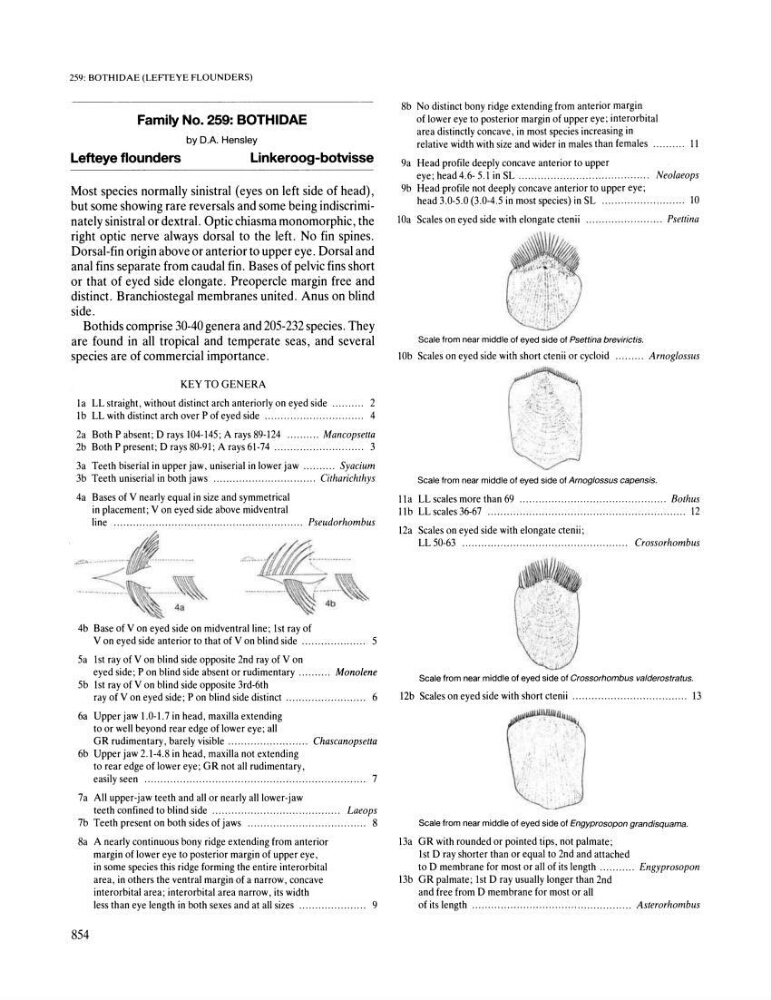
4a Bases of V nearly equal in size and symmetrical
in placement; V on eyed side above midventral
line ........................................................... Pseudorhombus
./.".:: ... . . .
<
4a
4b Base of V on eyed side on midventralline; 1st ray of
V on eyed side anterior to that of V on blind side .................... 5
Sa 1st ray of Von blind side opposite 2nd ray of Von
eyed side; P on blind side absent or rudimentary .......... Monolene
Sb 1st ray of V on blind side opposite 3rd-6th
ray of V on eyed side; P on blind side distinct ....... ... ... ............ 6
6a Upper jaw 1.0-1.7 in head, maxilla extending
to or well beyond rear edge of lower eye; all
GR rudimentary, barely visible ......................... Chascanopsetta
6b Upper jaw 2.1-4.8 in head, maxilla not extending
to rear edge of lower eye; GR not all rudimentary,
easily seen .............................................................. . .. .... 7
7a All upper-jaw teeth and all or nearly all lower-jaw
teeth confined to blind side ........................................ Laeops
7b Teeth present on both sides of jaws ..................................... 8
8a A nearly continuous bony ridge extending from anterior
854
margin of lower eye to posterior margin of upper eye,
in some species this ridge forming the entire interorbital
area, in others the ventral margin of a narrow, concave
interorbital area; interorbital area narrow, its width
less than eye length in both sexes and at all sizes ..................... 9
8b No distinct bony ridge extending from anterior margin
of lower eye to posterior margin of upper eye; interorbital
area distinctly concave, in most species increasing in
relative width with size and wider in males than females .......... 11
9a Head profile deeply concave anterior to upper
eye; head 4.6- 5.1 in SL ......................................... Neolaeops
9b Head profile not deeply concave anterior to upper eye;
head 3.0-5.0 (3.0-4.5 in most species) in SL .......................... 10
lOa Scales on eyed side with elongate ctenii ........ .. .............. Psettina
Scale from near middle of eyed side of Psettina brevirictis.
lOb Scales on eyed side with short ctenii or cycloid ......... Arnoglossus
Scale from near middle of eyed side of Arnog/ossus capensis.
lla LL scales more than 69 .............................................. Bothus
11 b LL scales 36-67 ....................................... ....................... 12
12a Scales on eyed side with elongate ctenii;
LL 50-63 .................................................... Crossorhombus
Scale from near middle of eyed side of Crossorhombus va/derostratus.
13
Scale from near middle of eyed side of Engyprosopon grandisquama.
13a GR with rounded or pointed tips, not palmate;
1st D ray shorter than or equal to 2nd and attached
to D membrane for most or all of its length ........... Engyprosopon
13b GR palmate; 1st D ray usually longer than 2nd
and free from D membrane for most or all
of its length ............................................. ..... Asterorhombus