

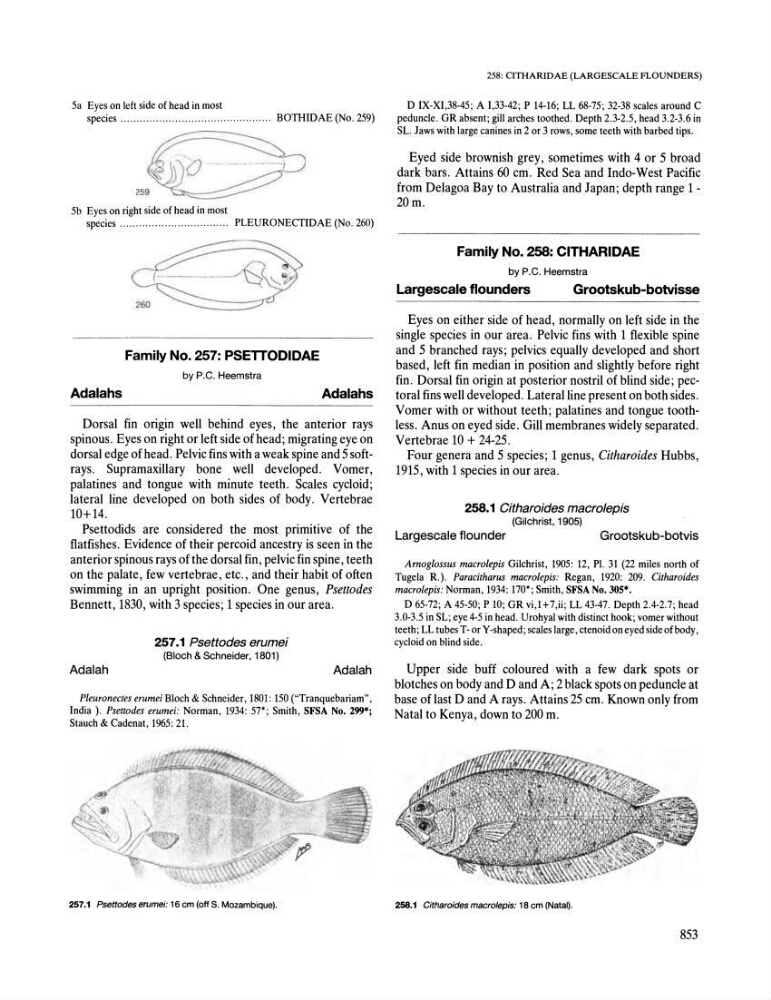
5a Eyes on left side of head in most
species ............................................... BOTHIDAE (No. 259)
5b Eyes on right side of head in most
species .................................. PLEURONECTIDAE (No. 260)
Family No. 257: PSETIODIDAE
by P.C. Heemstra
Adalahs
Adalahs
Dorsal fin origin well behind eyes, the anterior rays
spinous. Eyes on right or left side of head; migrating eye on
dorsal edge of head. Pelvic fins with a weak spine and 5 softrays. Supramaxillary bone well developed. Vomer,
palatines and tongue with minute teeth. Scales cycloid;
lateral line developed on both sides of body. Vertebrae
10+ 14.
Psettodids are considered the most primitive of the
flatfishes. Evidence of their percoid ancestry is seen in the
anterior spinous rays of the dorsal fin, pelvic fin spine, teeth
on the palate, few vertebrae, etc., and their habit of often
swimming in an upright position. One genus, Psettodes
Bennett, 1830, with 3 species; 1 species in our area.
Adalah
257.1 Psettodes erumei
(Bloch & Schneider, 1801)
Adalah
Pieuronectes erumei Bloch & Schneider, 1801: 150 ("Tranquebariam",
India ). Psettodes erumei: Norman, 1934: 57*; Smith, SFSA No. 299*;
Stauch & Cadenat, 1965: 21.
257.1 Psettodes erumei: 16 em (off S. Mozambique).
258: CITHARIDAE (LARGESCALE FLOUNDERS)
D IX-XI,38-45; A 1,33-42; P 14-16; LL 68-75; 32-38 scales around C
peduncle. GR absent; gill arches toothed. Depth 2.3-2.5, head 3.2-3.6 in
SL. Jaws with large canines in 2 or 3 rows, some teeth with barbed tips.
Eyed side brownish grey, sometimes with 4 or 5 broad
dark bars. Attains 60 cm. Red Sea and Indo-West Pacific
from Delagoa Bay to Australia and Japan; depth range 1 -
20m.
Family No. 258: CITHARIDAE
by P.C. Heemstra
Largescale flounders
Grootskub-botvisse
Eyes on either side of head, normally on left side in the
single species in our area. Pelvic fins with 1 flexible spine
and 5 branched rays; pelvics equally developed and short
based, left fin median in position and slightly before right
fin. Dorsal fin origin at posterior nostril of blind side; pectoral fins well developed. Lateral line present on both sides.
Vomer with or without teeth; palatines and tongue toothless. Anus on eyed side. Gill membranes widely separated.
Vertebrae 10 + 24-25.
Four genera and 5 species; 1 genus, Citharoides Hubbs,
1915, with 1 species in our area.
258.1 Citharoides macro/epis
(Gilchrist, 1905)
Largescale flounder
Grootskub-botvis
Arnogiossus macroiepis Gilchrist, 1905: 12, PI. 31 (22 miles north of
Tugela R.). Paracitharus macroiepis: Regan, 1920: 209. Citharoides
macroiepis: Norman, 1934: 170*; Smith, SFSA No. 305*.
D 65-72; A 45-50; P 10; GR vi,l + 7,ii; LL 43-47. Depth 2.4-2.7; head
3.0-3.5 in SL; eye 4-5 in head. Urohyal with distinct hook; vomer without
teeth; LL tubes T - or Y -shaped; scales large, ctenoid on eyed side of body,
cycloid on blind side.
Upper side buff coloured with a few dark spots or
blotches on body and D and A; 2 black spots on peduncle at
base of last D and A rays. Attains 25 cm. Known only from
Natal to Kenya, down to 200 m.
258.1 Citharoides macro/epis: 18 em (Natal).
853