

Order PLEURONECTIFORMES
Flatfishes
The pleuronectiforms (flatfishes) are readily distinguished from all other fishes by their compressed body and
head with both eyes on the same side , either right or left.
The eyed (upper) side also differs from the blind (underside
in colour, development of the paired fins , and in the nature
of the scales and of the lateral line . The larval flatfish has an
eye on each side of its head, but as it grows , one of the eyes
moves over the top of the head to lie on the same side as the
other. In most species of flatfishes , all the individuals are
either right-sided (dextral), with both eyes on the right side
of the head , or left-sided (sinistral) , with both eyes on the
left side , but in some species reversed specimens (a sinistral
individual of a species that is usually dextral or vice versa)
may occur.
Flatfishes spend most of their time on the bottom resting
on their blind side, which is mostly colourless ; the pigmented (upper) side is coloured to match the substrate , thus
concealing the flatfish from prey and predators alike . Their
ability to change their coloration to match their surroundings is remarkable . Flatfishes often bury themselves in the
sediment, with only their eyes and nostrils uncovered. The
eyes of some species protrude from the head and can be
moved independently.
It seems reasonable to suppose that flatfishes evolved
from some ancestral species that was accustomed to lying on
its side to rest or hide itself. Several species of wrasses
(Family Labridae) are known to bury themselves in sand or
gravel to sleep or to escape predators. The most primitive
fl atfishes , the Psettodidae , are apparently derived from a
percoid ancestor, as indicated by their pelvic fins with a
spine and 5 soft-rays, dorsal and anal fin spines, teeth on the
vomer and palatines, and well-developed supramaxilla.
Whether all of the other flatfishes are derived from a psettodid ancestor or from some other group of fishes is a moot
point.
Most flatfishes occur in depths of 10 to 200 m, a few live in
deeper water, and some are found close inshore, even in
estuaries. Many species are highly valued as food-fishes and
are taken in considerable quantities by trawlers. Flatfishes
are known from temperate and tropical waters of all three
major oceans. The small buoyant eggs are produced in
enormous numbers, with the larger species spawning more
than a million eggs at one time. Most flatfishes are less than
1 m in length , some no more than 10 cm, but the giant
halibut of the North Atlantic attains a length of 3 m and a
mass of 326 kg.
852
Platvisse
Six families are currently recognised (Nelson , 1984) ; all
six are represented in our area.
KEY TO FAMILIES
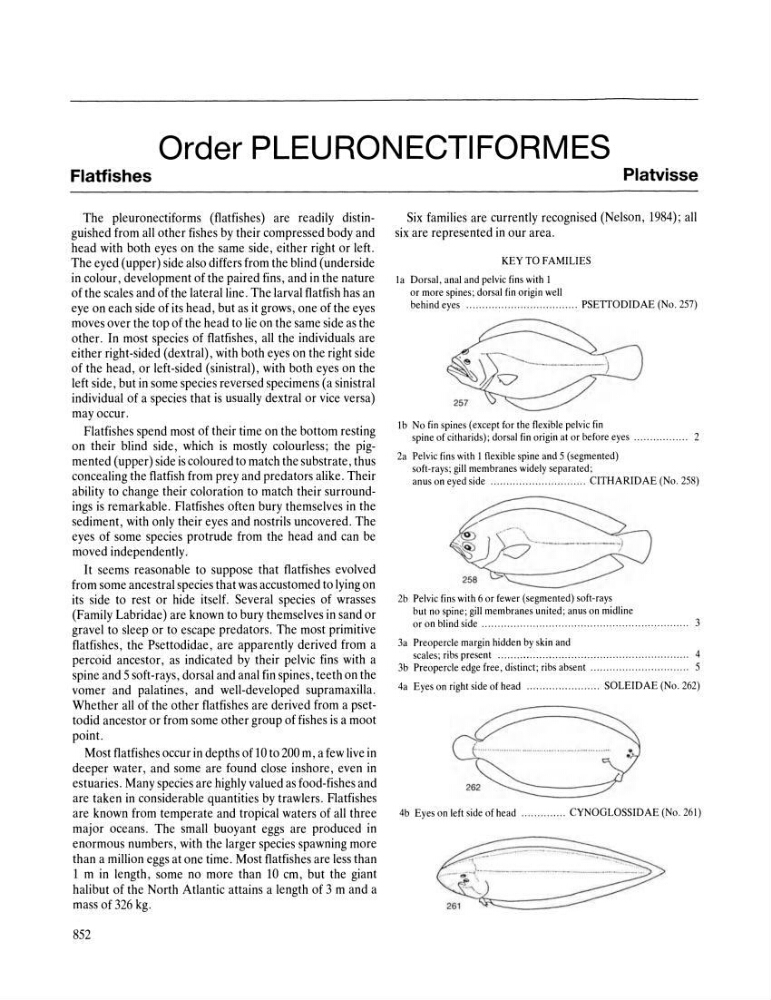
la Dorsal , anal and pelvic fins with 1
or more spines; dorsal fin origin well
behind eyes ..... .. ..... ... .................... PSETTODIDAE (No. 257)
Ib No fin spines (except for the flexible pelvic fin
spine of citharids) ; dorsal fin origin at or before eyes .. ... ...... ... ... 2
2a Pelvic fins with 1 flexible spine and 5 (segmented)
soft-rays; gill membranes widely separated;
anus on eyed side ..... .. ... ..... ....... ........ CITHARIDAE (No . 258)
2b Pelvic fins with 6 or fewer (segmented) soft-rays
but no spine ; gill membranes united; anus on midline
or on blind side .... .. .... ... ... ... ....... .... .. ..... .. ...... ..... ...... ...... ... 3
3a Preopercie margin hidden by skin and
scales; ribs present .... .. ..... .. ... .... ..... ..... ....... ... ... ......... ........ 4
3b Preopercie edge free, distinct; ribs absent .... ..... ... .... ...... .. .. ..... 5
4a Eyes on right side of head .. ...... .. ..... .... .... SOLEIDAE (No. 262)
4b Eyes on left side of head ...... ... ..... CYNOGLOSSIDAE (No. 261)