

KEY TO SPECIES
la Total D spines + rays 28-42; A III,16-25; D & A
spines distinct; body usually firm; lower GR 15-17 .................... 2
Ib Total D spines + rays 55-65; A spines + rays 33-41;
D & A spines weak, not distinguishable from soft-rays;
body soft and limp; lower GR 12-13 ........................... S. huttoni
2a D IV-VIII,31-34; A III,18-25 ............................................... 3
2b D V-VII,23-26; A III,16-18 .................................... S. pemarco
3a Prays 21-22; predorsal bones 2; vertebrae 25 .................. S. ovalis
3b Prays 19-21; pre dorsal bones 3; vertebrae 29 ............. S. maculatus
254.6 Schedophilus huttoni
(Waite, 1910)
Centrolophus huttoni Waite, 1910: 388 (Sumner, New Zealand). Centrolophus britannicus (non Gunther): Smith, 1965: 506, PI. 14. Coroplop us dicologlossops Smith, 1966: 1, PI. 1, Fig. A ("off the Cape").
Schedophilus huttoni: Karrer, 1973: 239*; Ahlstrom et aI., 1976: 319*;
McDowall, 1982: 124*.
D 55-65; A 33-41; P 19-20; LL >200; GR about 5+(12-13); vertebrae
30-32. Depth 3.6-4.0, head 4.8-5.2. Head spongy; skeleton very poorly
ossified. D & A bases covered with small scales; P and V short. Scales
minute, present on opercles but not on head. Pyloric caeca more than 50,
each caecum bifurcate.
Colour uniform blackish grey to brown; inside of mouth
and opercles black. Attains 90 cm. Oceanic, probably
mesopelagic and rarely seen. Circumglobal in Southern
'Ocean; common in 270 - 500 m off Namibia.
254.6 Sehedophilus huttoni: top: 77.5 em holotype (photo by J. Darby);
bottom: 88 em holotype of Coroplopus dieologlossops (off Cape Town).
254.7 Schedophilus macu/atus
Gunther, 1860
Schedophilus maculatus Gunther, 1860: 412 (China Seas); Smith, 1949:
842; Ahlstrom et aI., 1976: 322*; McDowall, 1980: 147*; 1982: 125*.
Mupus maculatus: Smith, SFSA No. 848*.
D VIII-IX,27-29; A III,23-25; P 19-21; LL 100-130; GR about
6+(15-16); vertebrae 29. Depth 1.9-2.6; head 2.5-4.0. Somewhat deepbodied with moderately firm musculature and rather heavy spines.
Preopercle with 10-15 prominent spines (juveniles) or "numerous fine
spines" (adults). The unusual vertebral number is diagnostic.
Juveniles with dark and light ill-defined vertical bands or
dark blotches extending onto median fins; P dusky and V
254: STROMATEIDAE (RUFFS)
black. Attains 30 cm. Occurs in widespread localities
around Southern Ocean, usually in deep water. Rare.
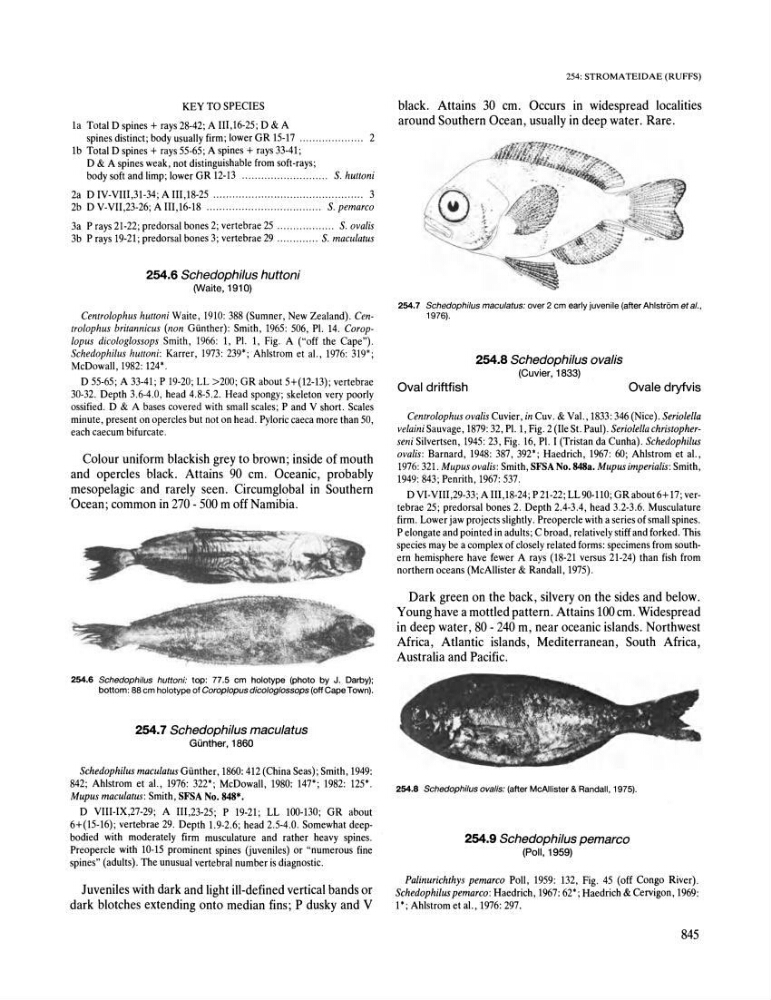
254.7 Sehedophilus maculatus: over 2 em early juvenile (after Ahlstrom et al.,
1976).
254.8 Schedophilus ova/is
(Cuvier, 1833)
Oval driftfish
Ovale dryfvis
Centrolophus ovalis Cuvier, in Cuv. & Val., 1833: 346 (Nice). Seriolella
velaini Sauvage, 1879: 32, PI. 1, Fig. 2 (Ile St. Paul). Seriolella christopherseni Silvertsen, 1945: 23, Fig. 16, PI. I (Tristan da Cunha). Schedophilus
ovalis: Barnard, 1948: 387, 392*; Haedrich, 1967: 60; Ahlstrom et aI.,
1976: 321. Mupus ovalis: Smith, SFSA No. 848a. Mupus imperialis: Smith,
1949: 843; Penrith, 1967: 537.
D VI-VIII,29-33; A III,18-24; P21-22; LL90-110; GR about 6+ 17; vertebrae 25; pre dorsal bones 2. Depth 2.4-3.4, head 3.2-3.6. Musculature
firm. Lower jaw projects slightly. Preopercle with a series of small spines.
P elongate and pointed in adults; C broad, relatively stiff and forked. This
species may be a complex of closely related forms: specimens from southern hemisphere have fewer A rays (18-21 versus 21-24) than fish from
northern oceans (McAllister & Randall, 1975).
Dark green on the back, silvery on the sides and below.
Young have a mottled pattern. Attains 100 cm. Widespread
in deep water, 80 - 240 m, near oceanic islands. Northwest
Africa, Atlantic islands, Mediterranean, South Africa,
Australia and Pacific.
254.8 Sehedophilus ovalis: (after McAllister & Randall, 1975).
254.9 Schedophilus pemarco
(Poll, 1959)
Palinurichthys pemarco Poll, 1959: 132, Fig. 45 (off Congo River).
Schedophilus pemarco: Haedrich, 1967: 62*; Haedrich & Cervigon, 1969:
1 *; Ahlstrom et aI., 1976: 297.
845