

254: STROMATEIDAE (RUFFS)
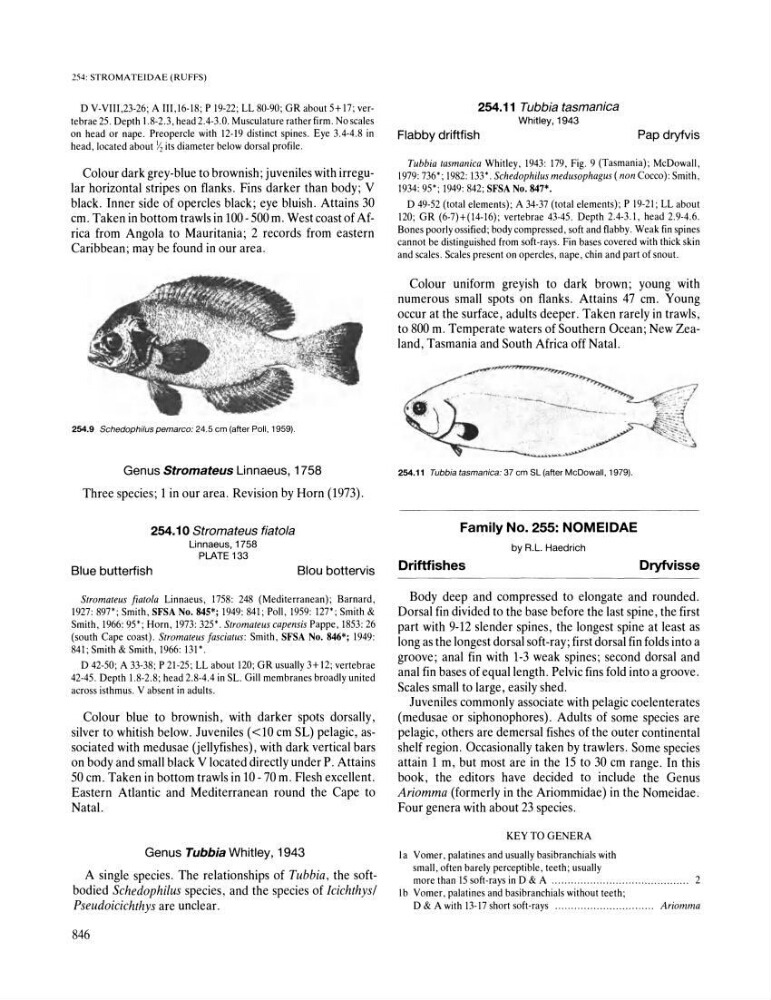
D V-VIII,23-26; A III,16-18; P 19-22; LL 80-90; GR about 5+ 17; vertebrae 25. Depth 1.8-2.3, head 2.4-3.0. Musculature rather firm. No scales
on head or nape. Preopercle with 12-19 distinct spines. Eye 3.4-4.8 in
head, located about ~ its diameter below dorsal profile.
Colour dark grey-blue to brownish; juveniles with irregular horizontal stripes on flanks. Fins darker than body; V
black. Inner side of opercles black; eye bluish. Attains 30
cm. Taken in bottom trawls in 100 - 500 m. West coast of Africa from Angola to Mauritania; 2 records from eastern
Caribbean; may be found in our area.
254.9 Sehedophilus pemareo: 24.5 em (after Poll, 1959).
Genus Stromateus Linnaeus, 1758
Three species; 1 in our area. Revision by Horn (1973).
254.10 Stromateus fiato/a
Linnaeus, 1758
PLATE 133
Blue butterfish
Blou bottervis
Stromateus fiatola Linnaeus, 1758: 248 (Mediterranean); Barnard,
1927: 897*; Smith, SFSA No. 845*; 1949: 841; Poll, 1959: 127*; Smith &
Smith, 1966: 95*; Horn, 1973: 325*. Stromateus capensis Pappe, 1853: 26
(south Cape coast). Stromateus fasciatus: Smith, SFSA No. 846*; 1949:
841; Smith & Smith, 1966: 131*.
D 42-50; A 33-38; P 21-25; LL about 120; GR usually 3+ 12; vertebrae
42-45. Depth 1.8-2.8; head 2.8-4.4 in SL. Gill membranes broadly united
across isthmus. V absent in adults.
Colour blue to brownish, with darker spots dorsally,
silver to whitish below. Juveniles «10 cm SL) pelagic, associated with medusae (jellyfishes), with dark vertical bars
on body and small black V located directly under P. Attains
50 cm. Taken in bottom trawls in 10 - 70 m. Flesh excellent.
Eastern Atlantic and Mediterranean round the Cape to
Natal.
Genus Tubbia Whitley, 1943
A single species. The relationships of Tubbia, the softbodied Schedophilus species, and the species of Icichthysl
Pseudoicichthys are unclear.
846
254.11 Tubbia tasmanica
Whitley, 1943
Flabby driftfish
Pap dryfvis
Tubbia tasmanica Whitley, 1943: 179, Fig. 9 (Tasmania); McDowall,
1979: 736*; 1982: 133*. Schedophilus medusophagus (non Cocco): Smith,
1934: 95*; 1949: 842; SFSA No. 847*.
D 49-52 (total elements); A 34-37 (total elements); P 19-21; LL about
120; GR (6-7)+(14-16); vertebrae 43-45. Depth 2.4-3.1, head 2.9-4.6.
Bones poorly ossified; body compressed, soft and flabby. Weak fin spines
cannot be distinguished from soft-rays. Fin bases covered with thick skin
and scales. Scales present on opercles, nape, chin and part of snout.
Colour uniform greyish to dark brown; young with
numerous small spots on flanks. Attains 47 cm. Young
occur at the surface, adults deeper. Taken rarely in trawls,
to 800 m. Temperate waters of Southern Ocean; New Zealand, Tasmania and South Africa off Natal.
254.11 Tubbia tasmaniea: 37 em SL (after McDowall, 1979).
Family No. 255: NOMEIDAE
by R.L. Haedrich
Driftfishes
Dryfvisse
Body deep and compressed to elongate and rounded.
Dorsal fin divided to the base before the last spine, the first
part with 9-12 slender spines, the longest spine at least as
long as the longest dorsal soft-ray; first dorsal fin folds into a
groove; anal fin with 1-3 weak spines; second dorsal and
anal fin bases of equal length. Pelvic fins fold into a groove.
Scales small to large, easily shed.
Juveniles commonly associate with pelagic coelenterates
(medusae or siphonophores). Adults of some species are
pelagic, others are demersal fishes of the outer continental
shelf region. Occasionally taken by trawlers. Some species
attain 1 m, but most are in the 15 to 30 cm range. In this
book, the editors have decided to include the Genus
Ariomma (formerly in the Ariommidae) in the Nomeidae.
Four genera with about 23 species.
KEY TO GENERA
la Vomer, palatines and usually basibranchials with
small, often barely perceptible, teeth; usually
more than 15 soft-rays in D & A ........................................... 2
lb Vomer, palatines and basibranchials without teeth;
D & A with 13-17 short soft-rays ............................... Ariomma