

254: STROMATEIDAE (RUFFS)
254.3 Hyperoglyphe moselii
(Cunningham, 1910)
Black butterfish
Swart bottervis
Leims moselii Cunningham. 1910: 95 (St. Helena). Palinurichthys
pringlei Smith, SFSA No. 849* (off Dassen Id.). Mupus pringlei: Smith.
1949: 844. Palinurichthys matthewsi Smith, 1960: 91. Fig. (off Walvis
Bay); 1961: 570, No. 849c*. Hyperoglyphe moselii: Haedrich, 1967: 58;
Trunov, 1975: 352.
D VI,23-25; A III,18-20; P 20·22; LL about 75-80 (?); GR 7+(14-16).
Depth 2.2-2.5, head 2.8-3.0. Head large, naked, with small pores; a few
scales on cheeks. Top of head spongy.
Adults uniformly grey to black; young with narrow and
irregular horizontal stripes on flanks. Attains 100 cm.
Taken rarely in trawls from 270 m or more. Gulf of Guinea
to South Africa, St. Helena.
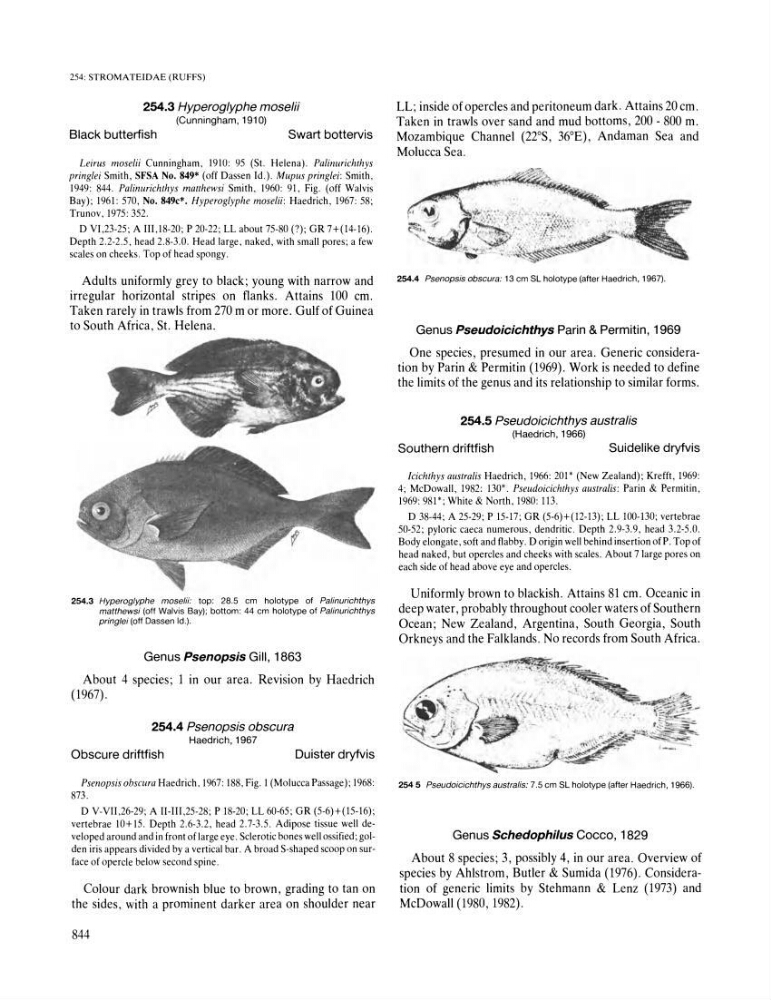
254.3 Hyperoglyphe moselii: top: 28.5 em holotype of Palinurichthys
matthewsi (off Walvis Bay): bottom: 44 em holotype of Palinurichthys
pringlei (off Dassen Id.).
Genus Psenopsis Gill, 1863
About 4 species; 1 in our area. Revision by Haedrich
(1967).
254.4 Psenopsis obscura
Haedrich, 1967
Obscure driftfish
Duister dryfvis
Psenopsis obscura Haedrich, 1967: 188, Fig. 1 (Molucca Passage); 1968:
873.
D V-VII,26-29; A II-III,25-28; P 18-20; LL 60-65; GR (5-6)+(15-16);
vertebrae 10+ 15. Depth 2.6-3.2, head 2.7-3.5. Adipose tissue well developed around and in front of large eye. Sclerotic bones well ossified; golden iris appears divided by a vertical bar. A broad S-shaped scoop on surface of opercle below second spine.
Colour dark brownish blue to brown, grading to tan on
the sides, with a prominent darker area on shoulder near
844
LL; inside of opercles and peritoneum dark. Attains 20 cm.
Taken in trawls over sand and mud bottoms, 200 - 800 m.
Mozambique Channel (22°S, 36°E) , Andaman Sea and
Molucca Sea.
254.4 Psenopsis obscura: 13 em SL holotype (after Haedrieh. 1967).
Genus Pseudoicichthys Parin & Permitin, 1969
One species, presumed in our area. Generic consideration by Parin & Permitin (1969). Work is needed to define
the limits of the genus and its relationship to similar forms.
254.5 Pseudoicichthys australis
(Haedrich, 1966)
Southern driftfish
Suidelike dryfvis
lcichthys australis Haedrich, 1966: 201 * (New Zealand); Krefft, 1969:
4; McDowall, 1982: 130* Pseudoicichthys australis: Parin & Perniitin,
1969: 981*; White & North, 1980: 113.
D 38-44; A 25-29; P 15-l7; GR (5-6)+(12-13); LL 100-130; vertebrae
50-52; pyloric caeca numerous, dendritic. Depth 2.9-3.9, head 3.2-5.0.
Body elongate, soft and flabby. D origin well behind insertion ofP. Top of
head naked, but opercles and cheeks with scales. About 7 large pores on
each side of head above eye and opercles.
Uniformly brown to blackish. Attains 81 cm. Oceanic in
deep water, probably throughout cooler waters of Southern
Ocean; New Zealand, Argentina, South Georgia, South
Orkneys and the Falklands. No records from South Africa.
254 5 Pseudoicichthys australis: 7.5 em SL holotype (after Haedrieh. 1966).
Genus Schedophilus Cocco, 1829
About 8 species; 3, possibly 4, in our area. Overview of
species by Ahlstrom, Butler & Sumida (1976). Consideration of generic limits by Stehmann & Lenz (1973) and
McDowall (1980,1982).