

4b Total elements in A 25-29; scales moderate in
size, not especially deciduous, present on
preopercle and cheek; LL 100-130;
vertebrae 50-52 .............................................. Pseudoicichthys
5a Vertebrae 25-32; no band of pores along bases
of D & A ......................................................... Schedophilus
5b Vertebrae 43-45; band of oblique rows of 8-10
pores on body along bases of D & A ............................... Tubbia
6a Soft Drays 19-25; A rays 14-21; preopercle
margin with small spines; scales not especially
deciduous; LL arched anteriorly, straightening
out over A; supramaxilla present; about 8 short
D spines, usually quite strong, not increasing in
length posteriorly .............................................. Hyperoglyphe
6b Soft Drays 25-40; A rays 18-30; preopercle smooth
or finely denticulate; scales very deciduous;
LL follows dorsal profile; supramaxilla absent;
D spines 5-7, sometimes quite weak, increasing
slightly in length posteriorly ..................................... Psenopsis
Genus Centrolophu5 Lacepede, 1803
A single species with a bipolar distribution. Revision by
Haedrich (1967).
Black ruff
254.1 Centrolophus niger
(Gmelin, 1789)
Swartroef
Perea nigra Gmelin, 1789: 132 (Cornwall). Centrolophodes irvini Gilchrist & von Bonde, 1923: 3, PI. 17, Fig. 1 (west coast, north of Paternoster Point in 85-90 fms). Centrolophus niger: Barnard, 1927: 895*; Smith,
SFSA No. 850*; 1949: 845; Haedrich, 1967: 65*; Krefft, 1969: 1*;
McDowall, 1982: 121*. Mupus bifasciatus Smith, 1961: 158, Fig (off
Rocky Point, Namibia).
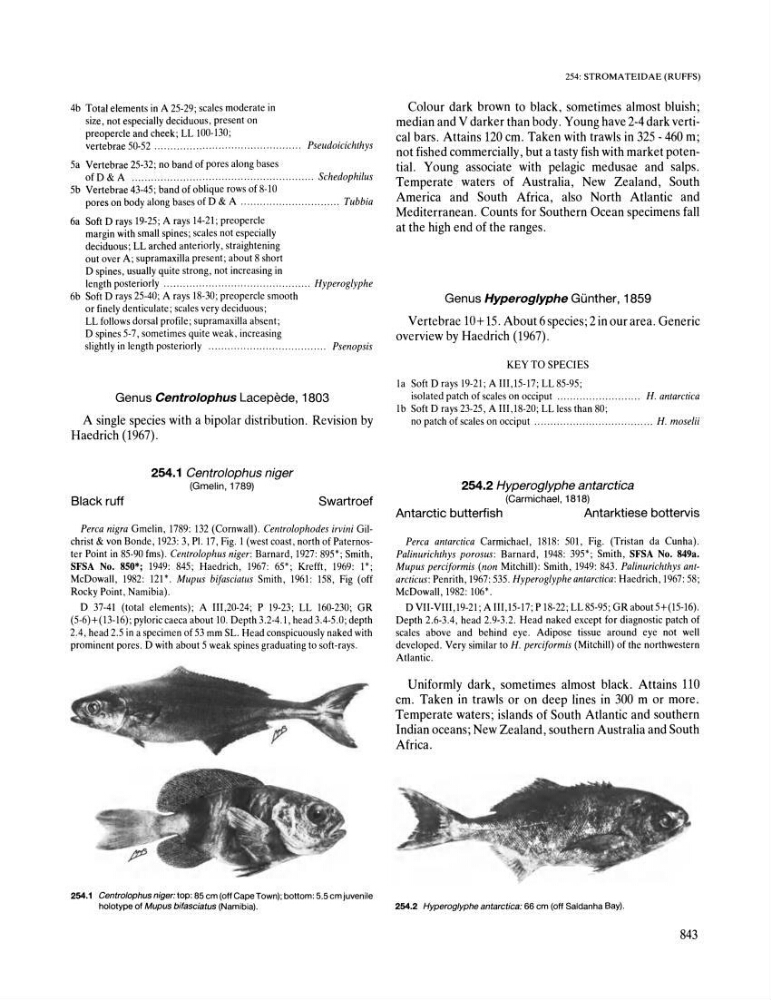
D 37-41 (total elements); A III ,20-24; P 19-23; LL 160-230; GR
(5-6)+(13-16); pyloric caeca about 10. Depth 3.2-4.1, head 3.4-5.0; depth
2.4, head 2.5 in a specimen of 53 mm SL. Head conspicuously naked with
prominent pores. D with about 5 weak spines graduating to soft-rays.
254.1 Centr%phus niger: top: 85 em (off Cape Town); bottom: 5.5 em juvenile
holotype of Mupus bifaseiatus (Namibia).
254: STROMATEIDAE (RUFFS)
Colour dark brown to black, sometimes almost bluish;
median and V darker than body. Young have 2-4 dark vertical bars. Attains 120 cm. Taken with trawls in 325 - 460 m;
not fished commercially, but a tasty fish with market potential. Young associate with pelagic medusae and salps.
Temperate waters of Australia, New Zealand, South
America and South Africa, also North Atlantic and
Mediterranean. Counts for Southern Ocean specimens fall
at the high end of the ranges.
Genus Hyperoglyphe Gunther, 1859
Vertebrae 10+ 15. About 6 species; 2 in our area. Generic
overview by Haedrich (1967).
KEY TO SPECIES
la Soft Drays 19-21; A III,15-17; LL85-95;
isolated patch of scales on occiput .......................... H. antarctica
Ib Soft Drays 23-25, A III, 18-20; LL less than 80;
no patch of scales on occiput ............................ ... ...... H. moselii
254.2 Hyperoglyphe antarctica
(Carmichael, 1818)
Antarctic butterfish
Antarktiese bottervis
Perea antarctica Carmichael, 1818: 501, Fig. (Tristan da Cunha).
Palinurichthys porosus: Barnard, 1948: 395*; Smith, SFSA No. 849a.
Mupus perriformis (non Mitchill): Smith, 1949: 843. Palinurichthys antarcticus: Penrith, 1967: 535. Hyperoglyphe antarctica: Haedrich, 1967: 58;
McDowall, 1982: 106*.
D VII-VIII, 19-21; A III,15-17; P 18-22; LL 85-95; GR about 5+(15-16).
Depth 2.6-3.4, head 2.9-3.2. Head naked except for diagnostic patch of
scales above and behind eye. Adipose tissue around eye not well
developed. Very similar to H. perciformis (Mitch ill) of the northwestern
Atlantic.
Uniformly dark, sometimes almost black. Attains 110
cm. Taken in trawls or on deep lines in 300 m or more.
Temperate waters; islands of South Atlantic and southern
Indian oceans; New Zealand, southern Australia and South
Africa.
254.2 Hyperog/yphe antarctica: 66 em (off Saldanha Bay).
843