

254: STROMATEOIDEI (RUFFS)
I b Dorsal fin continuous or two fins scarcely separated,
the 1st with 1-9 spines; the longest spine less than
half length of longest dorsal-fin ray; pelvic fins
present or absent; vomer, palatines and
basibranchials toothless ................ STROMATEIDAE (No. 254)
2a Pelvic fins jugular, their origin well before
pectoral fins and under rear edge of preopercle;
body translucent, no colour pattern apparent;
body slender with a deep caudal peduncle;
toothed pharyngeal sacs absent .......... AMARSIPIDAE (No. 253)
2b Pelvic fins thoracic, their origin usually under
pectoral fins or behind; if pelvic fin origin precedes
pectoral base, body has distinct dark blotches on
a silvery background; if body is translucent,
it is deep with a slender peduncle; pharyngeal
sacs present ....................................................... ... ... ... ..... 3
3a First dorsal fin with 10-20 short spines, the
longest only half length of longest dorsal-fin ray;
anal-fin rays 10-16; scales keeled, heavy, adherent;
modified scales form 2 well-developed lateral
keels on each side of peduncle near
caudal-fin base ...................... TETRAGONURIDAE (No. 256)
3b First dorsal fin with 9-12 long, slender spines, often
folded into a groove; longest spine nearly as
long as, or longer than, longest dorsal-fin ray;
anal-fin rays 13-31; scales cycloid, thin, deciduous;
fleshy lateral keels on peduncle near
caudal-fin base absent or only slightly
developed .......................................... NOMEIDAE (No. 255)
Family No. 253: AMARSIPIDAE
by R.l. Haedrich
Amarsipids
Amarsipiede
Body elongate and compressed. Two dorsal fins, scarcely
separated; first with 10-12 weak spines; second dorsal and
anal about equal in length. Pelvic fins on throat, with 1 short
spine and 5 weak rays. Caudal peduncle compressed. Premaxilla not protractile; preorbital bone covers only upper
margin of maxilla when mouth is closed; teeth strong, a
single series in jaws; a few similar teeth on vomer; no
toothed pharyngeal sacs. Scales very small and easily shed.
Known only from larvae and juveniles; largest specimen
known is only 12 cm; pelagic in tropical Indian and Pacific
oceans. A single genus with only one species.
253.1 Amarsipus carlsbergi
Haedrich, 1969
Amarsipus carlsbergi Haedrich, 1969: 8, Figs. 2-8 (Indian Ocean);
Ahlstrom, Butler & Sumida, 1976: 307*.
D X-XII,22-27; A 1,27-32; P 17-19; LL 100-150 (difficult to count); GR
about 6+(12-15); vertebrae 45-47. Depth 3.4-4.8, head 3.1-4.2 in SL.
842
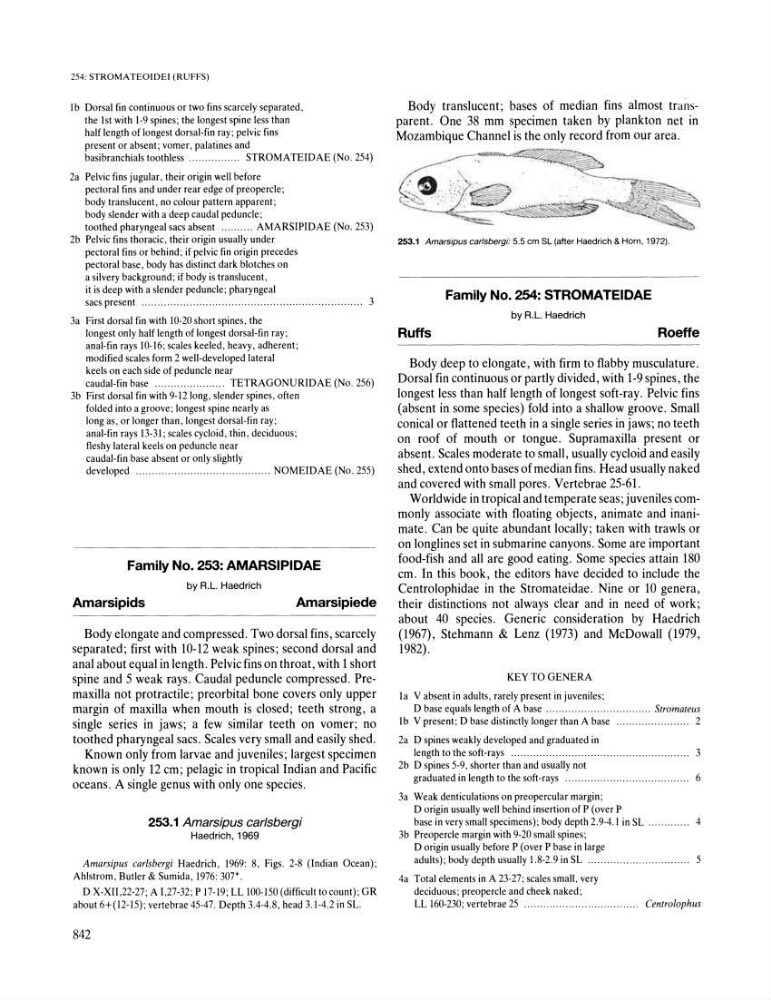
Body translucent; bases of median fins almost tra;1Sparent. One 38 mm specimen taken by plankton net in
Mozambique Channel is the only record from our area.
--...:""""-....~~
253.1 Amarsipus carlsbergi: 5.5 em SL (after Haedrieh & Horn, 1972).
Family No. 254: STROMATEIDAE
by R.L. Haedrich
Ruffs
Roeffe
Body deep to elongate, with firm to flabby musculature.
Dorsal fin continuous or partly divided, with 1-9 spines, the
longest less than half length of longest soft-ray. Pelvic fins
(absent in some species) fold into a shallow groove. Small
conical or flattened teeth in a single series in jaws; no teeth
on roof of mouth or tongue. Supramaxilla present or
absent. Scales moderate to small, usually cycloid and easily
shed, extend onto bases of median fins. Head usually naked
and covered with small pores. Vertebrae 25-61.
Worldwide in tropical and temperate seas; juveniles commonly associate with floating objects, animate and inanimate. Can be quite abundant locally; taken with trawls or
on longlines set in submarine canyons. Some are important
food-fish and all are good eating. Some species attain 180
cm. In this book, the editors have decided to include the
Centrolophidae in the Stromateidae. Nine or 10 genera,
their distinctions not always clear and in need of work;
about 40 species. Generic consideration by Haedrich
(1967), Stehmann & Lenz (1973) and McDowall (1979,
1982).
KEY TO GENERA
la V absent in adults, rarely present in juveniles;
D base equals length of A base ................................. Stromateus
Ib V present; D base distinctly longer than A base ....................... 2
2a D spines weakly developed and graduated in
length to the soft-rays .................................. " .. .................. 3
2b D spines 5-9, shorter than and usually not
graduated in length to the soft-rays .................. " ................... 6
3a Weak denticulations on preopercular margin;
D origin usually well behind insertion of P (over P
base in very small specimens); body depth 2.9-4.1 in SL ...... ".... 4
3b Preopercle margin with 9-20 small spines;
D origin usually before P (over P base in large
adults); body depth usually 1.8-2.9 in SL ................ .. ............. 5
4a Total elements in A 23-27; scales small, very
deciduous; preopercle and cheek naked;
LL 160-230; vertebrae 25 ............................... .. ... Centrolophus