

nini), A. thazard (Lacepede, 1800), is distinguished by its
narrow posterior extension of the scaly corselet (1-5 scales
wide below 2nd D origin) and wavy oblique dark bands on
the back.
Bullet tuna
249.3 Auxis rochei
(Risso, 1810)
Koeel-tuna
Scomber Rochei Risso, 1810: 165 (Nice). Auxis thazard (non Lacepede): Smith, SFSA No. 828*; Talbot, 1964: 196*. Auxis rochei: Talbot,
1964: 197; Collette & Nauen, 1983: 29*.
D X-XI+1O-11+8 finlets; A 13-15+6-7 finlets; P 23-25; GR (9-10)+
(33-37) = 42-46; vertebrae 20+19 = 39. Depth 4.1-4.7; head 3.7-3.8;
P 7.8-8.1. Teeth small and conical, 45-60 on each side of upper, 50-65 on
each side of lower jaw. No teeth on vomer or palatines. Swim-bladder
absent. Body naked posterior to well-developed corselet which extends
along LL as a band more than 6 scales wide under origin of 2nd D.
Back dark bluish, 15 or more subvertical dark bars in
scaleless area above LL. Attains at least 50 cm FL and about
2 kg. Epipelagic, neritic and oceanic. Schools have been
netted in Hout Bay during summer months; one specimen
taken in Mossel Bay and one from Natal. Abundant from
Tiger Bay northward in Angola. Cosmopolitan in warm
waters.
pelvic fin
~ interpelvic
process
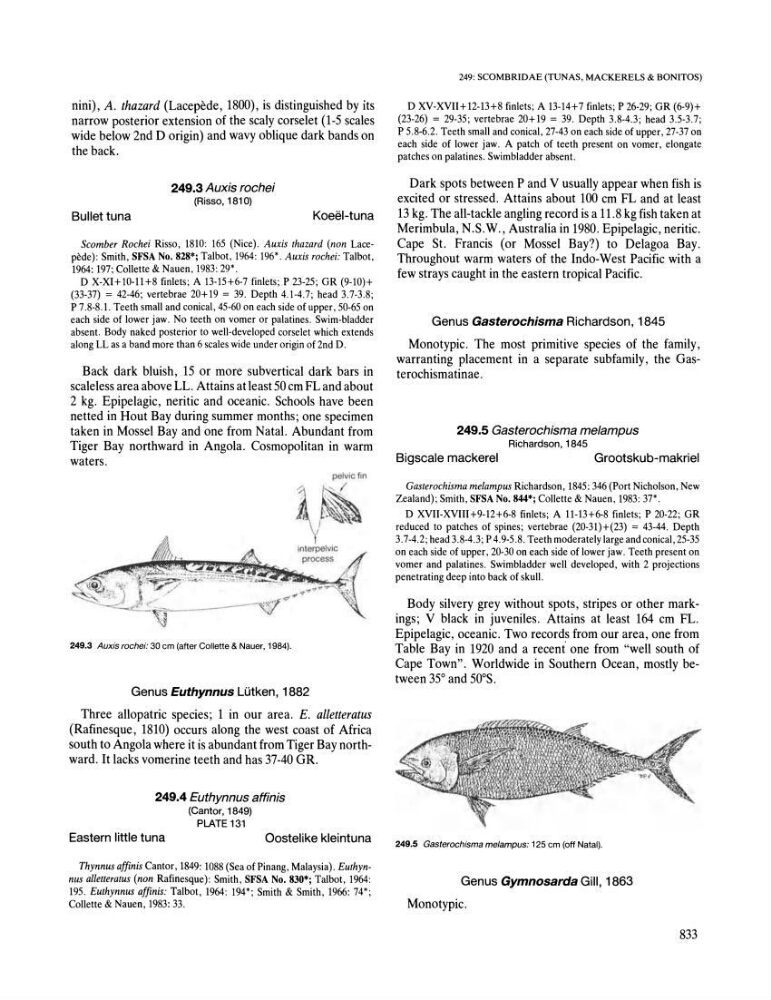
249.3 Auxis rochei: 30 em (after Collette & Nauer, 1984).
Genus Euthynnus Lutken, 1882
Three allopatric species; 1 in our area. E. alletteratus
(Rafinesque, 1810) occurs along the west coast of Africa,
south to Angola where it is abundant from Tiger Bay northward. It lacks vomerine teeth and has 37-40 GR.
249.4 Euthynnus affinis
(Cantor, 1849)
PLATE 131
Eastern little tuna
Oostelike kleintuna
Thynnus affinis Cantor, 1849: 1088 (Sea of Pinang, Malaysia). Euthynnus alletteratus (non Rafinesque): Smith, SFSA No. 830*; Talbot, 1964:
195. Euthynnus affinis: Talbot, 1964: 194*; Smith & Smith, 1966: 74*;
Collette & Nauen, 1983: 33.
249: SCOMBRIDAE (TUNAS, MACKERELS & BONITOS)
D XV-XVII + 12-13+8 finlets; A 13-14+7 finlets; P 26-29; GR (6-9)+
(23-26) = 29-35; vertebrae 20+ 19 = 39. Depth 3.8-4.3; head 3.5-3.7;
P 5.8-6.2. Teeth small and conical, 27-43 on each side of upper, 27-37 on
each side of lower jaw. A patch of teeth present on vomer, elongate
patches on palatines. Swimbladder absent.
Dark spots between P and V usually appear when fish is
excited or stressed. Attains about 100 cm FL and at least
13 kg. The all-tackle angling record is a 11.8 kg fish taken at
Merimbula, N.S.W., Australia in 1980. Epipelagic, neritic.
Cape St. Francis (or Mossel Bay?) to Delagoa Bay.
Throughout warm waters of the Indo-West Pacific with a
few strays caught in the eastern tropical Pacific.
Genus Gasterochisma Richardson, 1845
Monotypic. The most primitive species of the family,
warranting placement in a separate subfamily, the Gasterochismatinae.
249.5 Gasterochisma melampus
Richardson, 1845
Bigscale mackerel
Grootskub-makriel
Gasterochisma melampus Richardson, 1845: 346 (Port Nicholson, New
Zealand); Smith, SFSA No. 844*; Collette & Nauen, 1983: 37*.
D XVII-XVIII +9-12+6-8 finlets; A 11-13+6-8 finlets; P 20-22; GR
reduced to patches of spines; vertebrae (20-31)+(23) = 43-44. Depth
3.7-4.2; head 3.8-4.3; P 4.9-5.8. Teeth moderately large and conical, 25-35
on each side of upper, 20-30 on each side of lower jaw. Teeth present on
vomer and palatines. Swimbladder well developed, with 2 projections
penetrating deep into back of skull.
Body silvery grey without spots, stripes or other markings; V black in juveniles. Attains at least 164 cm FL.
Epipelagic, oceanic. Two records from our area, one from
Table Bay in 1920 and a recent one from "well south of
Cape Town". Worldwide in Southern Ocean, mostly between 35° and 50 0 S.
249.5 Gasterochisma melampus: 125 em (off Natal).
Genus Gymnosarda Gill, 1863
Monotypic.
833