

249: SCOMBRJDAE (TUNAS, MACKERELS & BONITOS)
9a First and 2nd D widely separated, the space
between them equal to length of 1st Dbase;
9-11 D spines; interpelvic process single and
as long as V." .... " .. " ""."" .... ""."." ." .... "." ..... ,,, ,, ....
pelvic
/
~ / I fin
J , ~
.
.~ ~'.
., .~
9a t
interpelvic
process
pelvic
~\
interpel vic
process
9b First and 2nd D barely separated, at most by
eye diameter; 12-17 D spines; interpelvic process
Auxis
bifid, much shorter than V """""""""""""""""""""""" 10
lOa 3-5 prominent dark longitudinal stripes on belly;
GR51-62 """"""""""."""""""""""""""".", Katsuwonus
lOb No dark longitudinal stripes on belly; GR 19-45
(26-44 in our area) """"""""""""""""""""" " " ... "" .. ". 11
11 a Body naked behind corselet of enlarged and
thickened scales; several black spots usually
present between P and V bases; back dark
blue-green with a complex striped pattern under
D bases; Prays 26-29 ............................................ Euthynnus
11 b Body covered with minute scales behind corselet;
no black spots on body; back dark blue without
stripes; Prays 30-36 """"""""""""""""""""""". Thunnus
Genus Acanthocybium Gill, 1862
Monotypic.
Wahoo
249.1 Acanthocybium solandri
(Cuvier, 1831)
Wahoo
eybium Solandri Cuvier, in Cuv. & Val., 1831: 192 (based on Solander's manuscript, locality unknown). Acanthocybium solandri: Smith,
SFSA No. 843*; 1964: 178*; Collette & Nauen, 1983: 25*.
D XXIII-XXVII + 12-16+ 7-10 finlets; A 12-14+7-9 finlets; P 22-24;
GRO; vertebrae (30-32)+(31-33) = 62-64. Depth6.5-7.7; head4.3-4.5; P
8.6-9.3. Snout and jaws elongate and beak-like. Teeth compressed, triangular, and finely serrate, 37-64 on each side of upper jaw, 31-50 in lower
jaw. Villiform teeth on vomer and palatines. Swimbladder well
developed. Body covered with small scales; no corselet.
Body marked with many narrow vertical bars, change
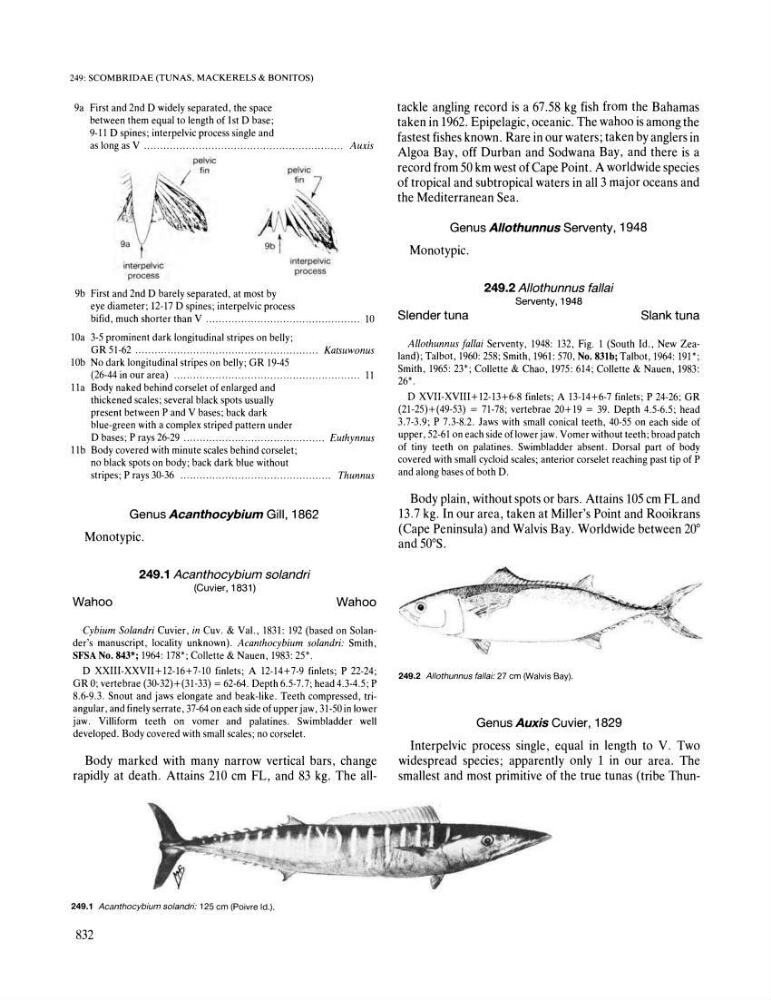
rapidly at death. Attains 210 cm FL, and 83 kg. The all249.1 Acanthocybium so/andri: 125 cm (Poivre Id.).
832
tackle angling record is a 67.58 kg fish from the Bahamas
taken in 1962. Epipelagic, oceanic. The wahoo is among the
fastest fishes known. Rare in our waters; taken by anglers in
Algoa Bay, off Durban and Sodwana Bay, and there is a
record from 50 km west of Cape Point. A worldwide species
of tropical and subtropical waters in all 3 major oceans and
the Mediterranean Sea.
Genus Allothunnus Serventy, 1948
Monotypic.
Slender tuna
249.2 Allothunnus fallai
Serventy, 1948
Siank tuna
Allothunnus fallai Serventy, 1948: 132, Fig. 1 (South Id., New Zealand); Talbot, 1960: 258; Smith, 1961: 570, No. 83lb; Talbot, 1964: 191 *;
Smith, 1965: 23*; Collette & Chao, 1975: 614; Collette & Nauen, 1983:
26*
D XVII-XVIII + 12-13+6-8 finlets; A 13-14+6-7 finlets; P 24-26; GR
(21-25)+(49-53) = 71-78; vertebrae 20+19 = 39. Depth 4.5-6.5; head
3.7-3.9; P 7.3-8.2. Jaws with small conical teeth, 40-55 on each side of
upper, 52-61 on each side of lower jaw. Vomer without teeth; broad patch
of tiny teeth on palatines. Swimbladder absent. Dorsal part of body
covered with small cycloid scales; anterior corselet reaching past tip of P
and along bases of both D.
Body plain, without spots or bars. Attains 105 cm FL and
13.7 kg. In our area, taken at Miller's Point and Rooikrans
(Cape Peninsula) and Walvis Bay. Worldwide between 20°
and 50 0 S.
--- ---- -~ -~
249.2 Allothunnus fallai: 27 em (Walvis Bay).
Genus Auxis Cuvier, 1829
Interpelvic process single, equal in length to V. Two
widespread species; apparently only 1 in our area. The
smallest and most primitive of the true tunas (tribe Thun-