

Family No. 249: SCOMBRIDAE
by B.B. Collette
Tunas, mackerels and
Tunas, makriele en
bonitos
bonito's
Body elongate and fusiform, moderately compressed in
some genera. Snout pointed; premaxillae beak-like, free
from nasal bones which are separated by ethmoid bone;
mouth rather large; teeth in jaws strong, moderate or weak;
no true canines; palate and tongue may be toothed.
Anterior dorsal fin usually short and separated from posterior fin, depressible into a groove; finlets present behind
dorsal and anal fins; pelvic fins moderate or small; caudal
fin deeply forked with supporting caudal rays completely
covering hypural plate. At least 2 small keels on each side of
caudal peduncle, a larger keel in between in many species.
Lateral line simple. Vertebrae 31-66. Body covered with
small to moderate scales or a scaly corselet developed (area
behind head and around pectoral fins covered with moderately large, thick scales) and rest of body naked or covered
with tiny scales.
Scombrids are swift, epipelagic predators; some species
occur in coastal waters, others far offshore. Many species
form large schools, and most are of great importance as
food-fishes both fresh and canned. If, however, the fish is
left lying in the sun, histamine develops in the flesh and the
peppery taste warns that it is not edible. Unlike the typical
"cold-blooded" fishes, some tunas maintain elevated body
temperatures several degrees above the ambient water
temperature. Some species feed on plankton, others capture fishes, squids and crustaceans. Eggs and larvae
planktonic. Lengths of species given here are fork length
(FL) , as is usual for this family. Fifteen genera and 48
species of which 12 genera and 18 species occur in our area.
Recently reviewed by Collette and Nauen (1983).
KEY TO GENERA
la Body covered with large cycloid scales; V huge in
juveniles, proportionally smaller at large sizes,
depressible into a groove .................................. Gasterochisma
Ib Body naked or covered with small to moderate-sized
scales; V small, no groove into which they fit ................ .. .. .. ... 2
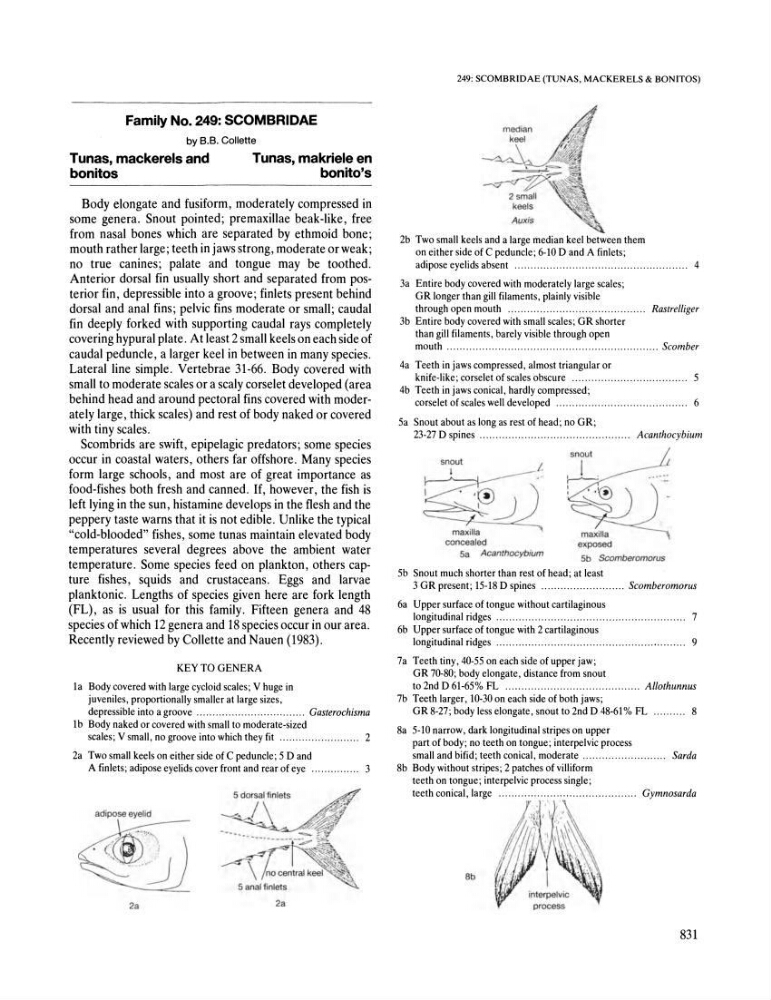
2a Two small keels on either side of C peduncle; 5 0 and
A finlets; adipose eyelids cover front and rear of eye ............... 3
adipose eyelid
@ ' "' ' ' '
,"
< ..
.... ~
2a
2a
249: SCOMBRIDAE (TUNAS, MACKERELS & BONITOS)
2b Two small keels and a large median keel between them
on either side of C peduncle; 6-10 0 and A finlets;
adipose eyelids absent ...................................................... 4
3a Entire body covered with moderately large scales;
GR longer than gill filaments, plainly visible
through open mouth ........................................... Rastrelliger
3b Entire body covered with small scales; GR shorter
than gill filaments, barely visible through open
mouth .................................................................. Scomber
4a Teeth in jaws compressed, almost triangular or
knife-like; corselet of scales obscure .................................... 5
4b Teeth in jaws conical, hardly compressed;
corselet of scales well developed ......................................... 6
5a Snout about as long as rest of head; no GR;
23-270 spines ............................................... Acanthocybium
concea led
Sa Acanthocybium
Sb Scomberomorus
5b Snout much shorter than rest of head; at least
3 GR present; 15-180 spines .......................... Scomberomorus
6a Upper surface of tongue without cartilaginous
longitudinal ridges ........................................................... 7
6b Upper surface of tongue with 2 cartilaginous
longitudinal ridges ........................................................... 9
7a Teeth tiny, 40-55 on each side of upper jaw;
GR 70-80; body elongate, distance from snout
to 2nd 0 61-65% FL .......................................... Allothunnus
7b Teeth larger, 10-30 on each side of both jaws;
G R 8-27; body less elongate, snout to 2nd 0 48-61 % FL .......... 8
8a 5-10 narrow, dark longitudinal stripes on upper
part of body; no teeth on tongue; interpel vic process
small and bifid; teeth conical, moderate .......................... Sarda
8b Body without stripes; 2 patches of villiform
teeth on tongue; interpelvic process single;
teeth conical, large ........................................... Gymnosarda
8b
831