

249: SCOMBRIDAE (TUNAS, MACKERELS & BONITOS)
249.6 Gymnosarda unic%r
(Ruppell, 1836)
Dogtooth tuna
Hoektand-tuna
Thynnus (Pelamis) unicolor Riippell, 1836: 40, PI. 12, Fig. I (Jeddah,
Red Sea). Gymnosarda unicolor: Collette & Chao, 1967: 613; Smith,
1980: 182; Collette & Nauen, 1983: 40*.
D XIII-XV + 12-14+6-7 finlets; A 12-13+6 finlets; P 25-28; GR
11-14; vertebrae 19+ 19 = 38. Depth 3.9-5.0; head 3.6-4.0; P 5.3-7.8.
Teeth large and conical, 14-31 on each side of upper, 10-24 on each side of
lower jaw; an elongate patch consisting of hundreds of tiny teeth on
palatines; a few small teeth on vomer; 2 patches of fine teeth on tongue.
Swimbladder well developed. Body naked behind corselet except for narrow band of scales along LL and D bases, and the caudal keel area.
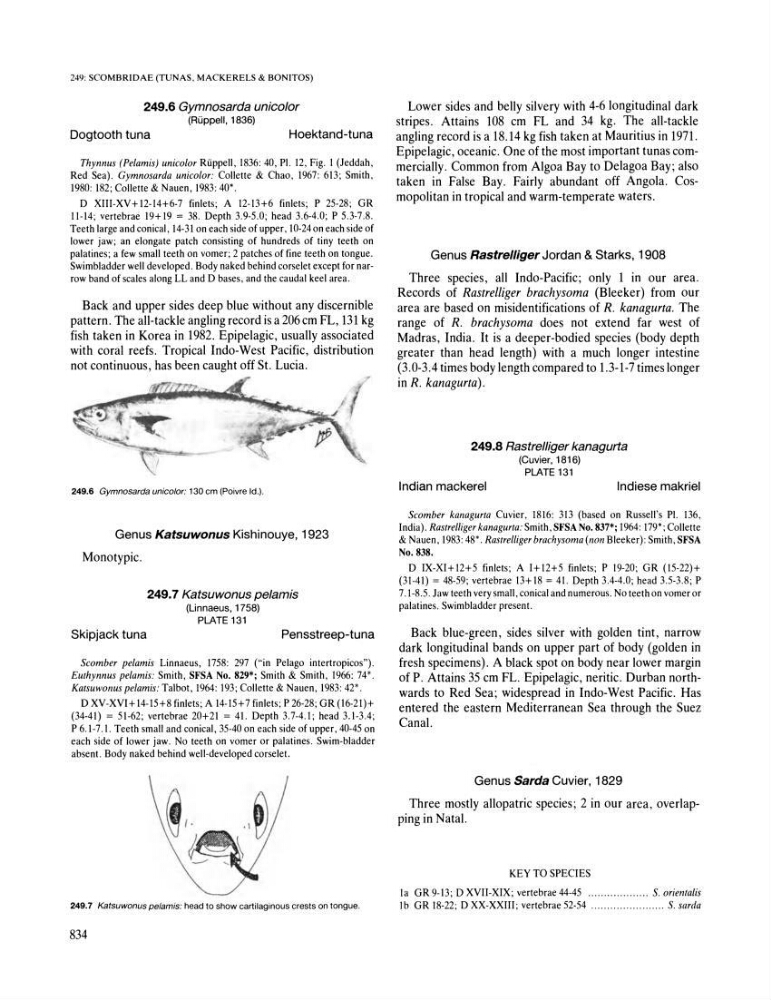
Back and upper sides deep blue without any discernible
pattern. The all-tackle angling record is a 206 cm FL, 131 kg
fish taken in Korea in 1982. Epipelagic, usually associated
with coral reefs. Tropical Indo-West Pacific, distribution
not continuous, has been caught off St. Lucia.
249.6 Gymnosarda unicolor: 130 em (Poivre Id.).
Genus Katsuwonus Kishinouye, 1923
Monotypic.
Skipjack tuna
249.7 Katsuwonus pe/amis
(Linnaeus, 1758)
PLATE 131
Pensstreep-tuna
Scomber pelamis Linnaeus, 1758: 297 ("in Pelago intertropicos").
Euthynnus pelamis: Smith, SFSA No. 829*; Smith & Smith, 1966: 74*.
Katsuwonus pelamis: Talbot, 1964: 193; Collette & Nauen, 1983: 42*.
D XV -XVI + 14-15+8 finlets; A 14-15+7 finlets; P 26-28; GR (16-21)+
(34-41) = 51-62; vertebrae 20+21 = 41. Depth 3.7-4.1; head 3.1-3.4;
P 6.1-7.1. Teeth small and conical, 35-40 on each side of upper, 40-45 on
each side of lower jaw. No teeth on vomer or palatines. Swim-bladder
absent. Body naked behind well-developed corselet.
249.7 Katsuwonus pelamis: head to show cartilaginous crests on tongue.
834
Lower sides and belly silvery with 4-6 longitudinal dark
stripes. Attains 108 cm FL and 34 kg. The all-tackle
angling record is a 18.14 kg fish taken at Mauritius in 1971.
Epipelagic, oceanic. One of the most important tunas commercially. Common from Algoa Bay to Delagoa Bay; also
taken in False Bay. Fairly abundant off Angola. Cosmopolitan in tropical and warm-temperate waters.
Genus Rastrelliger Jordan & Starks, 1908
Three species, all Indo-Pacific; only 1 in our area.
Records of Rastrelliger brachysoma (Bleeker) from our
area are based on misidentifications of R. kanagurta. The
range of R. brachysoma does not extend far west of
Madras, India. It is a deeper-bodied species (body depth
greater than head length) with a much longer intestine
(3.0-3.4 times body length compared to 1.3-1-7 times longer
in R. kanagurta).
249.8 Rastrelliger kanagurta
(Cuvier, 1816)
PLATE 131
Indian mackerel
Indiese makriel
Scomber kanagurta Cuvier, 1816: 313 (based on Russell's PI. 136,
India). Rastrelliger kanagurta: Smith, SFSA No. 837*; 1964: 179*; Collette
& Nauen, 1983: 48*. Rastrelligerbrachysoma (non Bleeker): Smith, SFSA
No. 838.
D IX-XI+12+5 finlets; A I+12+5 finlets; P 19-20; GR (15-22)+
(31-41) = 48-59; vertebrae 13+ 18 = 41. Depth 3.4-4.0; head 3.5-3.8; P
7.1-8.5. Jaw teeth very small, conical and numerous. No teeth on vomer or
palatines. Swim bladder present.
Back blue-green, sides silver with golden tint, narrow
dark longitudinal bands on upper part of body (golden in
fresh specimens). A black spot on body near lower margin
of P. Attains 35 cm FL. Epipelagic, neritic. Durban northwards to Red Sea; widespread in Indo-West Pacific. Has
entered the eastern Mediterranean Sea through the Suez
Canal.
Genus Sarda Cuvier, 1829
Three mostly allopatric species; 2 in our area, overlapping in Natal.
KEY TO SPECIES
la GR 9-13; D XVII-XIX; vertebrae 44-45 ................... S.orientalis
Ib GR 18-22; D XX-XXIII; vertebrae 52-54 ....................... S. sarda