

243: ACANTHURIDAE (SURGEONFISHES, UNICORNFISHES)
band from behind corner of mouth to below eye; diffuse yellow area behind eye; edges of lips orange-yellow; D orange-yellow with broad black
band at base, a blue line below, a white outer margin and black submarginal line; C brown with rear margin white, the upper and lower margins
black, joined by a black band in outer ~ of fin.
Attains about 45 cm total length. Indo-Pacific; south to
Durban, In the Pacific the coloration is somewhat different;
the yellow is absent from the D, and the C lacks the posterior white and black bands, having instead a submarginal
one of pale yellow. Feeds on benthic algae. Some authors
prefer to classify this species in its own genus, Callicanthus,
largely because of the difference from other Nasa in dentition of adults.
243.26 Naso minor
(Smith, 1966)
Slender unicorn
Siank eenhoringvis
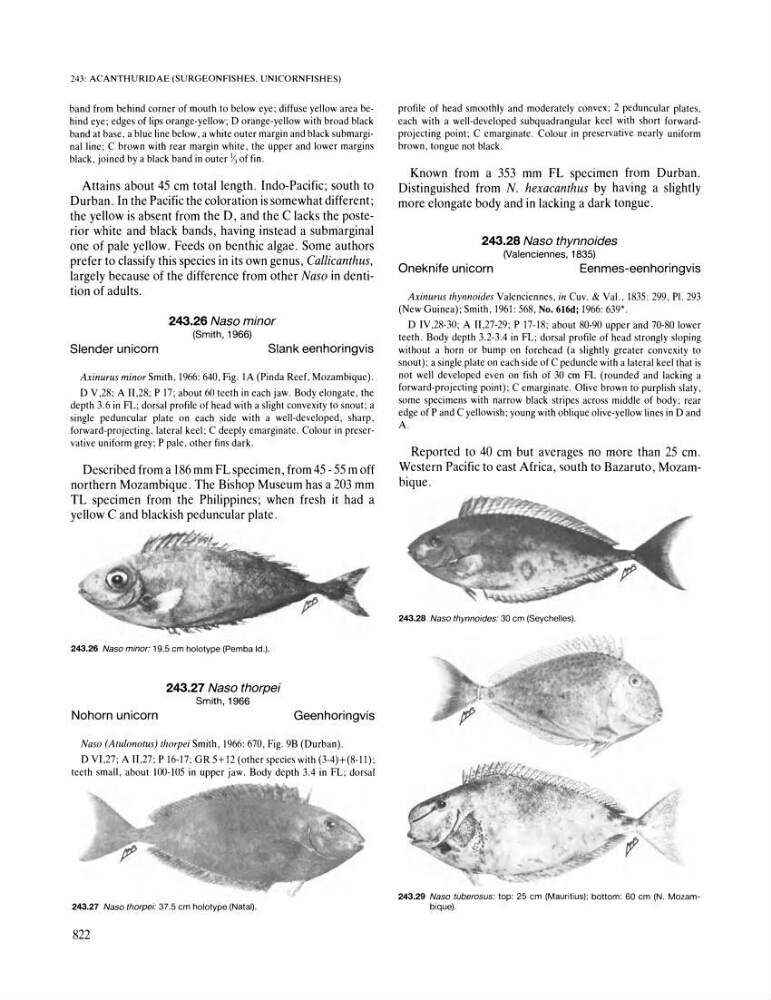
Axinurus minor Smith, 1966: 640, Fig. 1 A (Pinda Reef, Mozambique).
D V,28; A 1I,28; P 17; about 60 teeth in each jaw. Body elongate, the
depth 3.6 in FL; dorsal profile of head with a slight convexity to snout; a
single peduncular plate on each side with a well-developed, sharp,
forward-projecting, lateral keel; C deeply emarginate. Colour in preservative uniform grey; P pale, other fins dark.
Described from a 186 mm FL specimen, from 45 - 55 m off
northern Mozambique. The Bishop Museum has a 203 mm
TL specimen from the Philippines; when fresh it had a
yellow C and blackish peduncular plate,
243.26 Naso minor: 19.5 cm holotype (Pemba Id.).
Nohorn unicorn
243.27 Naso thorpei
Smith,1966
Geenhoringvis
Naso (Atulonotus) thorpei Smith, 1966: 670, Fig. 9B (Durban).
D VI,27; A 1I,27; P 16-17; GR 5+ 12 (other species with (3-4)+(8-11);
teeth small, about 100-105 in upper jaw. Body depth 3.4 in FL; dorsal
243.27 Naso thorpei: 37.5 cm holotype (Natal).
822
profile of head smoothly and moderately convex; 2 peduncular plates,
each with a well-developed subquadrangular keel with short forwardprojecting point; C emarginate. Colour in preservative nearly uniform
brown, tongue not black.
Known from a 353 mm FL specimen from Durban.
Distinguished from N. hexacanth us by having a slightly
more elongate body and in lacking a dark tongue,
243.28 Naso thynnoides
(Valenciennes, 1835)
Oneknife unicorn
Eenmes-eenhoringvis
Axinurus thynnoides Valenciennes, in Cuv. & Val., 1835: 299, PI. 293
(New Guinea); Smith, 1961: 568, No. 616dj 1966: 639*
D IV,28-30; A 11,27-29; P 17-18; about 80-90 upper and 70-80 lower
teeth. Body depth 3.2-3.4 in FL; dorsal profile of head strongly sloping
without a horn or bump on forehead (a slightly greater convexity to
snout); a single plate on each side of C peduncle with a lateral keel that is
not well developed even on fish of 30 cm FL (rounded and lacking a
forward-projecting point); C emarginate. Olive brown to purplish slaty,
some specimens with narrow black stripes across middle of body; rear
edge of P and C yellowish; young with oblique olive-yellow lines in D and
A.
Reported to 40 cm but averages no more than 25 cm.
Western Pacific to east Africa, south to Bazaruto, Mozambique.
243.28 Naso thynnoides: 30 cm (Seychelles).
243.29 Naso tuberosus: top: 25 cm (Mauritius); bottom: 60 cm (N. Mozambique).