

243.29 Naso tuberosus
Lacepede, 1802
Humpnose unicorn
Hompneus~eenhoringvis
Naso tuberosus Lacepede, 1802: 105, 111, PI. 7, Fig. 3 (Mauritius) ;
Smith , 1966: 657* . Cyphomycter tuberosus: Smith , 1961: 568, No. 617b.
D V,27-29 ; A II,26-27 ; P 16-18. Body depth of adults 2.6- 2.7 in FL; a
hump on back at 1st D soft-ray; adults with a large broadly-rounded protuberance on snout extending in front of mouth; 2 peduncular plates
nearly as large as eye diameter, each with a strong lateral keel bearing a
forward-projecting point; C emarginate, without filaments. Grey with
numerous small black spots on head, body , D, C and V.
Reaches at least 60 cm . Natal to Gilbert Ids.; a shallowwater reef fish .
243.30 Naso unieornis
(Forsskal, 1775)
PLATE 128
Bluespine unicorn
Bloustekel-eenhoringvis
Chaetodon unicornis Forsskal, 1775: 13,63 (Red Sea). Naso unicornis:
Smith , SFSA No. 616*; 1966: 645* ; van der Elst, 1981 : 99*'
D VI,27-30; A II,27-30; P 17-18. Body depth of adults less than 3.0 in
FL; adults with a tapering rostral projection in front of eye which does not
extend anterior to mouth (first sign of rostral projection is a bump before
the eye at lengths of about 12 cm); dorsal profile of snout to base of horn
straight, forming an angle of about 45°; C peduncle with 2 pairs of bony
plates, each with a well-developed lateral keel having a forwardprojecting point ; C slightly emarginate in young, becoming truncate with
produced lobes in adults. Light olive, the peduncular plates and keels blue
(blackish in preservative) ; lips bluish; D and A yellowish with longitudinal
narrow blue bands. At anyone size , adult males are reported to have a
longer horn , better developed peduncular spines, and longer C filaments
than females.
Reaches 70 cm . Indo-Pacific, south to Natal. A species of
coral reefs and rocky shores; enters surprisingly shallow
water for such a large fish; feeds on benthic algae .
243.31 Naso v/amingii
(Valenciennes, 1835)
PLATE 128
Bignose unicorn
Grootneus-eenhoringvis
Naseus V/amingii Valenciennes, in Cuv . & Val., 1835: 293 (Moluccas) .
Cyphomycter v/amingi: Smith, 1961: 568, No. 617a. Naso v/amingii:
Smith, 1966: 660* .
D VI,26-27; A II ,27-29; P 17-19. Body depth 2.6-2.9 in FL. Adults
develop a prominent convexity on forehead at level of lower edge of eye; 2
bony plates on C peduncle , those of adults bearing a sharp lateral keel
with forward-projecting point; D elevated, the 1st spine 1.5-1.7 in head;
soft-rays almost as long as head ; C truncate to slightly rounded, the fin of
adults with a long filament from each corner. Young with scattered small
dark spots; adults with vertical deep violet lines on side of body and small
spots above and below ; a broad irregular deep violet band extending
anteriorly from eye; lips deep violet. In life, the fish may change these
dark markings to brilliant blue .
244: ZANCLIDAE (MOORISH IDOL)
Attains about 60 cm TL. Indo-Pacific, south to Natal.
Typically found off reef fronts where it appears to feed in
midwater on zooplankton; retires to the reef at night to
sleep.
Family No. 244: ZANCLIDAE
by P.C. Heemstra & M . M. Smith
Moorish idol
Moorse afgod
Body strongly compressed, discoid, with minute rough
scales. No spine on caudal peduncle. Snout produced;
mouth small; teeth long, slender, bristle-like, mostly
covered by the wide lips. Pelvic fins well developed . Dorsal
fin spines elongated into a whip-like filament. A short spine
develops in front of each eye in adults.
A single species of the tropical Indo-Pacific; possibly
related to the surgeonfishes (Acanthuridae). Some eastern
people treat these fishes with great respect. If one is caught,
they bow to it and carefully return it to the water, hence the
common name.
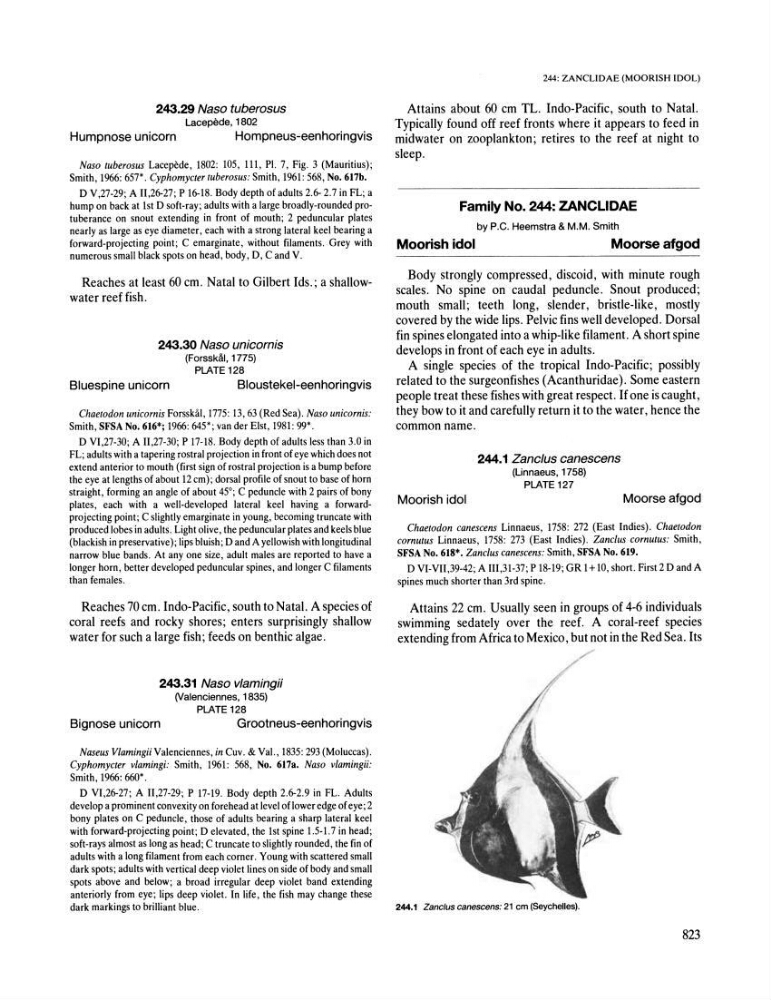
Moorish idol
244.1 Zane/us eaneseens
(Linnaeus, 1758)
PLATE 127
Moorse afgod
Chaetodon canescens Linnaeus, 1758: 272 (East Indies). Chaetodon
cornutus Linnaeus, 1758: 273 (East Indies). Zanclus cornUlus: Smith,
SFSA No. 618*. Zanclus canescens: Smith, SFSA No. 619.
D VI-VII ,39-42; A III,31-37; P 18-19; GR 1 + 10, short. First 2 D and A
spines much shorter than 3rd spine.
Attains 22 cm. Usually seen in groups of 4-6 individuals
swimming sedately over the reef. A coral-reef species
extending from Africa to Mexico, but not in the Red Sea. Its
244.1 Zane/us eaneseens: 21 cm (Seychelles).
823