

Reported to attain 60 cm, but 50 cm is large for the
species. Indo-Pacific, south to Durban, with young drifting
to Algoa Bay. Feeds on benthic algae when young, shifting
principally to zooplankton as adults. The change in food
habits may be associated with the development of the long
horn which would impede grazing on algae (the author once
saw an adult feed on algae at the tip of a pointed rock, the
horn then not encumbering).
243.23 Nasa fageni
Morrow, 1954
Harseface unicorn
Perdgesig-eenhoringvis
Naso fageni Morrow, 1954: 799 (Philippines); Smith, 1966: 655*.
Cyphomycter cavallo Smith , 1955: 173, PI. I , Fig. 3 (Pinda Reef, Mozambique). Rhinodactylus baixopindae Smith , 1956: 686, Fig. 1 (Mozambique) . Cyphomycter fageni: Smith , 1961: 568, No. 617c.
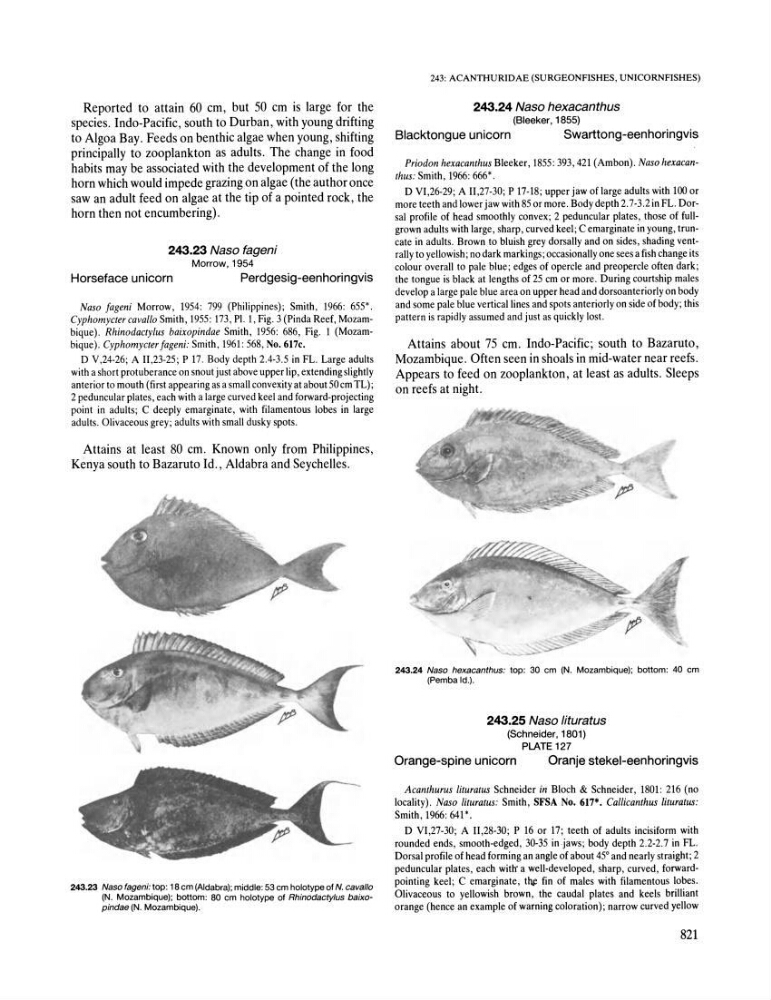
o V,24-26; A 11,23-25 ; P 17. Body depth 2.4-3 .5 in FL. Large adults
with a short protuberance on snout just above upper lip, extending slightly
anterior to mouth (first appearing as a small convexity at about 50 cm TL);
2 peduncular plates , each with a large curved keel and forward-projecting
point in adults ; C deeply emarginate , with filamentous lobes in large
adults. Olivaceous grey; adults with small dusky spots.
Attains at least 80 cm. Known only from Philippines,
Kenya south to Bazaruto Id. , Aldabra and Seychelles.
243.23 Naso fageni: top: 18 em (Aldabra); middle: 53 em holotype of N. cavallo
(N. Mozambique); bottom: 80 em holotype of Rhinodactylus baixopindae (N. Mozambique).
243: ACANTHURIDAE (SURGEONFISHES, UNICORNFISHES)
243.24 Nasa hexacanthus
(Bleeker, 1855)
Blacktongue unicorn
Swarttong-eenhoringvis
Priodon hexacanth us Bleeker, 1855: 393 , 421 (Ambon). Naso hexacanthus: Smith , 1966: 666*.
o VI ,26-29 ; A 11,27-30; P 17-18; upper jaw of large adults with 100 or
more teeth and lower jaw with 85 or more . Body depth 2.7-3.2in FL. Dorsal profile of head smoothly convex; 2 peduncular plates, those of fullgrown adults with large, sharp, curved keel; C emarginate in young, truncate in adults. Brown to bluish grey dorsally and on sides, shading ventrally to yellowish; no dark markings ; occasionally one sees a fish change its
colour overall to pale blue ; edges of opercle and preopercle often dark ;
the tongue is black at lengths of 25 cm or more. During courtship males
develop a large pale blue area on upper head and dorsoanteriorly on body
and some pale blue vertical lines and spots anteriorly on side of body; this
pattern is rapidly assumed and just as quickly lost.
Attains about 75 cm . Indo-Pacific; south to Bazaruto,
Mozambique. Often seen in shoals in mid-water near reefs.
Appears to feed on zooplankton, at least as adults. Sleeps
on reefs at night.
243.24 Naso hexacanthus: top: 30 em (N. Mozambique); bottom: 40 em
(Pemba Id.).
243.25 Nasa lituratus
(Schneider, 1801)
PLATE 127
Orange-spine unicorn
Oranje stekel-eenhoringvis
Acanthurus lituratus Schneider in Bloch & Schneider, 1801 : 216 (no
locality) . Naso lituratus: Smith, SFSA No. 617*. Callicanthus lituratus:
Smith , 1966: 641*.
o VI,27-30; A 11,28-30; P 16 or 17; teeth of adults incisiform with
rounded ends, smooth-edged, 30-35 in jaws; body depth 2.2-2.7 in FL.
Dorsal profIle of head forming an angle of about 45° and nearly straight; 2
peduncular plates, each witlr a well-developed, sharp, curved, forwardpointing keel; C emarginate. t~ fin of males with filamentous lobes.
Olivaceous to yellowish brown. the caudal plates and keels brilliant
orange (hence an example of warning coloration) ; narrow curved yellow
821