

243: ACANTHURIDAE (SURGEONFISHES, UNICORNFISHES)
647, Figs. 12A, B (on Naso brachycentron (non Valenciennes): Herre,
1927: 448, PI. 5, Fig. 2 (Bennett Id., Philippines)).
o V,28-29; A 11,27-28; P 17-19. Body depth 2.8-3.3 in FL. Adults with a
long tapering bony horn anterior to eye which can project as much as a
head length anterior to mouth (precursor of horn indicated by the bump
anterior to eye of the 235 mm specimen illustrated); dorsal profile of snout
to base of horn about 60°; 2 peduncular plates, each developing a knifelike keel in adults; C truncate in subadults, scalloped with a long trailing
filament from each corner in large adults. Olivaceous to brown, paler
ventrally, without dark markings on head or body; subadult's C with a distinct white, submarginally black, hind edge; adults with C rays black, narrow membranes and C filaments white; P with a white distal margin.
Juveniles reported to have a whitish ring around C peduncle.
A large species; attains at least 100 cm. Indo-Pacific,
south to Natal. Although juveniles and subadults may be
seen in shallow water, the large adults are rarely encountered in less than 25 m.
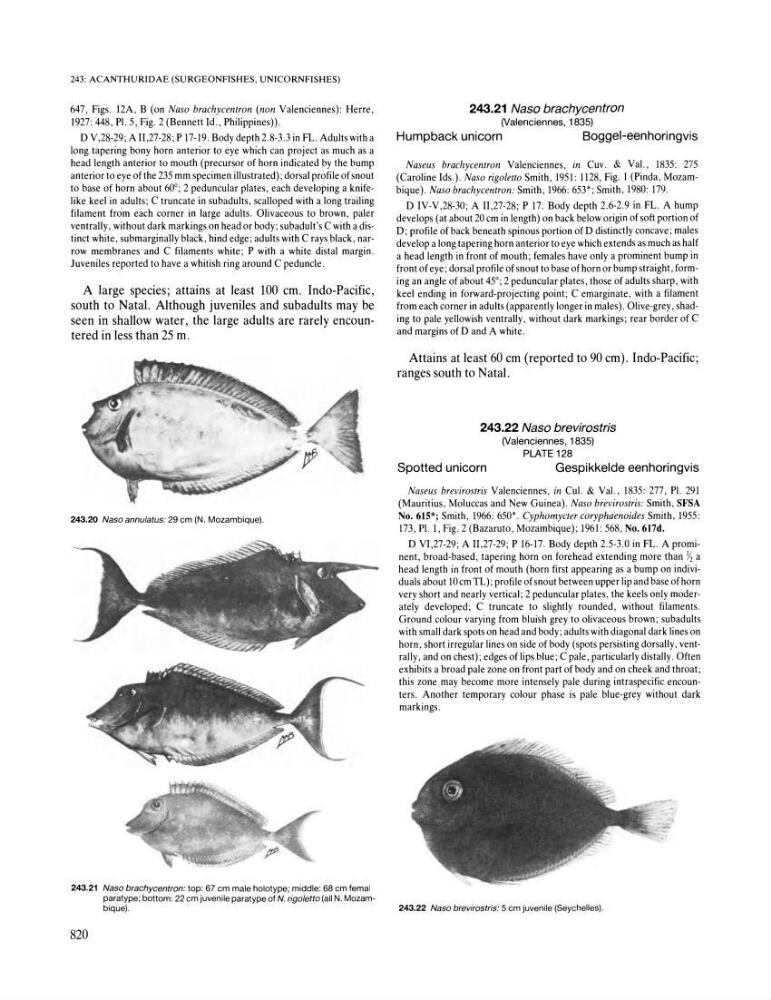
243.20 Nasa annu/atus: 29 em (N. Mozambique).
243.21 Nasa brachycentron: top: 67 em male holotype; middle: 68 em femal
paratype; bottom: 22 em juvenile paratype of N. riga/etta (all N. Mozambique).
820
243.21 Nasa brachycentron
(Valenciennes, 1835)
Humpback unicorn
Baggel-eenhoringvis
Naseus brachycentran Valenciennes, in Cuv. & Val., 1835: 275
(Caroline Ids.). Nasa rigaietta Smith, 1951: 1128, Fig. 1 (Pinda, Mozambique). Naso brachycentran: Smith, 1966: 653*; Smith, 1980: l79.
o IV-V,28-30; A 11,27-28; P 17. Body depth 2.6-2.9 in FL. A hump
develops (at about 20 cm in length) on back below origin of soft portion of
0; profile of back beneath spinous portion of 0 distinctly concave; males
develop a long tapering horn anterior to eye which extends as much as half
a head length in front of mouth; females have only a prominent bump in
front of eye; dorsal profile of snout to base of horn or bump straight, forming an angle of about 45°; 2 peduncular plates, those of adults sharp, with
keel ending in forward-projecting point; C emarginate, with a filament
from each corner in adults (apparently longer in males). Olive-grey, shading to pale yellowish ventrally, without dark markings; rear border of C
and margins of 0 and A white.
Attains at least 60 em (reported to 90 em). Indo-Pacific;
ranges south to Natal.
243.22 Nasa brevirastris
(Valenciennes, 1835)
PLATE 128
Spotted unicorn
Gespikkelde eenhoringvis
Naseus brevirostris Valenciennes, in CuI. & Val., 1835: 277, PI. 291
(Mauritius, Moluccas and New Guinea). Naso brevirostris: Smith, SFSA
No. 615*; Smith, 1966: 650* Cyphomycter coryphaenoides Smith, 1955:
173, PI. 1, Fig. 2 (Bazaruto, Mozambique); 1961: 568, No. 617d.
o VI,27-29; A 11,27-29; P 16-l7. Body depth 2.5-3.0 in FL. A prominent, broad-based, tapering horn on forehead extending more than ~ a
head length in front of mouth (horn first appearing as a bump on individuals about 10 cm TL); profile of snout between upper lip and base of horn
very short and nearly vertical; 2 peduncular plates, the keels only moderately developed; C truncate to slightly rounded, without filaments.
Ground colour varying from bluish grey to olivaceous brown; subadults
with small dark spots on head and body; adults with diagonal dark lines on
horn, short irregular lines on side of body (spots persisting dorsally, ventrally, and on chest); edges of lips blue; C pale, particularly distally. Often
exhibits a broad pale zone on front part of body and on cheek and throat;
this zone may become more intensely pale during intraspecific encounters. Another temporary colour phase is pale blue-grey without dark
markings.
243.22 Nasa brevirastris: 5 em juvenile (Seychelles).