

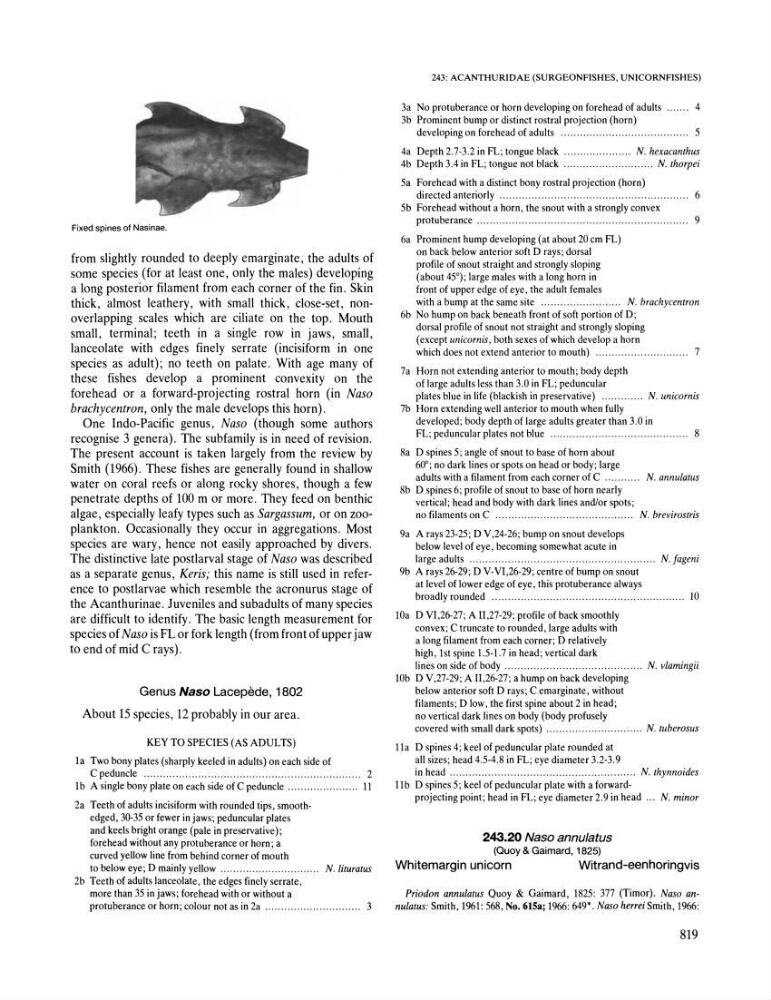
Fixed spines of Nasinae.
from slightly rounded to deeply emarginate, the adults of
some species (for at least one, only the males) developing
a long posterior filament from each corner of the fin. Skin
thick, almost leathery, with small thick, close-set, nonoverlapping scales which are ciliate on the top. Mouth
small, terminal; teeth in a single row in jaws, small,
lanceolate with edges finely serrate (incisiform in one
species as adult); no teeth on palate. With age many of
these fishes develop a prominent convexity on the
forehead or a forward-projecting rostral horn (in Nasa
brachycentran, only the male develops this horn).
One Indo-Pacific genus, Nasa (though some authors
recognise 3 genera). The subfamily is in need of revision.
The present account is taken largely from the review by
Smith (1966). These fishes are generally found in shallow
water on coral reefs or along rocky shores, though a few
penetrate depths of 100 m or more. They feed on benthic
algae, especially leafy types such as Sargassum, or on zooplankton. Occasionally they occur in aggregations. Most
species are wary, hence not easily approached by divers.
The distinctive late postlarval stage of Nasa was described
as a separate genus, Keris; this name is still used in reference to postlarvae which resemble the acronurus stage of
the Acanthurinae. Juveniles and subadults of many species
are difficult to identify. The basic length measurement for
species of Nasa is FL or fork length (from front of upper jaw
to end of mid Crays).
Genus Naso Lacepede, 1802
About 15 species, 12 probably in our area.
KEY TO SPECIES (AS ADULTS)
1a Two bony plates (sharply keeled in adults) on each side of
C peduncle ..... " ... " . . . . . . . . .. . . . .. . . . . . .. .. . . . . . .. . . . .. . . . . . . . . . . . . . .. . . . .. 2
1 b A single bony plate on each side of C peduncle ...................... 11
2a Teeth of adults incisiform with rounded tips, smoothedged, 30-35 or fewer in jaws; peduncular plates
and keels bright orange (pale in preservative);
forehead without any protuberance or horn; a
curved yellow line from behind corner of mouth
to below eye; D mainly yellow ............................... N. lituratus
2b Teeth of adults lanceolate, the edges finely serrate,
more than 35 in jaws; forehead with or without a
protuberance or horn; colour not as in 2a .............................. 3
243: ACANTHURIDAE (SURGEONFISHES, UNICORNFISHES)
3a No protuberance or horn developing on forehead of adults ....... 4
3b Prominent bump or distinct rostral projection (horn)
developing on forehead of adults ........................................ 5
4a Depth 2.7-3.2 in FL; tongue black ..................... N. hexacanthus
4b Depth 3.4 in FL; tongue not black ............................ N. thorpei
5a Forehead with a distinct bony rostral projection (horn)
directed anteriorly ........................................................... 6
5b Forehead without a horn, the snout with a strongly convex
protuberance .................................................................. 9
6a Prominent hump developing (at about 20 cm FL)
on back below anterior soft D rays; dorsal
profile of snout straight and strongly sloping
(about 45°); large males with a long horn in
front of upper edge of eye, the adult females
with a bump at the same site ......................... N. brachycentron
6b No hump on back beneath front of soft portion of D;
dorsal profile of snout not straight and strongly sloping
(except unicornis, both sexes of which develop a horn
which does not extend anterior to mouth) ............................. 7
7a Horn not extending anterior to mouth; body depth
of large adults less than 3.0 in FL; peduncular
plates blue in life (blackish in preservative) ............. N. unicornis
7b Horn extending well anterior to mouth when fully
developed; body depth of large adults greater than 3.0 in
FL; peduncular plates not blue ........................................... 8
8a D spines 5; angle of snout to base of horn about
60°; no dark lines or spots on head or body; large
adults with a filament from each corner of C ........... N. annulatus
8b D spines 6; profile of snout to base of horn nearly
vertical; head and body with dark lines and/or spots;
no filaments on C ........................................... N. brevirostris
9a A rays 23-25; D V,24-26; bump on snout develops
below level of eye, becoming somewhat acute in
large adults .......................................................... N. fageni
9b A rays 26-29; D V-VI,26-29; centre of bump on snout
at level of lower edge of eye, this protuberance always
broadly rounded ............................................................ 10
lOa D VI,26-27; A II,27-29; profile of back smoothly
convex; C truncate to rounded, large adults with
a long filament from each corner; D relatively
high, 1st spine 1.5-1.7 in head; vertical dark
lines on side of body ........................................... N. vlamingii
lOb D V,27-29; A II,26-27; a hump on back developing
below anterior soft Drays; C emarginate, without
filaments; D low, the first spine about 2 in head;
no vertical dark lines on body (body profusely
covered with small dark spots) .............................. N. tuberosus
11a D spines 4; keel of peduncular plate rounded at
all sizes; head 4.5-4.8 in FL; eye diameter 3.2-3.9
in head .......................................................... N. thynnoides
11 b D spines 5; keel of peduncular plate with a forwardprojecting point; head in FL; eye diameter 2.9 in head ... N. minor
243.20 Nasa annulatus
(Quoy & Gaimard, 1825)
Whitemargin unicorn
Witrand-eenhoringvis
Priodon annulatus Quoy & Gaimard, 1825: 377 (Timor). Naso annulatus: Smith, 1961: 568, No. 615a; 1966: 649*. Naso herrei Smith, 1966:
819