

243: ACANTHURIDAE (SURGEONFISHES, UNICORNFISHES)
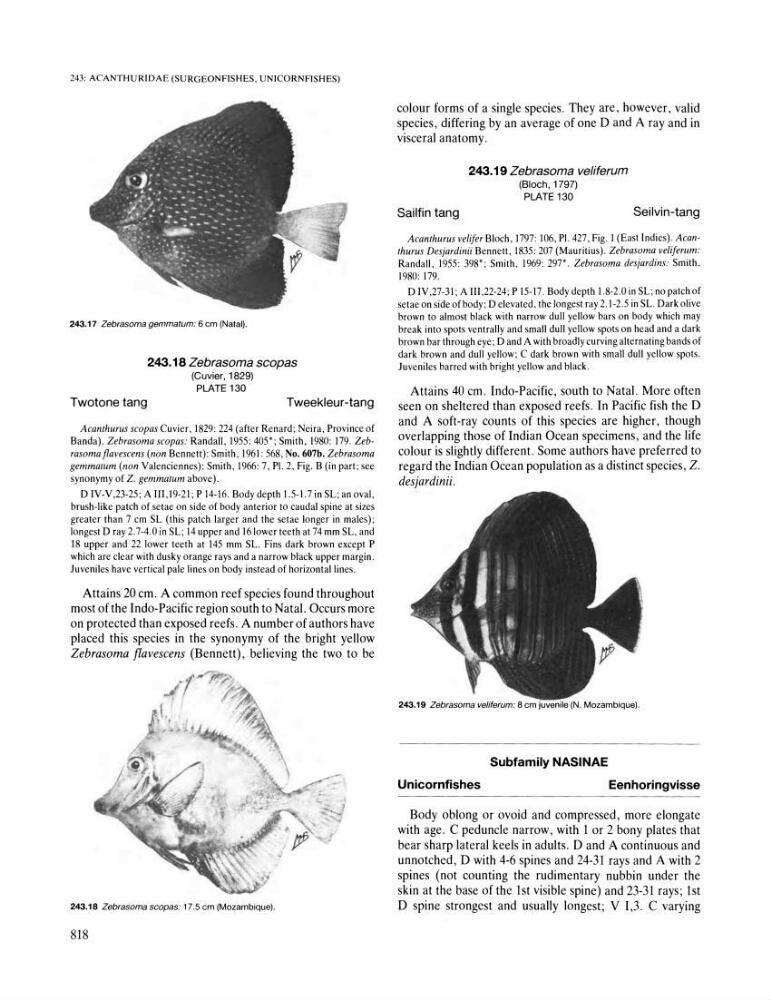
243.17 Zebrasoma gemma tum: 6 em (Natal).
Twotone tang
243.18 Zebrasoma scopas
(Cuvier, 1829)
PLATE 130
Tweekleur-tang
Acanthurus scopas Cuvier, 1829: 224 (after Renard; Neira, Province of
Banda). Zebrasoma scopas: Randall, 1955: 405*; Smith, 1980: 179. Zebrasoma flavescens (non Bennett): Smith, 1961: 568, No. 607b. Zebrasoma
gemmatum (non Valenciennes): Smith, 1966: 7, PI. 2, Fig. B (in part; see
synonymy of Z. gemmatum above).
D IV-V,23-25; A III,19-21; P 14-16. Body depth 1.5-1.7 in SL; an oval,
brush-like patch of setae on side of body anterior to caudal spine at sizes
greater than 7 em SL (this patch larger and the setae longer in males);
longest Dray 2.7-4.0 in SL; 14 upper and 16 lower teeth at 74 mm SL, and
18 upper and 22 lower teeth at 145 mm SL. Fins dark brown except P
which are clear with dusky orange rays and a narrow black upper margin.
Juveniles have vertical pale lines on body instead of horizontal lines.
Attains 20 cm. A common reef species found throughout
most of the Indo-Pacific region south to Natal. Occurs more
on protected than exposed reefs. A number of authors have
placed this species in the synonymy of the bright yellow
Zebrasoma flavescens (Bennett), believing the two to be
243.18 Zebrasoma scopas: 17.5 em (Mozambique).
818
colour forms of a single species. They are, however, valid
species, differing by an average of one D and A ray and in
visceral anatomy,
Sailfin tang
243.19 Zebrasoma veliferum
(Bloch, 1797)
PLATE 130
Seilvin-tang
Acanthurus veliferBloch, 1797: 106, PI. 427, Fig. 1 (East Indies). Acanthurus Desjardinii Bennett, 1835: 207 (Mauritius). Zebrasoma veliferum:
Randall, 1955: 398*; Smith, 1969: 297*. Zebrasoma desjardins: Smith,
1980: 179.
D IV ,27-31; A I1I,22-24; P 15-17. Body depth 1.8-2.0 in SL; no patch of
setae on side of body; D elevated, the longest ray 2.1-2.5 in SL. Dark olive
brown to almost black with narrow dull yellow bars on body which may
break into spots ventrally and small dull yellow spots on head and a dark
brown bar through eye; D and A with broadly curving alternating bands of
dark brown and dull yellow; C dark brown with small dull yellow spots.
Juveniles barred with bright yellow and black.
Attains 40 cm. Indo-Pacific, south to Natal. More often
seen on sheltered than exposed reefs. In Pacific fish the D
and A soft-ray counts of this species are higher, though
overlapping those of Indian Ocean specimens, and the life
colour is slightly different. Some authors have preferred to
regard the Indian Ocean population as a distinct species, Z.
desjardinii.
243.19 Zebrasoma veliferum: 8 em juvenile (N. Mozambique).
Subfamily NASINAE
Unicornfishes
Eenhoringvisse
Body oblong or ovoid and compressed, more elongate
with age. C peduncle narrow, with 1 or 2 bony plates that
bear sharp lateral keels in adults. D and A continuous and
unnotched, D with 4-6 spines and 24-31 rays and A with 2
spines (not counting the rudimentary nubbin under the
skin at the base of the 1st visible spine) and 23-31 rays; 1st
D spine strongest and usually longest; V 1,3. C varying