

240: GOBIIDAE (GOBlES)
Genus Ptereleotris Gill, 1863
Head strongly compressed; scales minute; V separate 1,4;
head pore pattern Type B; papillae pattern reduced, often
not visible; chin with longitudinal fold, sometimes with barbel; gill opening extends to below rear preopercular margin; scales cycloid; 2nd 0 1,24-37; A 1,23-36; P 20-24; V 1,4;
LS about 100-150. Vertebrae 26. Easily confused with
Nemateleotris, which has ctenoid scales posteriorly, VI,S
and a higher 1st D. Tropical and subtropical species normally found around coral or rocky reefs, sometimes
trawled. About 15 species, 3 in our area.
KEY TO SPECIES
la Chin with enlarged barbel: 0 VI + 1,37 ...... .... ......... P. lineopinnis
Ib Chin without barbels; 0 VI + 1,23-29 ...... ... ............................ 2
2a Body pale; C black centrally ....................... ....... .. P. heteroptera
2b Rear part of body darker than front part and head;
C clear centrally; juveniles uniformly coloured,
but with black spot ventrally on C peduncle ........ . ..... .... P. evides
Scissortail
240.88 Ptereleotris evides
(Jordan & Hubbs, 1925)
PLATE 125
Skerstert
Encaeura evides Jordan & Hubbs, 1925: 303, PI. 11, Fig. 2 (Japan).
Ptereleotris tricolor Smith, 1956: 817, Fig. 1 (Waimizi Id., Mozambique);
1958: 155* .
o VI+I,23-25; A 1,23-25; P 22-23; GR (6-7)+(\9-21).
Attains 12 cm. Adults generally swim together in pairs
about coral heads. Red Sea and tropical Indo-West Pacific,
south to Natal.
240.89 Ptereleotris heteroptera
(Bleeker, 1855)
PLATE 126
Blacktail goby
Swartstert-dikkop
Eleotris heteropterus Bleeker, 1855: 422 (Bandjermasin); Smith, 1980:
183.
o VI+ I ,27-32; A 1,24-30; P 20-26.
Attains 14 cm. Indo-Pacific, south to Natal.
Sad glider
240.90 Ptereleotris lineopinnis
(Fowler, 1935)
PLATE 125
Treurige swerwer
Laccoeleotris lilleopinnis Fowler, 1935: 403, Fig. 35 (Umzumbi, Natal);
Smith, SFSA No. 944*; 1958: 154*.
o VI + 1,37; A 1,36; P 21; GR 5+ 15.
802
Known only from the 11.5 cm holotype taken from the
stomach of a flounder caught at 90 m.
Genus Redigobius Herre, 1927
Head compressed; head pore pattern Type B; anterior
nasal pore absent; head papillae pattern longitudinal; large
ctenoid scales; gill opening extends to below mid-operculum; V form disc. Males often with very large mouth. 0
VI+I,6-8; A 1,4-7; P 16-19; LS 20-30. Vertebrae (11-12)+
(14-15)=26. Juveniles easily confused with Pandaka, which
lacks 2nd 0 and A spines and has a broader interorbital.
Sometimes confused with Mugilogobius, which lacks pores,
has a broad interorbital and depressed head. Can also be
confused with the extralimital Pseudogobius, which has a
small inferior or subinferior mouth. Tropical and subtropical species found in freshwater, mangroves and sea grass
beds. Numerous species, 3 in our area.
KEY TO SPECIES
1a One distinct bar below 1st 0; dark band from
eye to lower part of operculum; tip of 1st 0 black ...... R. balteatops
1 b One or more vertical bars or none on body; no
oblique band from rear of eye; black spot basally on 1st 0 .......... 2
2a Black blotch on each side of urogenital papilla;
PO 6-8; cycloid on midline, anteriormost scale
distinctly enlarged ........... ............. ... ....... ............ R. bikolanus
2b No black blotch at sides of urogenital papilla;
PO 9-11; usually ctenoid on midline, becoming
cycloid in large males, anteriormost scale
not distinctly enlarged .................................. ... ....... R. dewaali
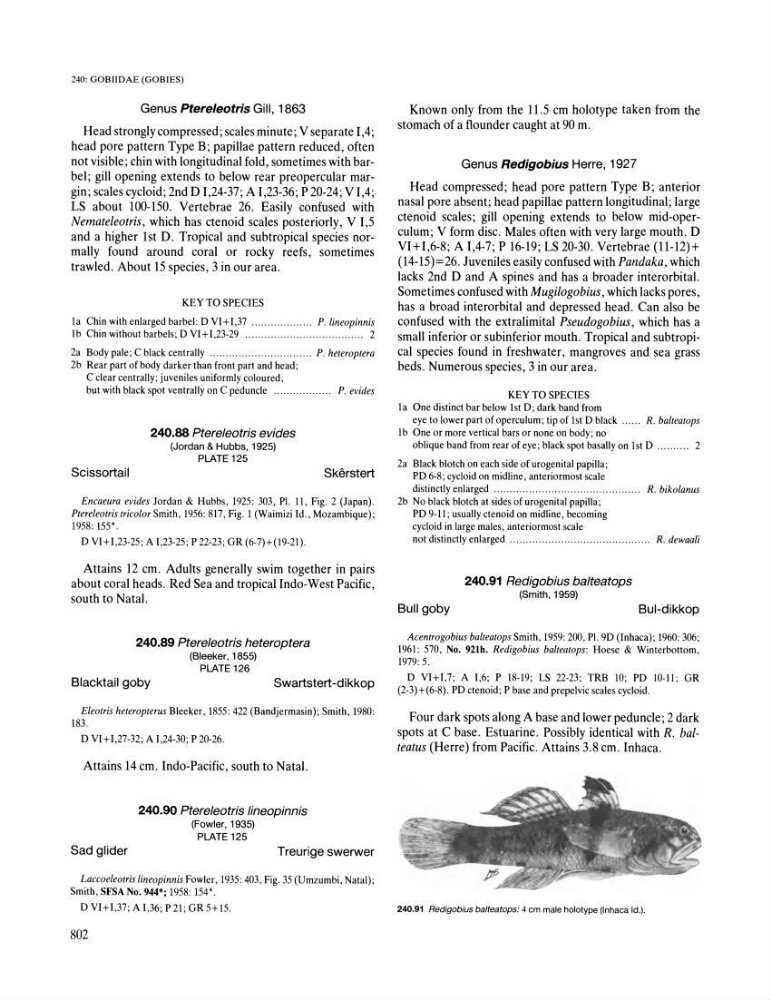
240.91 Redigobius balteatops
(Smith, 1959)
Bull goby
Bul-dikkop
Acentrogobius balteatops Smith, 1959: 200, PI. 90 (Inhaca); 1960: 306;
1961: 570, No. 92th. Redigobius balteatops: Hoese & Winterbottom,
1979: 5.
o VI+I,7; A 1,6; P 18-19; LS 22-23; TRB 10; PO 10-11; GR
(2-3)+(6-8). PO ctenoid; P base and prepelvic scales cycloid.
Four dark spots along A base and lower peduncle; 2 dark
spots at C base. Estuarine. Possibly identical with R. balteatus (Herre) from Pacific. Attains 3.8 cm. Inhaca.
240.91 Redigobius balteatops: 4 em male holotype (Inhaea Id.).