

240.92 Redigobius biko/anus
(Herre, 1927)
Bigmouth goby
Grootbek-dikkop
Vaimosa bikolana Herre, 1927: 151, PI. 11, Fig. 2 (Luzon, Philippines).
Stigmatogobius versicolor Smith, 1959: 197, Fig. 12 (Mahe, Seychelles).
Redigobius bikolanus: Akihito & Meguro , 1975: 49*.
D VI+I,7; A 1,6; P 15-17; LS 21-23; TRB 7-8; PD 6-8 ; GR (1-2)+(4-6).
P base and prepelvic scales cycloid. Males with mouth reaching well behind eye, females with mouth to under mid-eye.
Two or 3 dark spots at C base. Freshwater and estuarine.
Attains 3 cm. Indo-Pacific, south to Coffee Bay.
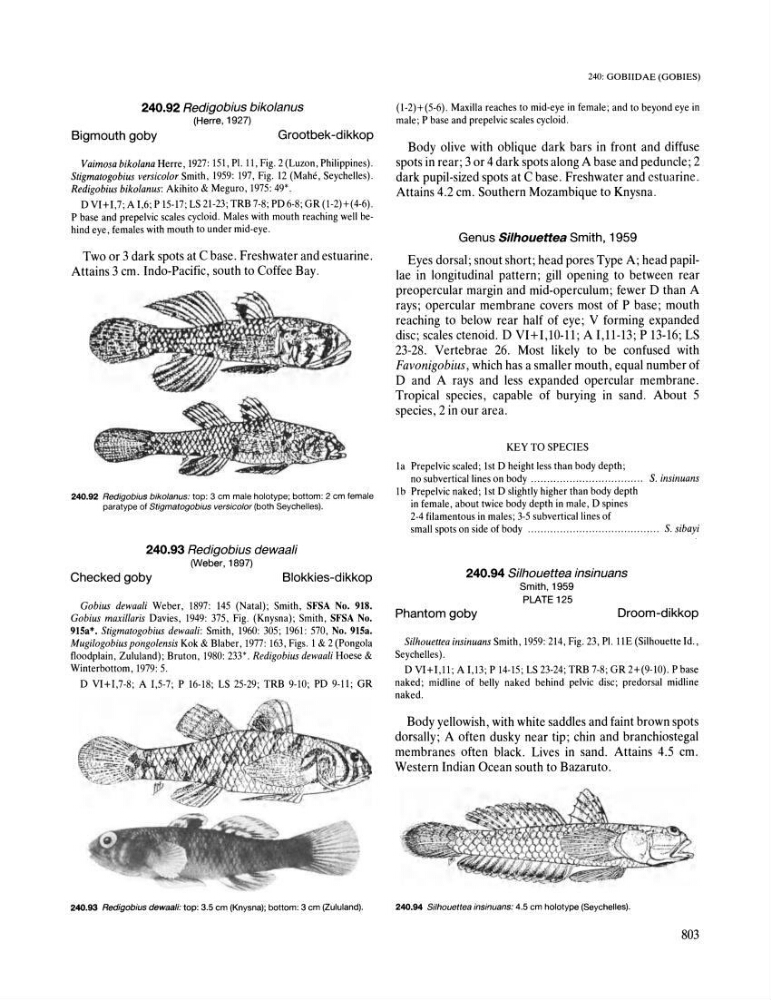
240.92 Redigobius bikolanus: top: 3 cm male holotype; bottom: 2 cm female
paratype of Stigmatogobius versicolor (both Seychelles).
240.93 Redigobius dewaali
(Weber, 1897)
Checked goby
Blokkies-dikkop
Gobius dewaali Weber, 1897: 145 (Natal); Smith, SFSA No. 918.
Gobius maxillaris Davies, 1949: 375, Fig. (Knysna) ; Smith , SFSA No.
915a*. Stigmatogobius dewaali: Smith, 1960: 305; 1961: 570, No. 915a.
Mugilogobius pongolensis Kok & Blaber, 1977: 163 , Figs. 1 & 2 (Pongola
floodplain , Zululand); Bruton , 1980: 233*. Redigobius dewaali Hoese &
Winterbottom , 1979: 5.
D VI+I,7-8; A 1,5-7; P 16-18; LS 25-29; TRB 9-10; PD 9-11; GR
240.93 Redigobius dewaali: top: 3.5 cm (Knysna); bottom: 3 em (Zululand).
240: GOBIIDAE (GOBlES)
(1-2)+(5-6). Maxilla reaches to mid-eye in female; and to beyond eye in
male; P base and prepelvic scales cycloid.
Body olive with oblique dark bars in front and diffuse
spots in rear; 3 or 4 dark spots along A base and peduncle; 2
dark pupil-sized spots at C base . Freshwater and estuarine .
Attains 4.2 cm. Southern Mozambique to Knysna.
Genus Silhouettea Smith, 1959
Eyes dorsal; snout short; head pores Type A; head papillae in longitudinal pattern; gill opening to between rear
preopercular margin and mid-operculum; fewer D than A
rays; opercular membrane covers most of P base; mouth
reaching to below rear half of eye; V forming expanded
disc; scales ctenoid. D VI+I,lO-l1 ; A 1,11-13; P 13-16; LS
23-28. Vertebrae 26. Most likely to be confused with
Favonigobius, which has a smaller mouth, equal number of
D and A rays and less expanded opercular membrane.
Tropical species, capable of burying in sand. About 5
species, 2 in our area.
KEY TO SPECIES
1a Prepelvic scaled; 1st D height less than body depth;
no subverticallines on body ................... ... .. .......... . S. insinuans
1 b Prepelvic naked; 1st D slightly higher than body depth
in female , about twice body depth in male, D spines
2-4 filamentous in males ; 3-5 subverticallines of
small spots on side of body ............ ... ................. ... ...... S. sibayi
240.94 Silhouettea insinuans
Smith,1959
PLATE 125
Phantom goby
Droom-dikkop
Silhouettea insinuans Smith , 1959: 214, Fig. 23 , PI. lIE (Silhouette Id. ,
Seychelles) .
D VI+I ,l1 ; A 1,13; P 14-15; LS 23-24; TRB 7-8; GR 2+(9-10) . P base
naked; midline of belly naked behind pelvic disc; predorsal midline
naked.
Body yellowish, with white saddles and faint brown spots
dorsally ; A often dusky near tip; chin and branchiostegal
membranes often black. Lives in sand. Attains 4.5 cm.
Western Indian Ocean south to Bazaruto.
240.94 Silhouettea insinuans: 4.5 em holotype (Seychelles).
803