

240.83 Pleurosicya sp. 1
D VI+I,8 (rarely 7); A 1,8; P 14-16; LS 24-31; TRB 7-9; GR 2+4
(rudimentary). Lower l -4 of 1st gill arch bound to gill cover by membrane.
Gill opening restricted to P base. Pre dorsal naked.
Found on Acropora. Attains 2.2 cm. Sodwana Bay,
Seychelles, Chagos Archipelago, tropical Indian Ocean and
western tropical Pacific.
Genus Prio/epis Ehrenberg, 1837
Gill opening extending to below rear preopercular margin; head broad; outer teeth of upper jaw widely spaced;
lower jaw truncate when viewed from below; V united; V
frenum rarely present; head pores absent; sensory papillae
reduced to a transverse pattern; scales ctenoid, large. Second D 1,9-11; A 1,7-9; P 16-21; LS 23-32. Vertebrae 26. Easily confused with Trimma, which has a broader gill opening
and the extralimital Lubricogobius, which has few or no
scales. A tropical and subtropical genus found on coral or
rocky reefs. About 15 species, 3 in our area.
KEY TO SPECIES
la Predorsal and operculum naked; transverse
bands on head connected by horizontal stripe
above preoperculum and operculum; D VI + 1,8 ................. P. sp.
Ib Pre dorsal scaled to eyes; operculum usually scaled
dorsally; transverse bands on head not connected
by horizontal stripe; D VI +I, 10-11 ....................................... 2
2a Body with 7 dark bars; P 17-19; size to 6 cm ................... P. cincta
2b Body without bars or at most 1 or 2 anteriorly;
P 15-17; size to 4 cm ................................................. P. inhaca
240.84 Priolepis cincta
(Regan, 1908)
PLATE 124
Convict goby
Bandiet-dikkop
Gobiomorphus cinctus Regan, 1908: 240 (Chagos Archipelago).
Hetereleotris eugenius (non Jordan & Evermann): Smith, SFSA No. 935a*.
Quisquilius eugenius (non Jordan & Evermann): Smith, 1959: 210*; 1960:
305; 1961: 570, No. 935a. Quisquilius cinctus: Hoese & Winterbottom,
1979: 4.
D VI+I,11; A 1,9; P 17-19; LS 29-33; TRB 12-14; PD 15-20; GR
3+(11-13). V frenum absent.
Attains 6 cm. Indo-West Pacific, south to Natal.
Brick goby
240.85 Priolepis inhaca
(Smith, 1949)
PLATE 125
Baksteen-dikkop
Gobius inhaca Smith, 1949: 103 (Inhaca); SFSA No. 923a*. Quisquilius
inhaca: Smith, 1959: 210*; 1960: 305; 1961: 570, No. 923a.
D VI+I,9-1O; A 1,8; P 15-17; LS 25-28; TRB 9-11; PD 13-18; GR 2+
(9-10). V frenum absent.
240: GOBIIDAE (GOBlES)
Scale pockets edged in dark, forming network pattern.
Attains 4 cm. Indo-West Pacific, south to Inhaca.
240.86 Priolepis sp.
Sodwana goby
Sodwana-dikkop
Priolepis semidoliatus (non Valenciennes): Hoese & Winterbottom,
1979: 5.
D VI+ 1,8; A 1,7; P 18-19; LS 22; TRB 6. V frenum absent.
Attains 2.5 cm. Indo-West Pacific, south to Sodwana
Bay.
Genus Psammogobius Smith, 1936
Broad head; tongue tip notched; gill opening extends to
below eye, with a free fold across isthmus; head pores Type
A; papillae pattern longitudinal; V a disc; scales ctenoid.
Easily confused with Favonigobius, which has a narrow gill
opening and truncate tongue tip, and Glossogobius, which
has a longer snout and mouth. One species, known only
from South Africa.
240.87 Psammogobius knysnaensis
Smith,1936
PLATE 125
Knysna sandgoby
Knysna-sanddikkop
Psammogobius knysnaensis Smith, 1936: 215 (Knysna); SFSA No. 906*;
1960: 311 *; Smith & Smith, 1966: 105*; Hoese & Winterbottom, 1979: 5.
D VI+ 1,9-10; A 1,9-11; P 17-18; LS 27-30; TRB 7-8. Vertebrae 11+ 17.
Head, P base and midline of belly naked; a few prepelvic scales; predorsal
scaled to above rear of preopercie.
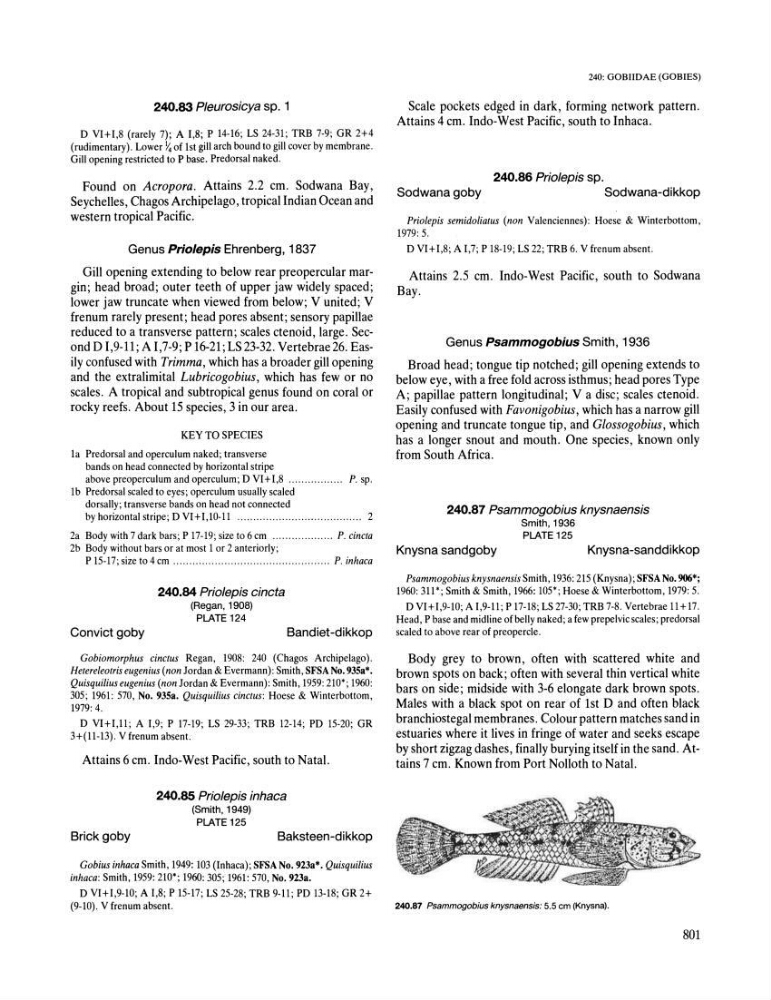
Body grey to brown, often with scattered white and
brown spots on back; often with several thin vertical white
bars on side; midside with 3-6 elongate dark brown spots.
Males with a black spot on rear of 1st D and often black
branchiostegal membranes. Colour pattern matches sand in
estuaries where it lives in fringe of water and seeks escape
by short zigzag dashes, finally burying itself in the sand. Attains 7 cm. Known from Port Nolloth to Natal.
240.87 Psammogobius knysnaensis: 5.5 em (Knysna).
801