

230: URANOSCOPIDAE (STARGAZERS)
D IV-V + 13; A 13-14; P 17-18; 52-56 oblique scale series from shoulder
spine to C base; 10 branched C rays. Depth 3.7-4.1, head 2.8-2.9 in SL.
Eye 4-5 in head, subequal to interorbital width. Anterior nostril tubular;
4-6 spines along lower edge of preopercle; 2 or 3 blunt preorbital spines.
Body grey or brown usually with numerous round pale
spots dorsally; 1st D black with pale border; P greyish with
pale margin; C uniform. Attains 33 cm. Taken by trawl in
60 - 300 m from Mossel Bay to Kenya; common in Mozambique Channel.
Family No. 231: TRICHONOTIDAE
by P.C. Heemstra
Sand divers
Sandduikers
Body very elongate, somewhat compressed, covered
with rather large cycloid scales. Lateral line continuous.
Dorsal fin begins over pectoral fin base and continues
almost to caudal fin; anal fin almost as long as dorsal; ventrals (1,5) well developed; 11 or 12 branched caudal rays.
Mouth large, terminal; lower jaw projecting; upper jaw
slightly protrusile; small sharp teeth on jaws, vomer and
palatines. Gill membranes separate, not joined to isthmus;
branchiostegal rays 7.
One genus, Trichonotus Bloch & Schneider, 1801, with 3
or 4 species, distinguished mainly by colour patterns; 1
species in our area.
Sand diver
231.1 Trichonotus marleyi
(Smith,1936)
PLATE 113
Sandduiker
Taeniolabrus marleyi Smith, 1936: 4, PI. 1 (Durban); Smith, SFSA No.
374*. Trichonotus marleyi: Clark & von Schmidt, 1966.
D 45-47; 1st 2 or 3 rays not articulated and more or less prolonged; A
37-39; P 14; LL 55-57; GR 6+(19-21). Body depth 12-13 in SL; head
length (from tip of snout) 5.0 in SL.
Colour: "Above amber, studded with turquoise blue and
red dots. The lower surface faint rosy. Anal and ventrals
with numerous dark red dots. Eye with about 20 golden
lines, umbrous red above" (H.W. Bell-Marley). Attains
19 cm. Known only from Durban to Delagoa Bay.
Family No. 232: CREEDIIDAE
by J.S. Nelson
Sand burrowers
Sandgrawers
Body elongate. Dorsal fin continuous. All fins except
pelvics without spines; dorsal, anal and pectoral rays
unbranched (except in 1 Australian species). Tip of snout
(upper lip) fleshy, projecting beyond lower jaw. Eyes dorsolateral, chameleon-like. Row of cirri along lower lip. Gill
membranes separate, free from isthmus; branchiostegal
rays 7. Gill-rakers low knobs, about 6-9 on lower limb,
covered with spinules. Lateral-line scales behind pectoral
fin with posterior extension, often trilobed. Vertebrae
37-59. Colour in life usually translucent to transparent; preserved specimens with dark saddle bars.
An Indo-West Pacific family of small cryptic fishes occurring on sand and gravel bottoms, from shore out to about
165 m. Rarely seen in life, these sand burrowing fishes can
be collected in considerable numbers using ichthyocides.
Seven genera with 14 species, 3 in our area. Reviewed by
Nelson (1978, 1979).
KEY TO GENERA
la V present; LL descending gradually at end of P ............... . ........ 2
Ib V absent; LL descending abruptly at end of P and
running near base of A ....................................... Apodocreedia
2a D and A each with 35 or more rays; V 1,4; body
naked anteriorly except for LL scales...................... Chalixodytes
2b D and A with 34 or fewer rays; V 1,5; body
fully scaled ........................................................ Limnichthys
Genus Apodocreedia de Beaufort, 1948
One species, endemic to southern Africa.
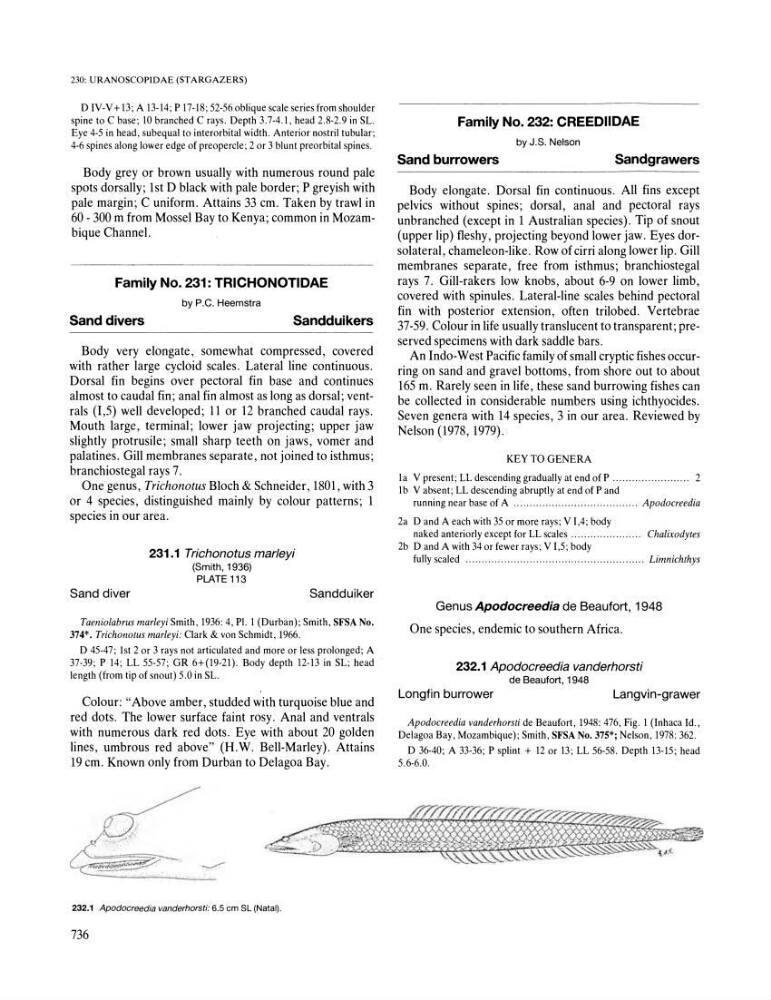
232.1 Apodocreedia vanderhorsti
de Beaufort, 1948
Longfin burrower
Langvin-grawer
Apodocreedia vanderhorsti de Beaufort, 1948: 476, Fig. 1 (lnhaca Id.,
Delagoa Bay, Mozambique); Smith, SFSA No. 375*; Nelson, 1978: 362.
D 36-40; A 33-36; P splint + 12 or 13; LL 56-58. Depth 13-15; head
5.6-6.0.
••. • • :.: • .;'~:T
"
•
•
""
•
..
. . . .
•
'.
' ."
• •
'
•
'"
: . - .
~.::=;;;::::
232.1 Apodocreedia vanderhorsti: 6.5 em SL (Natal).
736
D IV-V + 13; A 13-14; P 17-18; 52-56 oblique scale series from shoulder
spine to C base; 10 branched C rays. Depth 3.7-4.1, head 2.8-2.9 in SL.
Eye 4-5 in head, subequal to interorbital width. Anterior nostril tubular;
4-6 spines along lower edge of preopercle; 2 or 3 blunt preorbital spines.
Body grey or brown usually with numerous round pale
spots dorsally; 1st D black with pale border; P greyish with
pale margin; C uniform. Attains 33 cm. Taken by trawl in
60 - 300 m from Mossel Bay to Kenya; common in Mozambique Channel.
Family No. 231: TRICHONOTIDAE
by P.C. Heemstra
Sand divers
Sandduikers
Body very elongate, somewhat compressed, covered
with rather large cycloid scales. Lateral line continuous.
Dorsal fin begins over pectoral fin base and continues
almost to caudal fin; anal fin almost as long as dorsal; ventrals (1,5) well developed; 11 or 12 branched caudal rays.
Mouth large, terminal; lower jaw projecting; upper jaw
slightly protrusile; small sharp teeth on jaws, vomer and
palatines. Gill membranes separate, not joined to isthmus;
branchiostegal rays 7.
One genus, Trichonotus Bloch & Schneider, 1801, with 3
or 4 species, distinguished mainly by colour patterns; 1
species in our area.
Sand diver
231.1 Trichonotus marleyi
(Smith,1936)
PLATE 113
Sandduiker
Taeniolabrus marleyi Smith, 1936: 4, PI. 1 (Durban); Smith, SFSA No.
374*. Trichonotus marleyi: Clark & von Schmidt, 1966.
D 45-47; 1st 2 or 3 rays not articulated and more or less prolonged; A
37-39; P 14; LL 55-57; GR 6+(19-21). Body depth 12-13 in SL; head
length (from tip of snout) 5.0 in SL.
Colour: "Above amber, studded with turquoise blue and
red dots. The lower surface faint rosy. Anal and ventrals
with numerous dark red dots. Eye with about 20 golden
lines, umbrous red above" (H.W. Bell-Marley). Attains
19 cm. Known only from Durban to Delagoa Bay.
Family No. 232: CREEDIIDAE
by J.S. Nelson
Sand burrowers
Sandgrawers
Body elongate. Dorsal fin continuous. All fins except
pelvics without spines; dorsal, anal and pectoral rays
unbranched (except in 1 Australian species). Tip of snout
(upper lip) fleshy, projecting beyond lower jaw. Eyes dorsolateral, chameleon-like. Row of cirri along lower lip. Gill
membranes separate, free from isthmus; branchiostegal
rays 7. Gill-rakers low knobs, about 6-9 on lower limb,
covered with spinules. Lateral-line scales behind pectoral
fin with posterior extension, often trilobed. Vertebrae
37-59. Colour in life usually translucent to transparent; preserved specimens with dark saddle bars.
An Indo-West Pacific family of small cryptic fishes occurring on sand and gravel bottoms, from shore out to about
165 m. Rarely seen in life, these sand burrowing fishes can
be collected in considerable numbers using ichthyocides.
Seven genera with 14 species, 3 in our area. Reviewed by
Nelson (1978, 1979).
KEY TO GENERA
la V present; LL descending gradually at end of P ............... . ........ 2
Ib V absent; LL descending abruptly at end of P and
running near base of A ....................................... Apodocreedia
2a D and A each with 35 or more rays; V 1,4; body
naked anteriorly except for LL scales...................... Chalixodytes
2b D and A with 34 or fewer rays; V 1,5; body
fully scaled ........................................................ Limnichthys
Genus Apodocreedia de Beaufort, 1948
One species, endemic to southern Africa.
232.1 Apodocreedia vanderhorsti
de Beaufort, 1948
Longfin burrower
Langvin-grawer
Apodocreedia vanderhorsti de Beaufort, 1948: 476, Fig. 1 (lnhaca Id.,
Delagoa Bay, Mozambique); Smith, SFSA No. 375*; Nelson, 1978: 362.
D 36-40; A 33-36; P splint + 12 or 13; LL 56-58. Depth 13-15; head
5.6-6.0.
••. • • :.: • .;'~:T
"
•
•
""
•
..
. . . .
•
'.
' ."
• •
'
•
'"
: . - .
~.::=;;;::::
232.1 Apodocreedia vanderhorsti: 6.5 em SL (Natal).
736