

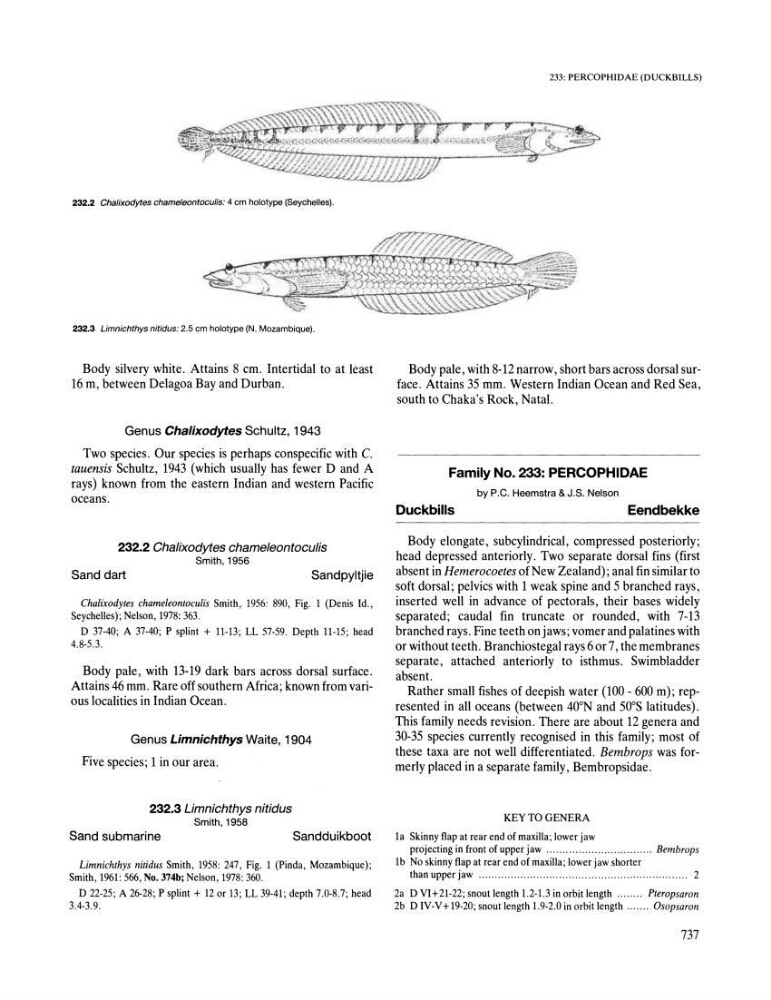
232.2 Chalixodytes ehameleontoeulis: 4 em holotype (Seychelles).
232.3 Limniehthys nitidus: 2.5 cm holotype (N. Mozambique).
Body silvery white. Attains 8 cm. Intertidal to at least
16 m, between Delagoa Bay and Durban.
Genus Cha/ixodytes Schultz, 1943
Two species. Our species is perhaps conspecific with C.
tauensis Schultz, 1943 (which usually has fewer D and A
rays) known from the eastern Indian and western Pacific
oceans.
232.2 Chalixodytes chameleontoculis
Smith,1956
Sand dart
Sandpyltjie
Chalixodytes chameleontoculis Smith, 1956: 890, Fig. 1 (Denis Id.,
Seychelles); Nelson, 1978: 363.
D 37-40; A 37-40; P splint + 11-13; LL 57-59. Depth 11-15; head
4.8-5.3.
Body pale, with 13-19 dark bars across dorsal surface.
Attains 46 mm. Rare off southern Africa; known from various localities in Indian Ocean.
Genus Limnichthys Waite, 1904
Five species; 1 in our area.
232.3 Limnichthys nitidus
Smith,1958
Sand submarine
Sandduikboot
Limnichthys nitidus Smith, 1958: 247, Fig. 1 (Pinda, Mozambique);
Smith, 1961: 566, No. 374b; Nelson, 1978: 360.
D 22-25; A 26-28; P splint + 12 or 13; LL 39-41; depth 7.0-8.7; head
3.4-3.9.
233: PERCOPHIDAE (DUCKBILLS)
Body pale, with 8-12 narrow, short bars across dorsal surface. Attains 35 mm. Western Indian Ocean and Red Sea,
south to Chaka's Rock, Natal.
Family No. 233: PERCOPHIDAE
by P.C. Heemstra & J.S. Nelson
Duckbills
Eendbekke
Body elongate, subcylindrical, compressed posteriorly;
head depressed anteriorly. Two separate dorsal fins (first
absent in Hemerocoetes of New Zealand); anal fin similar to
soft dorsal; pelvics with 1 weak spine and 5 branched rays,
inserted well in advance of pectorals, their bases widely
separated; caudal fin truncate or rounded, with 7-13
branched rays. Fine teeth on jaws; vomer and palatines with
or without teeth. Branchiostegal rays 6 or 7, the membranes
separate, attached anteriorly to isthmus. Swimbladder
absent.
Rather small fishes of deepish water (100 - 600 m); represented in all oceans (between 400N and 50 0 S latitudes).
This family needs revision. There are about 12 genera and
30-35 species currently recognised in this family; most of
these taxa are not well differentiated. Bembrops was formerly placed in a separate family, Bembropsidae.
KEY TO GENERA
la Skinny flap at rear end of maxilla; lower jaw
projecting in front of upper jaw ................................. Bembrops
Ib No skinny flap at rear end of maxilla; lower jaw shorter
than upper jaw ................................................................. 2
2a D VI+21-22; snout length 1.2-1.3 in orbit length ........ Pteropsaron
2b D IV-V + 19-20; snout length 1.9-2.0 in orbit length ....... Osopsaron
737
232.3 Limniehthys nitidus: 2.5 cm holotype (N. Mozambique).
Body silvery white. Attains 8 cm. Intertidal to at least
16 m, between Delagoa Bay and Durban.
Genus Cha/ixodytes Schultz, 1943
Two species. Our species is perhaps conspecific with C.
tauensis Schultz, 1943 (which usually has fewer D and A
rays) known from the eastern Indian and western Pacific
oceans.
232.2 Chalixodytes chameleontoculis
Smith,1956
Sand dart
Sandpyltjie
Chalixodytes chameleontoculis Smith, 1956: 890, Fig. 1 (Denis Id.,
Seychelles); Nelson, 1978: 363.
D 37-40; A 37-40; P splint + 11-13; LL 57-59. Depth 11-15; head
4.8-5.3.
Body pale, with 13-19 dark bars across dorsal surface.
Attains 46 mm. Rare off southern Africa; known from various localities in Indian Ocean.
Genus Limnichthys Waite, 1904
Five species; 1 in our area.
232.3 Limnichthys nitidus
Smith,1958
Sand submarine
Sandduikboot
Limnichthys nitidus Smith, 1958: 247, Fig. 1 (Pinda, Mozambique);
Smith, 1961: 566, No. 374b; Nelson, 1978: 360.
D 22-25; A 26-28; P splint + 12 or 13; LL 39-41; depth 7.0-8.7; head
3.4-3.9.
233: PERCOPHIDAE (DUCKBILLS)
Body pale, with 8-12 narrow, short bars across dorsal surface. Attains 35 mm. Western Indian Ocean and Red Sea,
south to Chaka's Rock, Natal.
Family No. 233: PERCOPHIDAE
by P.C. Heemstra & J.S. Nelson
Duckbills
Eendbekke
Body elongate, subcylindrical, compressed posteriorly;
head depressed anteriorly. Two separate dorsal fins (first
absent in Hemerocoetes of New Zealand); anal fin similar to
soft dorsal; pelvics with 1 weak spine and 5 branched rays,
inserted well in advance of pectorals, their bases widely
separated; caudal fin truncate or rounded, with 7-13
branched rays. Fine teeth on jaws; vomer and palatines with
or without teeth. Branchiostegal rays 6 or 7, the membranes
separate, attached anteriorly to isthmus. Swimbladder
absent.
Rather small fishes of deepish water (100 - 600 m); represented in all oceans (between 400N and 50 0 S latitudes).
This family needs revision. There are about 12 genera and
30-35 species currently recognised in this family; most of
these taxa are not well differentiated. Bembrops was formerly placed in a separate family, Bembropsidae.
KEY TO GENERA
la Skinny flap at rear end of maxilla; lower jaw
projecting in front of upper jaw ................................. Bembrops
Ib No skinny flap at rear end of maxilla; lower jaw shorter
than upper jaw ................................................................. 2
2a D VI+21-22; snout length 1.2-1.3 in orbit length ........ Pteropsaron
2b D IV-V + 19-20; snout length 1.9-2.0 in orbit length ....... Osopsaron
737