

Body brownish dorsally; lateral and ventral parts silvery.
Attains 14 cm. A widely distributed species reported from
India, Indonesia and the Philippines; from the Cape to Durban in fairly deep water (to 460 m). Occur in great shoals,
evidently rising to the surface at night; after storms, sometimes numbers are found still alive on the beach in the early
morning.
Family No. 230: URANOSCOPIDAE
by P.C. Heemstra
Stargazers
Opkykers
Body thick, compressed posteriorly, naked or with small
scales. Head massive, flattened dorsally with bones exposed. Mouth large, vertical; lower jaw heavy, projecting.
Upper jaw somewhat protrusible. Small teeth on jaws,
vomer and palatines. Gill membranes separate, not connected to isthmus; 6 branchiostegal rays. Pelvic fins on
isthmus, well in front of pectorals, with 1 short spine and 5
rays. Spinous dorsal fin small or absent (reduced to isolated
nubbins in Pleuroscopus) or continuous with soft -rayed part
of fin. Gill-rakers rudimentary.
Stargazers are benthic predators that often lie buried up
to their eyes in mud or sand waiting for their unsuspecting
prey to venture close enough to be caught with a swift lunge.
Some species have a long tentacle on inside of lower jaw
which can be made to wriggle like a worm to attract small
creatures which are then engulfed. Eight genera and about
25 species are currently recognised; 2 genera represented in
our area.
KEY TO GENERA
1a Eyes dorsal; spinous D present; scales cycloid,
in oblique series, none on belly ............................. Uranoscopus
1 b Eyes lateral; spinous D reduced to a series
of isolated nubbins before the soft D; body
completely covered with spiny, non-imbricate
scales .............................................................. Pleuroscopus
Genus Pleuroscopus Barnard, 1927
Scales spiny, thickened (rather like the denticles of some
sharks). Interorbital very broad, its width 2.4-2.6 times
orbit diameter. Supraorbital shelf with a bony knob-like
tubercle. Opercle not free above (gill openings not extending above P base), with a bony horizontal ridge. No spines
on preopercle or subopercle. LL obscure, running well
below Dbase. Monotypic.
230: URANOSCOPIDAE (STARGAZERS)
230.1 Pleuroscopus pseudodorsalis
Barnard, 1927
Spotted stargazer
Gespikkelde opkyker
Pleuroscopus pseudodorsalis Barnard, 1927: 437, PI. 18, Fig. 6 (off
Table Bay in about 200 fms); Smith, SFSA No. 379*.
D 9 or 10 (not counting a row of9 or 10 short conical tubercles in front of
fin); A 10 (mostly covered by skin and denticles); P 21-22; 18-20 low spiny
plates on 1st gill arch. One row of subequal cardiform teeth in lower jaw, 2
rows in upper jaw, and 1 row on palatines and vomer.
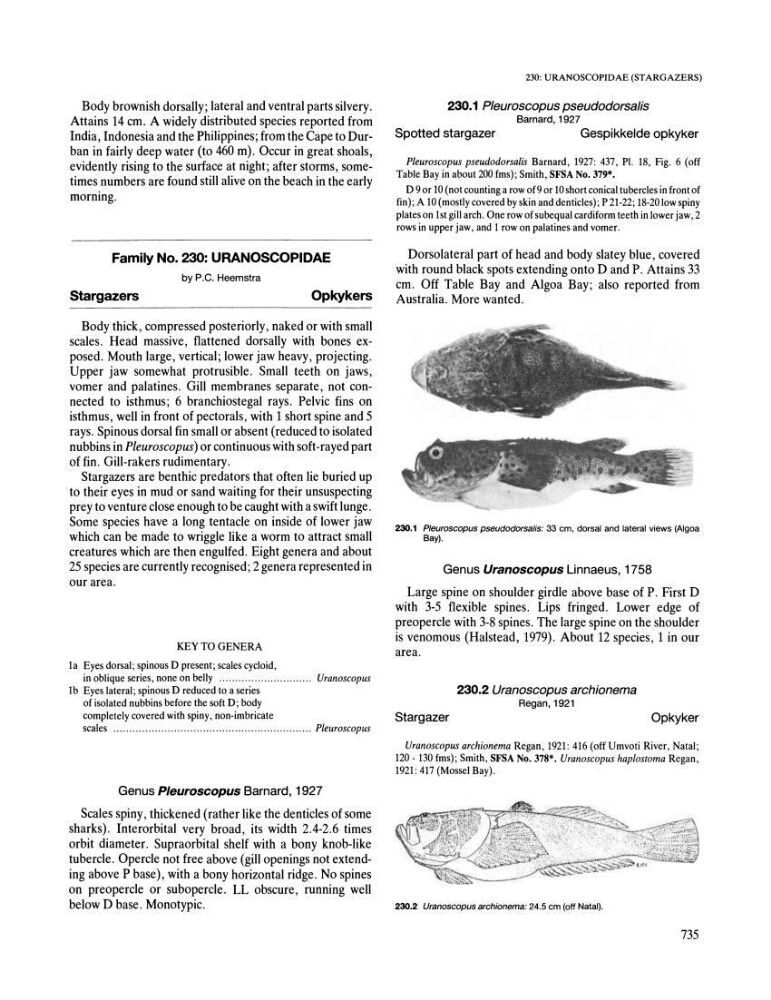
Dorsolateral part of head and body slatey blue, covered
with round black spots extending onto D and P. Attains 33
cm. Off Table Bay and Algoa Bay; also reported from
Australia. More wanted.
230.1 Pleuroscopus pseudodorsa/is: 33 em, dorsal and lateral views (Algoa
Bay).
Genus Uranoscopus Linnaeus, 1758
Large spine on shoulder girdle above base of P. First D
with 3-5 flexible spines. Lips fringed. Lower edge of
preopercle with 3-8 spines. The large spine on the shoulder
is venomous (Halstead, 1979). About 12 species, 1 in our
area.
230.2 Uranoscopus archionema
Regan, 1921
Stargazer
Opkyker
Uranoscopus archionema Regan, 1921: 416 (off Umvoti River, Natal;
120 - 130 fms); Smith, SFSA No. 378*. Uranoscopus haplostoma Regan,
1921: 417 (Mossel Bay).
230.2 Uranoscopus arehionema: 24.5 em (off Natal).
735
Attains 14 cm. A widely distributed species reported from
India, Indonesia and the Philippines; from the Cape to Durban in fairly deep water (to 460 m). Occur in great shoals,
evidently rising to the surface at night; after storms, sometimes numbers are found still alive on the beach in the early
morning.
Family No. 230: URANOSCOPIDAE
by P.C. Heemstra
Stargazers
Opkykers
Body thick, compressed posteriorly, naked or with small
scales. Head massive, flattened dorsally with bones exposed. Mouth large, vertical; lower jaw heavy, projecting.
Upper jaw somewhat protrusible. Small teeth on jaws,
vomer and palatines. Gill membranes separate, not connected to isthmus; 6 branchiostegal rays. Pelvic fins on
isthmus, well in front of pectorals, with 1 short spine and 5
rays. Spinous dorsal fin small or absent (reduced to isolated
nubbins in Pleuroscopus) or continuous with soft -rayed part
of fin. Gill-rakers rudimentary.
Stargazers are benthic predators that often lie buried up
to their eyes in mud or sand waiting for their unsuspecting
prey to venture close enough to be caught with a swift lunge.
Some species have a long tentacle on inside of lower jaw
which can be made to wriggle like a worm to attract small
creatures which are then engulfed. Eight genera and about
25 species are currently recognised; 2 genera represented in
our area.
KEY TO GENERA
1a Eyes dorsal; spinous D present; scales cycloid,
in oblique series, none on belly ............................. Uranoscopus
1 b Eyes lateral; spinous D reduced to a series
of isolated nubbins before the soft D; body
completely covered with spiny, non-imbricate
scales .............................................................. Pleuroscopus
Genus Pleuroscopus Barnard, 1927
Scales spiny, thickened (rather like the denticles of some
sharks). Interorbital very broad, its width 2.4-2.6 times
orbit diameter. Supraorbital shelf with a bony knob-like
tubercle. Opercle not free above (gill openings not extending above P base), with a bony horizontal ridge. No spines
on preopercle or subopercle. LL obscure, running well
below Dbase. Monotypic.
230: URANOSCOPIDAE (STARGAZERS)
230.1 Pleuroscopus pseudodorsalis
Barnard, 1927
Spotted stargazer
Gespikkelde opkyker
Pleuroscopus pseudodorsalis Barnard, 1927: 437, PI. 18, Fig. 6 (off
Table Bay in about 200 fms); Smith, SFSA No. 379*.
D 9 or 10 (not counting a row of9 or 10 short conical tubercles in front of
fin); A 10 (mostly covered by skin and denticles); P 21-22; 18-20 low spiny
plates on 1st gill arch. One row of subequal cardiform teeth in lower jaw, 2
rows in upper jaw, and 1 row on palatines and vomer.
Dorsolateral part of head and body slatey blue, covered
with round black spots extending onto D and P. Attains 33
cm. Off Table Bay and Algoa Bay; also reported from
Australia. More wanted.
230.1 Pleuroscopus pseudodorsa/is: 33 em, dorsal and lateral views (Algoa
Bay).
Genus Uranoscopus Linnaeus, 1758
Large spine on shoulder girdle above base of P. First D
with 3-5 flexible spines. Lips fringed. Lower edge of
preopercle with 3-8 spines. The large spine on the shoulder
is venomous (Halstead, 1979). About 12 species, 1 in our
area.
230.2 Uranoscopus archionema
Regan, 1921
Stargazer
Opkyker
Uranoscopus archionema Regan, 1921: 416 (off Umvoti River, Natal;
120 - 130 fms); Smith, SFSA No. 378*. Uranoscopus haplostoma Regan,
1921: 417 (Mossel Bay).
230.2 Uranoscopus arehionema: 24.5 em (off Natal).
735