

Life colour unknown; D with black spot between spines
3-5, fin otherwise mostly dusky with a few pale spots.
Attains 92 mm. Known from Natal to Shimoni, Kenya.
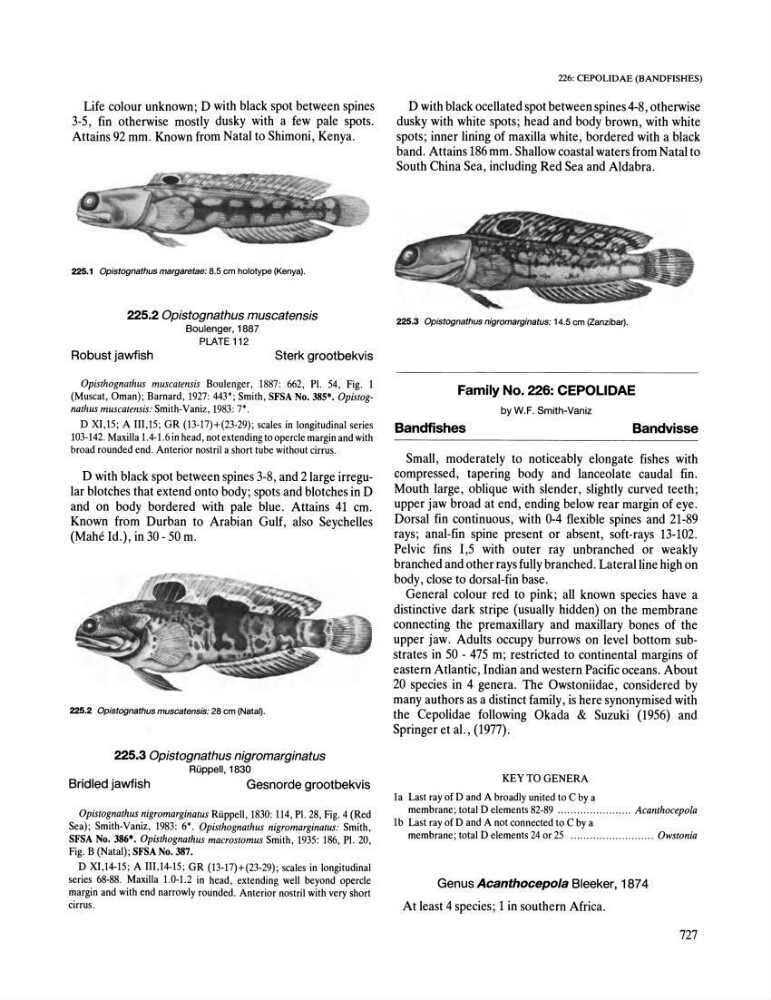
225.1 Opistognathus margaretae: 8.5 em holotype (Kenya).
225.2 Opistognathus muscatensis
Boulenger, 1887
PLATE 112
Robust jawfish
Sterk grootbekvis
Opisthognathus muscatensis Boulenger, 1887: 662, PI. 54, Fig. 1
(Muscat, Oman); Barnard, 1927: 443*; Smith, SFSA No. 385*. Opistognathus muscatensis: Smith-Vaniz, 1983: 7*
D XI,15; A m,15 ; GR (13-17)+(23-29); scales in longitudinal series
103-142. Maxilla 1.4-1.6 in head, not extending to opercle margin and with
broad rounded end. Anterior nostril a short tube without cirrus.
D with black spot between spines 3-8, and 2 large irregular blotches that extend onto body; spots and blotches in D
and on body bordered with pale blue. Attains 41 cm.
Known from Durban to Arabian Gulf, also Seychelles
(Mahe Id.), in 30 - 50 m.
225.2 Opistognathus muscatensis: 28 em (Natal).
225.3 Opistognathus nigromarginatus
Ruppell,1830
Bridled jawfish
Gesnorde grootbekvis
Opistognathus nigromarginatus Riippell, 1830: 114, PI. 28, Fig. 4 (Red
Sea); Smith-Vaniz, 1983: 6*. Opisthognathus nigromarginatus: Smith,
SFSA No. 386*. Opisthognathus macrostomus Smith, 1935: 186, PI. 20,
Fig. B (Natal); SFSA No. 387.
D XI,14-15; A III,14-15; GR (13-17)+(23-29); scales in longitudinal
series 68-88. Maxilla 1.0-1.2 in head, extending well beyond opercle
margin and with end narrowly rounded. Anterior nostril with very short
cirrus.
226: CEPOLIDAE (BANDFISHES)
D with black ocellated spot between spines 4-8, otherwise
dusky with white spots; head and body brown, with white
spots; inner lining of maxilla white, bordered with a black
band. Attains 186 mm. Shallow coastal waters from Natal to
South China Sea, including Red Sea and Aldabra.
225.3 Opistognathus nigromarginatus: 14.5 em (Zanzibar).
Family No. 226: CEPOLIDAE
by W.F. Smith-Vaniz
Bandfishes
Bandvisse
Small, moderately to noticeably elongate fishes with
compressed, tapering body and lanceolate caudal fin.
Mouth large, oblique with slender, slightly curved teeth;
upper jaw broad at end, ending below rear margin of eye .
Dorsal fin continuous, with 0-4 flexible spines and 21-89
rays; anal-fin spine present or absent, soft-rays 13-102.
Pelvic fins 1,5 with outer ray unbranched or weakly
branched and other rays fully branched. Lateral line high on
body, close to dorsal-fin base.
General colour red to pink; all known species have a
distinctive dark stripe (usually hidden) on the membrane
connecting the premaxillary and maxillary bones of the
upper jaw. Adults occupy burrows on level bottom substrates in 50 - 475 m; restricted to continental margins of
eastern Atlantic, Indian and western Pacific oceans. About
20 species in 4 genera. The Owstoniidae, considered by
many authors as a distinct family, is here synonymised with
the Cepolidae following Okada & Suzuki (1956) and
Springer et aI., (1977).
KEY TO GENERA
la Last ray of D and A broadly united to C by a
membrane; total D elements 82-89 .. ...... ...... ......... Acanthocepola
Ib Last ray of D and A not connected to C by a
membrane; total D elements 24 or 25 ...... .. ............. ..... Owstonia
Genus Acanthocepo/a Bleeker, 1874
At least 4 species; 1 in southern Africa.
727
3-5, fin otherwise mostly dusky with a few pale spots.
Attains 92 mm. Known from Natal to Shimoni, Kenya.
225.1 Opistognathus margaretae: 8.5 em holotype (Kenya).
225.2 Opistognathus muscatensis
Boulenger, 1887
PLATE 112
Robust jawfish
Sterk grootbekvis
Opisthognathus muscatensis Boulenger, 1887: 662, PI. 54, Fig. 1
(Muscat, Oman); Barnard, 1927: 443*; Smith, SFSA No. 385*. Opistognathus muscatensis: Smith-Vaniz, 1983: 7*
D XI,15; A m,15 ; GR (13-17)+(23-29); scales in longitudinal series
103-142. Maxilla 1.4-1.6 in head, not extending to opercle margin and with
broad rounded end. Anterior nostril a short tube without cirrus.
D with black spot between spines 3-8, and 2 large irregular blotches that extend onto body; spots and blotches in D
and on body bordered with pale blue. Attains 41 cm.
Known from Durban to Arabian Gulf, also Seychelles
(Mahe Id.), in 30 - 50 m.
225.2 Opistognathus muscatensis: 28 em (Natal).
225.3 Opistognathus nigromarginatus
Ruppell,1830
Bridled jawfish
Gesnorde grootbekvis
Opistognathus nigromarginatus Riippell, 1830: 114, PI. 28, Fig. 4 (Red
Sea); Smith-Vaniz, 1983: 6*. Opisthognathus nigromarginatus: Smith,
SFSA No. 386*. Opisthognathus macrostomus Smith, 1935: 186, PI. 20,
Fig. B (Natal); SFSA No. 387.
D XI,14-15; A III,14-15; GR (13-17)+(23-29); scales in longitudinal
series 68-88. Maxilla 1.0-1.2 in head, extending well beyond opercle
margin and with end narrowly rounded. Anterior nostril with very short
cirrus.
226: CEPOLIDAE (BANDFISHES)
D with black ocellated spot between spines 4-8, otherwise
dusky with white spots; head and body brown, with white
spots; inner lining of maxilla white, bordered with a black
band. Attains 186 mm. Shallow coastal waters from Natal to
South China Sea, including Red Sea and Aldabra.
225.3 Opistognathus nigromarginatus: 14.5 em (Zanzibar).
Family No. 226: CEPOLIDAE
by W.F. Smith-Vaniz
Bandfishes
Bandvisse
Small, moderately to noticeably elongate fishes with
compressed, tapering body and lanceolate caudal fin.
Mouth large, oblique with slender, slightly curved teeth;
upper jaw broad at end, ending below rear margin of eye .
Dorsal fin continuous, with 0-4 flexible spines and 21-89
rays; anal-fin spine present or absent, soft-rays 13-102.
Pelvic fins 1,5 with outer ray unbranched or weakly
branched and other rays fully branched. Lateral line high on
body, close to dorsal-fin base.
General colour red to pink; all known species have a
distinctive dark stripe (usually hidden) on the membrane
connecting the premaxillary and maxillary bones of the
upper jaw. Adults occupy burrows on level bottom substrates in 50 - 475 m; restricted to continental margins of
eastern Atlantic, Indian and western Pacific oceans. About
20 species in 4 genera. The Owstoniidae, considered by
many authors as a distinct family, is here synonymised with
the Cepolidae following Okada & Suzuki (1956) and
Springer et aI., (1977).
KEY TO GENERA
la Last ray of D and A broadly united to C by a
membrane; total D elements 82-89 .. ...... ...... ......... Acanthocepola
Ib Last ray of D and A not connected to C by a
membrane; total D elements 24 or 25 ...... .. ............. ..... Owstonia
Genus Acanthocepo/a Bleeker, 1874
At least 4 species; 1 in southern Africa.
727