

224: SPHYRAENIDAE (BARRACUDAS)
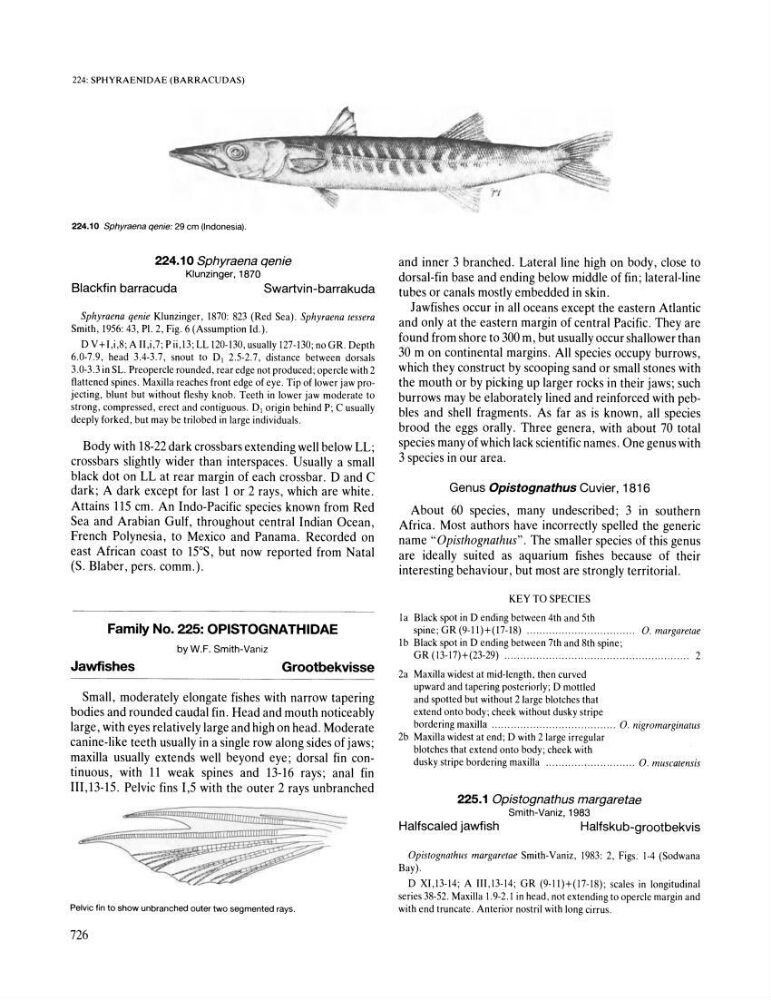
224.10 Sphyraena qenie: 29 cm (Indonesia).
224.10 Sphyraena qenie
Klunzinger, 1870
Blackfin barracuda
Swartvin-barrakuda
Sphyraena qenie Klunzinger, 1870: 823 (Red Sea). Sphyraena tessera
Smith, 1956: 43, PI. 2, Fig. 6 (Assumption Id.).
D Y+ I,i,8; A I1 ,i,7; P ii,13; LL 120·130, usually 127-130; no GR . Depth
6.0-7.9 , head 3.4-3.7 , snout to D\ 2.5-2.7 , distance between dorsals
3.0-3.3 in SL. Preopercle rounded, rear edge not produced; opercle with 2
flattened spines. Maxilla reaches front edge of eye . Tip of lower jaw projecting, blunt but without fleshy knob. Teeth in lower jaw moderate to
strong, compressed , erect and contiguous. D\ origin behind P; C usually
deeply forked , but may be trilobed in large individuals.
Body with 18-22 dark crossbars extending well below LL;
crossbars slightly wider than interspaces. Usually a small
black dot on LL at rear margin of each crossbar. D and C
dark; A dark except for last 1 or 2 rays, which are white.
Attains 115 cm. An Indo-Pacific species known from Red
Sea and Arabian Gulf, throughout central Indian Ocean,
French Polynesia , to Mexico and Panama. Recorded on
east African coast to lSOS, but now reported from Natal
(S. Blaber, pers. comm .).
Family No. 225: OPISTOGNATHIDAE
by W.F. Smith-Vaniz
Jawfishes
Grootbekvisse
Small, moderately elongate fishes with narrow tapering
bodies and rounded caudal fin. Head and mouth noticeably
large, with eyes relatively large and high on head. Moderate
canine-like teeth usually in a single row along sides of jaws;
maxilla usually extends well beyond eye; dorsal fin continuous, with 11 weak spines and 13-16 rays; anal fin
I1I,13-15. Pelvic fins 1,5 with the outer 2 rays unbranched
Pelvic fin to show unbranched outer two segmented rays.
726
and inner 3 branched. Lateral line high on body, close to
dorsal-fin base and ending below middle of fin; lateral-line
tubes or canals mostly embedded in skin .
Jawfishes occur in all oceans except the eastern Atlantic
and only at the eastern margin of central Pacific. They are
found from shore to 300 m, but usually occur shallower than
30 m on continental margins. All species occupy burrows,
which they construct by scooping sand or small stones with
the mouth or by picking up larger rocks in their jaws; such
burrows may be elaborately lined and reinforced with pebbles and shell fragments. As far as is known, all species
brood the eggs orally. Three genera, with about 70 total
species many of which lack scientific names. One genus with
3 species in our area.
Genus Opistognathus Cuvier, 1816
About 60 species, many undescribed; 3 in southern
Africa. Most authors have incorrectly spelled the generic
name "Opisthognathus". The smaller species of this genus
are ideally suited as aquarium fishes because of their
interesting behaviour, but most are strongly territorial.
KEY TO SPECIES
la Black spot in D ending between 4th and 5th
spine; GR (9-11)+(17-18) ............................... ... O. margaretae
Ib Black spot in D ending between 7th and 8th spine ;
GR (13-17)+(23-29) .......................................... .. ....... .. .... 2
2a Maxilla widest at mid-length, then curved
upward and tapering posteriorly; D mottled
and spotted but without 2 large blotches that
extend onto body; cheek without dusky stripe
bordering maxilla ....... ................ .... ... ......... O. nigromarginatus
2b Maxilla widest at end; D with 2 large irregular
blotches that extend onto body; cheek with
dusky stripe bordering maxilla ............................ O. muscatensis
225.1 Opistognathus margaretae
Smith-Vaniz, 1983
Halfscaled jawfish
Halfskub-grootbekvis
Opistognathus margaretae Smith-Yaniz, 1983: 2, Figs . 1-4 (Sodwana
Bay).
D XI ,13-14; A III,13-14; GR (9-11)+(17-18); scales in longitudinal
series 38-52. Maxilla 1.9-2.1 in head, not extending to opercle margin and
with end truncate. Anterior nostril with long cirrus.
224.10 Sphyraena qenie: 29 cm (Indonesia).
224.10 Sphyraena qenie
Klunzinger, 1870
Blackfin barracuda
Swartvin-barrakuda
Sphyraena qenie Klunzinger, 1870: 823 (Red Sea). Sphyraena tessera
Smith, 1956: 43, PI. 2, Fig. 6 (Assumption Id.).
D Y+ I,i,8; A I1 ,i,7; P ii,13; LL 120·130, usually 127-130; no GR . Depth
6.0-7.9 , head 3.4-3.7 , snout to D\ 2.5-2.7 , distance between dorsals
3.0-3.3 in SL. Preopercle rounded, rear edge not produced; opercle with 2
flattened spines. Maxilla reaches front edge of eye . Tip of lower jaw projecting, blunt but without fleshy knob. Teeth in lower jaw moderate to
strong, compressed , erect and contiguous. D\ origin behind P; C usually
deeply forked , but may be trilobed in large individuals.
Body with 18-22 dark crossbars extending well below LL;
crossbars slightly wider than interspaces. Usually a small
black dot on LL at rear margin of each crossbar. D and C
dark; A dark except for last 1 or 2 rays, which are white.
Attains 115 cm. An Indo-Pacific species known from Red
Sea and Arabian Gulf, throughout central Indian Ocean,
French Polynesia , to Mexico and Panama. Recorded on
east African coast to lSOS, but now reported from Natal
(S. Blaber, pers. comm .).
Family No. 225: OPISTOGNATHIDAE
by W.F. Smith-Vaniz
Jawfishes
Grootbekvisse
Small, moderately elongate fishes with narrow tapering
bodies and rounded caudal fin. Head and mouth noticeably
large, with eyes relatively large and high on head. Moderate
canine-like teeth usually in a single row along sides of jaws;
maxilla usually extends well beyond eye; dorsal fin continuous, with 11 weak spines and 13-16 rays; anal fin
I1I,13-15. Pelvic fins 1,5 with the outer 2 rays unbranched
Pelvic fin to show unbranched outer two segmented rays.
726
and inner 3 branched. Lateral line high on body, close to
dorsal-fin base and ending below middle of fin; lateral-line
tubes or canals mostly embedded in skin .
Jawfishes occur in all oceans except the eastern Atlantic
and only at the eastern margin of central Pacific. They are
found from shore to 300 m, but usually occur shallower than
30 m on continental margins. All species occupy burrows,
which they construct by scooping sand or small stones with
the mouth or by picking up larger rocks in their jaws; such
burrows may be elaborately lined and reinforced with pebbles and shell fragments. As far as is known, all species
brood the eggs orally. Three genera, with about 70 total
species many of which lack scientific names. One genus with
3 species in our area.
Genus Opistognathus Cuvier, 1816
About 60 species, many undescribed; 3 in southern
Africa. Most authors have incorrectly spelled the generic
name "Opisthognathus". The smaller species of this genus
are ideally suited as aquarium fishes because of their
interesting behaviour, but most are strongly territorial.
KEY TO SPECIES
la Black spot in D ending between 4th and 5th
spine; GR (9-11)+(17-18) ............................... ... O. margaretae
Ib Black spot in D ending between 7th and 8th spine ;
GR (13-17)+(23-29) .......................................... .. ....... .. .... 2
2a Maxilla widest at mid-length, then curved
upward and tapering posteriorly; D mottled
and spotted but without 2 large blotches that
extend onto body; cheek without dusky stripe
bordering maxilla ....... ................ .... ... ......... O. nigromarginatus
2b Maxilla widest at end; D with 2 large irregular
blotches that extend onto body; cheek with
dusky stripe bordering maxilla ............................ O. muscatensis
225.1 Opistognathus margaretae
Smith-Vaniz, 1983
Halfscaled jawfish
Halfskub-grootbekvis
Opistognathus margaretae Smith-Yaniz, 1983: 2, Figs . 1-4 (Sodwana
Bay).
D XI ,13-14; A III,13-14; GR (9-11)+(17-18); scales in longitudinal
series 38-52. Maxilla 1.9-2.1 in head, not extending to opercle margin and
with end truncate. Anterior nostril with long cirrus.