

226: CEPOLIDAE (BAND FISHES)
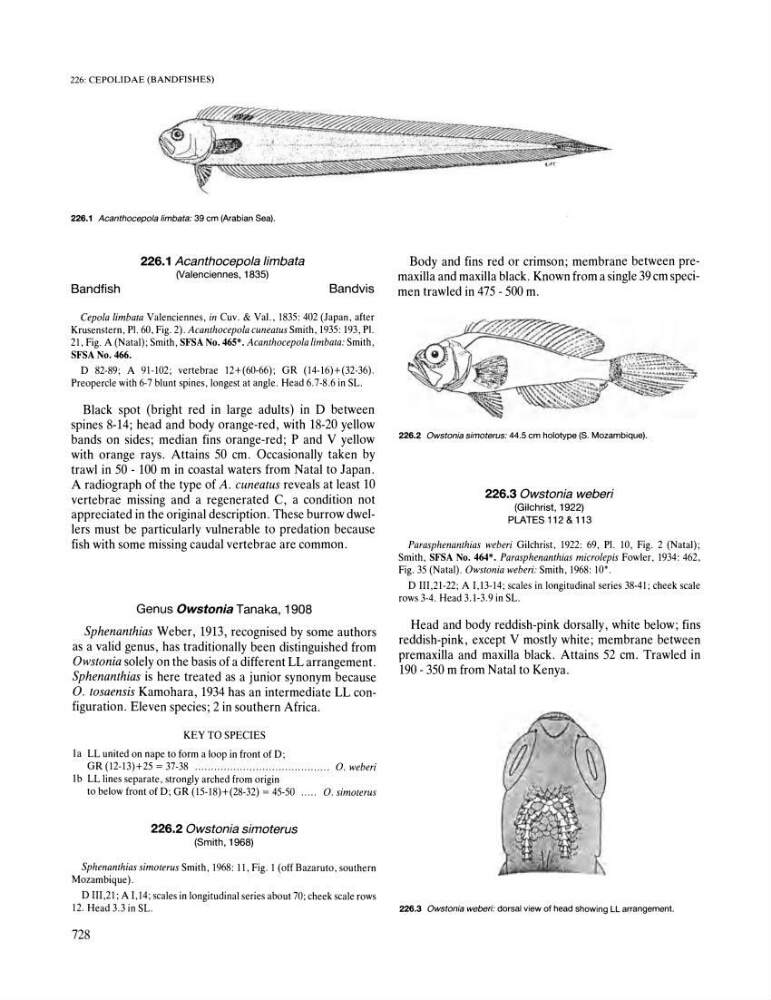
226.1 Acanthocepo/a limbata: 39 em (Arabian Sea).
Bandfish
226.1 Acanthocepo/a limbata
(Valenciennes, 1835)
Bandvis
Cepola limbata Valenciennes, in Cuv. & Val., 1835: 402 (Japan, after
Krusenstern, PI. 60, Fig. 2). Acanthocepola cuneatus Smith, 1935: 193, PI.
21, Fig. A (Natal); Smith, SFSA No. 465*. Acanthocepola limbata: Smith,
SFSA No. 466.
D 82-89; A 91-102; vertebrae 12+(60-66); GR (14-16)+(32-36).
Preopercle with 6-7 blunt spines, longest at angle. Head 6.7-8.6 in SL.
Black spot (bright red in large adults) in D between
spines 8-14; head and body orange-red, with 18-20 yellow
bands on sides; median fins orange-red; P and V yellow
with orange rays. Attains 50 cm. Occasionally taken by
trawl in 50 - 100 m in coastal waters from Natal to Japan.
A radiograph of the type of A. cuneatus reveals at least 10
vertebrae missing and a regenerated C, a condition not
appreciated in the original description. These burrow dwellers must be particularly vulnerable to predation because
fish with some missing caudal vertebrae are common.
Genus Owstonia Tanaka, 1908
Sphenanthias Weber, 1913, recognised by some authors
as a valid genus, has traditionally been distinguished from
Owstonia solely on the basis of a different LL arrangement.
Sphenanthias is here treated as a junior synonym because
O. tosaensis Kamohara, 1934 has an intermediate LL configuration. Eleven species; 2 in southern Africa.
KEY TO SPECIES
la LL united on nape to form a loop in front of D;
GR (12-13)+25 = 37-38 .......................................... O. weberi
Ib LL lines separate, strongly arched from origin
to below front of D; GR (15-18)+(28-32) = 45-50 ..... O. simoterus
226.2 Owstonia simoterus
(Smith, 1968)
Sphenanthias simoterus Smith, 1968: II, Fig. 1 (off Bazaruto, southern
Mozambique).
D III ,21; A I, 14; scales in longitudinal series about 70; cheek scale rows
12. Head 3.3 in SL.
728
Body and fins red or crimson; membrane between premaxilla and maxilla black. Known from a single 39 cm specimen trawled in 475 - 500 m.
226.2 Owstonia simoterus: 44.5 em holotype (S. Mozambique).
226.3 Owstonia weberi
(Gilchrist, 1922)
PLATES 112 & 113
Parasphenanthias weberi Gilchrist, 1922: 69, PI. 10, Fig. 2 (Natal);
Smith, SFSA No. 464*. Parasphenanthias microlepis Fowler, 1934: 462,
Fig. 35 (Natal). Owstonia weberi: Smith, 1968: 10*.
D III,21-22; A I,13-14; scales in longitudinal series 38-41; cheek scale
rows 3-4. Head 3.1-3.9 in SL.
Head and body reddish-pink dorsally, white below; fins
reddish-pink, except V mostly white; membrane between
premaxilla and maxilla black. Attains 52 cm. Trawled in
190 - 350 m from Natal to Kenya.
226.3 Owstonia weberi: dorsal view of head showing LL arrangement.
226.1 Acanthocepo/a limbata: 39 em (Arabian Sea).
Bandfish
226.1 Acanthocepo/a limbata
(Valenciennes, 1835)
Bandvis
Cepola limbata Valenciennes, in Cuv. & Val., 1835: 402 (Japan, after
Krusenstern, PI. 60, Fig. 2). Acanthocepola cuneatus Smith, 1935: 193, PI.
21, Fig. A (Natal); Smith, SFSA No. 465*. Acanthocepola limbata: Smith,
SFSA No. 466.
D 82-89; A 91-102; vertebrae 12+(60-66); GR (14-16)+(32-36).
Preopercle with 6-7 blunt spines, longest at angle. Head 6.7-8.6 in SL.
Black spot (bright red in large adults) in D between
spines 8-14; head and body orange-red, with 18-20 yellow
bands on sides; median fins orange-red; P and V yellow
with orange rays. Attains 50 cm. Occasionally taken by
trawl in 50 - 100 m in coastal waters from Natal to Japan.
A radiograph of the type of A. cuneatus reveals at least 10
vertebrae missing and a regenerated C, a condition not
appreciated in the original description. These burrow dwellers must be particularly vulnerable to predation because
fish with some missing caudal vertebrae are common.
Genus Owstonia Tanaka, 1908
Sphenanthias Weber, 1913, recognised by some authors
as a valid genus, has traditionally been distinguished from
Owstonia solely on the basis of a different LL arrangement.
Sphenanthias is here treated as a junior synonym because
O. tosaensis Kamohara, 1934 has an intermediate LL configuration. Eleven species; 2 in southern Africa.
KEY TO SPECIES
la LL united on nape to form a loop in front of D;
GR (12-13)+25 = 37-38 .......................................... O. weberi
Ib LL lines separate, strongly arched from origin
to below front of D; GR (15-18)+(28-32) = 45-50 ..... O. simoterus
226.2 Owstonia simoterus
(Smith, 1968)
Sphenanthias simoterus Smith, 1968: II, Fig. 1 (off Bazaruto, southern
Mozambique).
D III ,21; A I, 14; scales in longitudinal series about 70; cheek scale rows
12. Head 3.3 in SL.
728
Body and fins red or crimson; membrane between premaxilla and maxilla black. Known from a single 39 cm specimen trawled in 475 - 500 m.
226.2 Owstonia simoterus: 44.5 em holotype (S. Mozambique).
226.3 Owstonia weberi
(Gilchrist, 1922)
PLATES 112 & 113
Parasphenanthias weberi Gilchrist, 1922: 69, PI. 10, Fig. 2 (Natal);
Smith, SFSA No. 464*. Parasphenanthias microlepis Fowler, 1934: 462,
Fig. 35 (Natal). Owstonia weberi: Smith, 1968: 10*.
D III,21-22; A I,13-14; scales in longitudinal series 38-41; cheek scale
rows 3-4. Head 3.1-3.9 in SL.
Head and body reddish-pink dorsally, white below; fins
reddish-pink, except V mostly white; membrane between
premaxilla and maxilla black. Attains 52 cm. Trawled in
190 - 350 m from Natal to Kenya.
226.3 Owstonia weberi: dorsal view of head showing LL arrangement.