

224: SPHYRAENIDAE (BARRACUDAS)
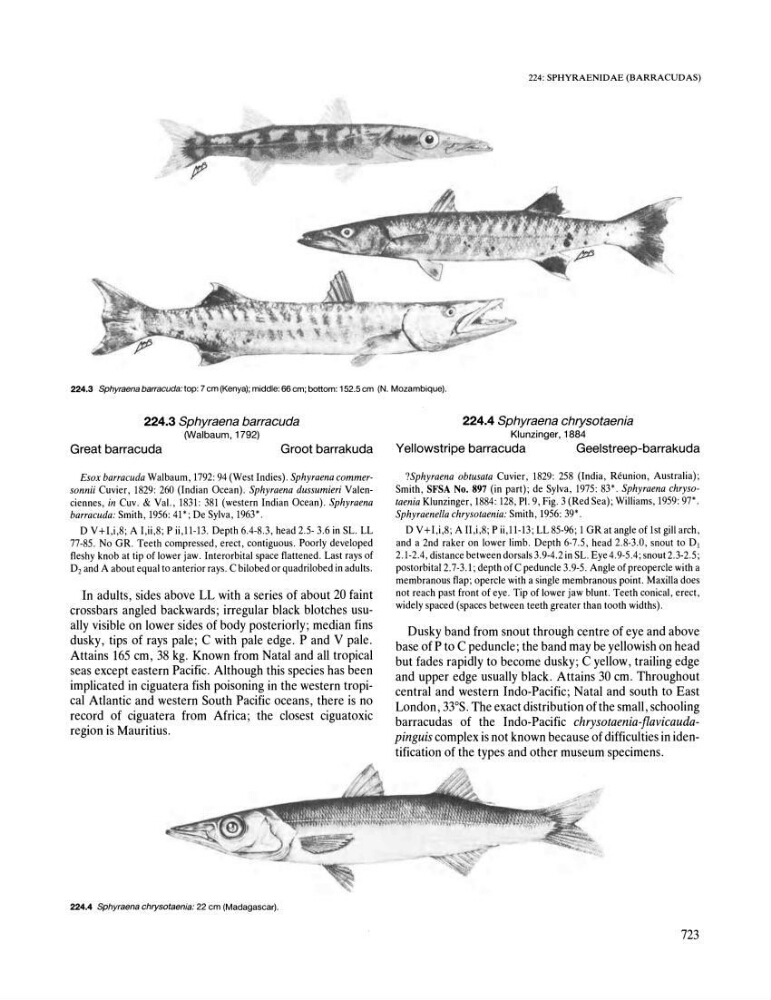
224.3 Sphyraena barracuda: top: 7 cm (Kenya); middle: 66 cm; bottom: 152.5 cm (N. Mozambique).
224.3 Sphyraena barracuda
(Walbaum, 1792)
Great barracuda
Groot barrakuda
Esox barracuda Walbaum, 1792: 94 (West Indies). Sphyraena commersonnii Cuvier, 1829: 260 (Indian Ocean). Sphyraena dussumieri Valenciennes, in Cuv. & Val., 1831: 381 (western Indian Ocean). Sphyraena
barracuda: Smith, 1956: 41 *; De Sylva, 1963*.
D V + I,i,8; A l,ii,8; P ii ,lI-13. Depth 6.4-8.3, head 2.5- 3.6 in SL. LL
77-85. No GR . Teeth compressed, erect, contiguous. Poorly developed
fleshy knob at tip of lower jaw. Interorbital space flattened . Last rays of
D2 and A about equal to anterior rays. C bilobed or quadrilobed in adults.
In adults, sides above LL with a series of about 20 faint
crossbars angled backwards; irregular black blotches usually visible on lower sides of body posteriorly; median fins
dusky, tips of rays pale; C with pale edge. P and V pale.
Attains 165 cm, 38 kg. Known from Natal and all tropical
seas except eastern Pacific. Although this species has been
implicated in ciguatera fish poisoning in the western tropical Atlantic and western South Pacific oceans, there is no
record of ciguatera from Africa; the closest ciguatoxic
region is Mauritius.
224_4 Sphyraena chrysotaenia: 22 cm (Madagascar).
224.4 Sphyraena chrysotaenia
Klunzinger, 1884
Yellowstripe barracuda
Geelstreep-barrakuda
?Sphyraena obtusata Cuvier , 1829: 258 (India, Reunion, Australia);
Smith, SFSA No. 897 (in part); de Sylva, 1975: 83*. Sphyraena chrysotaenia Klunzinger , 1884: 128 , PI. 9, Fig. 3 (Red Sea); Williams, 1959: 97*.
Sphyraenella chrysotaenia: Smith, 1956: 39*.
D V+ I,i,8; A II,i,8; P ii,lI-13; LL 85-96; 1 GR at angle of 1st gill arch,
and a 2nd raker on lower limb. Depth 6-7.5 , head 2.8-3.0, snout to DI
2.1-2.4, distance between dorsals 3.9-4.2 in SL. Eye 4.9-5.4; snout 2.3-2.5;
postorbital 2.7-3.1; depth of C peduncle 3.9-5 . Angle of preopercle with a
membranous flap; opercle with a single membranous point. Maxilla does
not reach past front of eye. Tip of lower jaw blunt. Teeth conical, erect,
widely spaced (spaces between teeth greater than tooth widths).
Dusky band from snout through centre of eye and above
base of P to C peduncle; the band may be yellowish on head
but fades rapidly to become dusky; C yellow, trailing edge
and upper edge usually black. Attains 30 cm. Throughout
central and western Indo-Pacific; Natal and south to East
London, 33°S. The exact distribution of the small, schooling
barracudas of the Indo-Pacific chrysotaenia-flavicaudapinguis complex is not known because of difficulties in identification of the types and other museum specimens.
723
224.3 Sphyraena barracuda: top: 7 cm (Kenya); middle: 66 cm; bottom: 152.5 cm (N. Mozambique).
224.3 Sphyraena barracuda
(Walbaum, 1792)
Great barracuda
Groot barrakuda
Esox barracuda Walbaum, 1792: 94 (West Indies). Sphyraena commersonnii Cuvier, 1829: 260 (Indian Ocean). Sphyraena dussumieri Valenciennes, in Cuv. & Val., 1831: 381 (western Indian Ocean). Sphyraena
barracuda: Smith, 1956: 41 *; De Sylva, 1963*.
D V + I,i,8; A l,ii,8; P ii ,lI-13. Depth 6.4-8.3, head 2.5- 3.6 in SL. LL
77-85. No GR . Teeth compressed, erect, contiguous. Poorly developed
fleshy knob at tip of lower jaw. Interorbital space flattened . Last rays of
D2 and A about equal to anterior rays. C bilobed or quadrilobed in adults.
In adults, sides above LL with a series of about 20 faint
crossbars angled backwards; irregular black blotches usually visible on lower sides of body posteriorly; median fins
dusky, tips of rays pale; C with pale edge. P and V pale.
Attains 165 cm, 38 kg. Known from Natal and all tropical
seas except eastern Pacific. Although this species has been
implicated in ciguatera fish poisoning in the western tropical Atlantic and western South Pacific oceans, there is no
record of ciguatera from Africa; the closest ciguatoxic
region is Mauritius.
224_4 Sphyraena chrysotaenia: 22 cm (Madagascar).
224.4 Sphyraena chrysotaenia
Klunzinger, 1884
Yellowstripe barracuda
Geelstreep-barrakuda
?Sphyraena obtusata Cuvier , 1829: 258 (India, Reunion, Australia);
Smith, SFSA No. 897 (in part); de Sylva, 1975: 83*. Sphyraena chrysotaenia Klunzinger , 1884: 128 , PI. 9, Fig. 3 (Red Sea); Williams, 1959: 97*.
Sphyraenella chrysotaenia: Smith, 1956: 39*.
D V+ I,i,8; A II,i,8; P ii,lI-13; LL 85-96; 1 GR at angle of 1st gill arch,
and a 2nd raker on lower limb. Depth 6-7.5 , head 2.8-3.0, snout to DI
2.1-2.4, distance between dorsals 3.9-4.2 in SL. Eye 4.9-5.4; snout 2.3-2.5;
postorbital 2.7-3.1; depth of C peduncle 3.9-5 . Angle of preopercle with a
membranous flap; opercle with a single membranous point. Maxilla does
not reach past front of eye. Tip of lower jaw blunt. Teeth conical, erect,
widely spaced (spaces between teeth greater than tooth widths).
Dusky band from snout through centre of eye and above
base of P to C peduncle; the band may be yellowish on head
but fades rapidly to become dusky; C yellow, trailing edge
and upper edge usually black. Attains 30 cm. Throughout
central and western Indo-Pacific; Natal and south to East
London, 33°S. The exact distribution of the small, schooling
barracudas of the Indo-Pacific chrysotaenia-flavicaudapinguis complex is not known because of difficulties in identification of the types and other museum specimens.
723