

224: SPHYRAENIDAE (BARRACUDAS)
species have been most recently revised by Williams (1959)
and by de Sylva (1975). LL scale counts are of all pored
scales, including those on the caudal fin base.
KEY TO SPECIES
la GRabsent .... .. ...... .. ................................ ......................... 2
Ib GR present ......... ........... ................................. ......... ........ 7
2a LL 75-85; sides of body with irregular black
blotches below LL .... .. ........................................ S. barracuda
2b LL greater than 100; sides of body without irregular
black blotches ........... ..... .......... ......... ........ ........ ............ .. . 3
3a No crossbars or contrasted markings on body ........ .... ..... S. fosteri
3b Crossbars or contrasted markings on body .................. .... ........ 4
4a Preopercle obliquely rounded; teeth usually
slanted backwards; last rays of O2 and A
longer than anterior rays .......... .. . ........ .... ........... . S. putnamiae
4b Preopercle smoothly rounded; teeth erect; last rays
of O2 and A not longer than anterior rays ................ ...... ........ . 5
5a Crossbars on body chevron-shaped ...................... .. ........ S. afra
5b Crossbars on body not chevron-shaped ............... .... .. .. .. ......... 6
6a LL 120-130, usually 127-130; body blue-black
above , with vertical or slightly angled wavy
crossbars usually reaching well below LL;
o and A dark, except last 2 rays of A pale,
contrasting strongly with rest offin ......................... .. ..... S. qenie
6b LL 130-140, usually 135-140; body dusky yellowgreen above , with short serpentine crossbars
reaching only slightly below LL; 0 dusky
green; A pale ......... .. ............... .... .. .... .. ............. .. ... .... S. jello
7a A single GR at angle of 1st gill arch; LL 120-155 ........ .. ............ 8
7b Two(rarely3)GRonlstgillarch;LL80-96 .................. .. ... .. .. 9
8a Origin of D[ above or in front of origin of V ;
LL 122-128, usually 124-127; body depth
6.5-8.5 times in SL .... .. .......................... .. .. .. ...... S. acutipinnis
8b Origin of D[ distinctly behind origin of V;
LL 127-155, usually 127-140; body depth
9.5-10 in SL ...................................... .
S. novaehollandiae
9a Tip of P reaches past D[ origin; D[ height
equal to or greater than postorbital head length
and greater than di stance between D[ and O2 ........ S. chrysotaenia
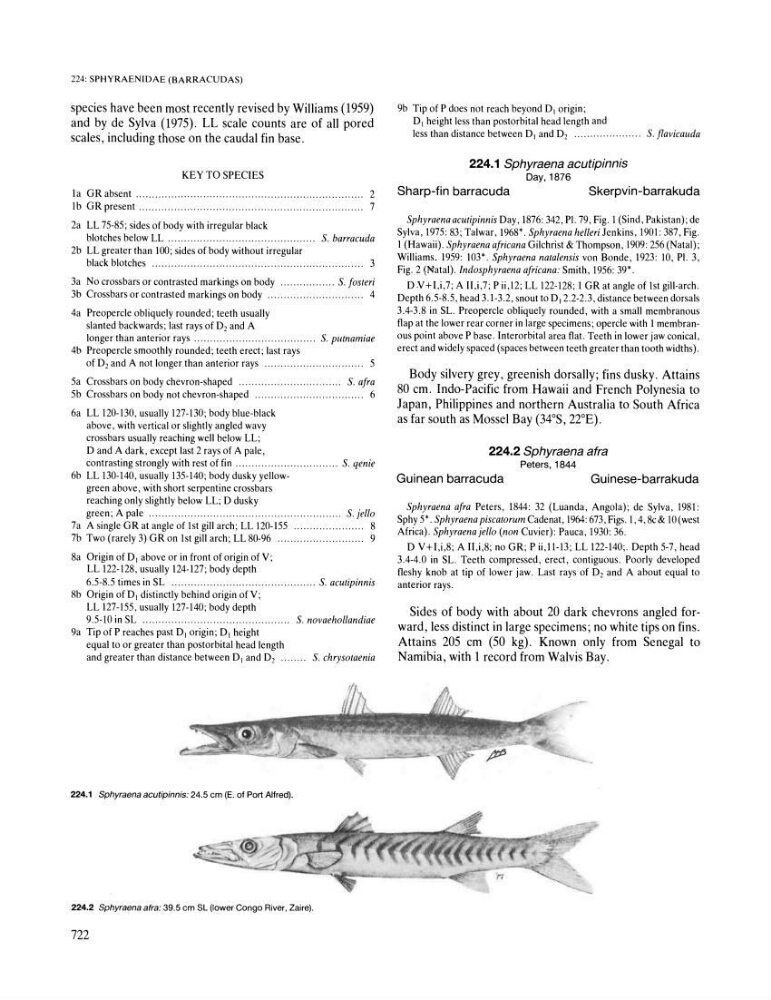
224.1 Sphyraena acutipinnis: 24.5 em (E. of Port Alfred).
224.2 Sphyraena afra: 39.5 em SL (lower Congo River, Zaire).
722
9b Tip of P does not reach beyond D[ origin;
D[ height less than postorbital head length and
less than distance between D[ and O2 •. . .............••... S. flavicauda
224.1 Sphyraena acutipinnis
Day, 1876
Sharp-fin barracuda
Skerpvin-barrakuda
Sphyraena acutipinnis Day, 1876: 342, PI. 79, Fig. 1 (Sind, Pakistan); de
Sylva, 1975: 83; Talwar, 1968*. Sphyraena helleri Jenkins, 1901: 387, Fig.
I (Hawaii). Sphyraena africana Gilchrist & Thompson, 1909: 256 (Natal);
Williams. 1959: 103*. Sphyraena natalensis von Bonde , 1923: 10, PI. 3,
Fig. 2 (Natal). Indosphyraena africana: Smith, 1956: 39*.
D.v + I,i,7; A II,i,7; P ii, 12; LL 122-128 ; I GR at angle of 1st gill-arch.
Depth 6.5-8.5, head 3.1-3.2, snout to 0 1 2.2-2.3, distance between dorsals
3.4-3.8 in SL. Preopercle obliquely rounded, with a small membranous
flap at the lower rear corner in large specimens; opercle with I membranous point above P base. Interorbital area flat. Teeth in lower jaw conical,
erect and widely spaced (spaces between teeth greater than tooth widths).
Body silvery grey, greenish dorsally; fins dusky. Attains
80 cm. Indo-Pacific from Hawaii and French Polynesia to
Japan, Philippines and northern Australia to South Africa
as far south as Mossel Bay (34°S , 22°E).
224.2 Sphyraena afra
Peters, 1844
Guinean barracuda
Guinese-barrakuda
Sphyraena afra Peters, 1844: 32 (Luanda, Angola); de Sylva, 1981:
Sphy 5*' Sphyraena piscatorum Cadenat, 1964: 673, Figs. 1,4, 8c & 10 (west
Africa). Sphyraena jello (non Cuvier): Pauca, 1930: 36.
o V+I,i,8; A II,i,8; no GR; P ii,II-I3; LL 122-140;. Depth 5-7, head
3.4-4.0 in SL. Teeth compressed, erect, contiguous. Poorly developed
fleshy knob at tip of lower jaw. Last rays of O2 and A about equal to
anterior rays .
Sides of body with about 20 dark chevrons angled forward, less distinct in large specimens; no white tips on fins.
Attains 205 cm (50 kg). Known only from Senegal to
Namibia, with 1 record from Walvis Bay.
species have been most recently revised by Williams (1959)
and by de Sylva (1975). LL scale counts are of all pored
scales, including those on the caudal fin base.
KEY TO SPECIES
la GRabsent .... .. ...... .. ................................ ......................... 2
Ib GR present ......... ........... ................................. ......... ........ 7
2a LL 75-85; sides of body with irregular black
blotches below LL .... .. ........................................ S. barracuda
2b LL greater than 100; sides of body without irregular
black blotches ........... ..... .......... ......... ........ ........ ............ .. . 3
3a No crossbars or contrasted markings on body ........ .... ..... S. fosteri
3b Crossbars or contrasted markings on body .................. .... ........ 4
4a Preopercle obliquely rounded; teeth usually
slanted backwards; last rays of O2 and A
longer than anterior rays .......... .. . ........ .... ........... . S. putnamiae
4b Preopercle smoothly rounded; teeth erect; last rays
of O2 and A not longer than anterior rays ................ ...... ........ . 5
5a Crossbars on body chevron-shaped ...................... .. ........ S. afra
5b Crossbars on body not chevron-shaped ............... .... .. .. .. ......... 6
6a LL 120-130, usually 127-130; body blue-black
above , with vertical or slightly angled wavy
crossbars usually reaching well below LL;
o and A dark, except last 2 rays of A pale,
contrasting strongly with rest offin ......................... .. ..... S. qenie
6b LL 130-140, usually 135-140; body dusky yellowgreen above , with short serpentine crossbars
reaching only slightly below LL; 0 dusky
green; A pale ......... .. ............... .... .. .... .. ............. .. ... .... S. jello
7a A single GR at angle of 1st gill arch; LL 120-155 ........ .. ............ 8
7b Two(rarely3)GRonlstgillarch;LL80-96 .................. .. ... .. .. 9
8a Origin of D[ above or in front of origin of V ;
LL 122-128, usually 124-127; body depth
6.5-8.5 times in SL .... .. .......................... .. .. .. ...... S. acutipinnis
8b Origin of D[ distinctly behind origin of V;
LL 127-155, usually 127-140; body depth
9.5-10 in SL ...................................... .
S. novaehollandiae
9a Tip of P reaches past D[ origin; D[ height
equal to or greater than postorbital head length
and greater than di stance between D[ and O2 ........ S. chrysotaenia
224.1 Sphyraena acutipinnis: 24.5 em (E. of Port Alfred).
224.2 Sphyraena afra: 39.5 em SL (lower Congo River, Zaire).
722
9b Tip of P does not reach beyond D[ origin;
D[ height less than postorbital head length and
less than distance between D[ and O2 •. . .............••... S. flavicauda
224.1 Sphyraena acutipinnis
Day, 1876
Sharp-fin barracuda
Skerpvin-barrakuda
Sphyraena acutipinnis Day, 1876: 342, PI. 79, Fig. 1 (Sind, Pakistan); de
Sylva, 1975: 83; Talwar, 1968*. Sphyraena helleri Jenkins, 1901: 387, Fig.
I (Hawaii). Sphyraena africana Gilchrist & Thompson, 1909: 256 (Natal);
Williams. 1959: 103*. Sphyraena natalensis von Bonde , 1923: 10, PI. 3,
Fig. 2 (Natal). Indosphyraena africana: Smith, 1956: 39*.
D.v + I,i,7; A II,i,7; P ii, 12; LL 122-128 ; I GR at angle of 1st gill-arch.
Depth 6.5-8.5, head 3.1-3.2, snout to 0 1 2.2-2.3, distance between dorsals
3.4-3.8 in SL. Preopercle obliquely rounded, with a small membranous
flap at the lower rear corner in large specimens; opercle with I membranous point above P base. Interorbital area flat. Teeth in lower jaw conical,
erect and widely spaced (spaces between teeth greater than tooth widths).
Body silvery grey, greenish dorsally; fins dusky. Attains
80 cm. Indo-Pacific from Hawaii and French Polynesia to
Japan, Philippines and northern Australia to South Africa
as far south as Mossel Bay (34°S , 22°E).
224.2 Sphyraena afra
Peters, 1844
Guinean barracuda
Guinese-barrakuda
Sphyraena afra Peters, 1844: 32 (Luanda, Angola); de Sylva, 1981:
Sphy 5*' Sphyraena piscatorum Cadenat, 1964: 673, Figs. 1,4, 8c & 10 (west
Africa). Sphyraena jello (non Cuvier): Pauca, 1930: 36.
o V+I,i,8; A II,i,8; no GR; P ii,II-I3; LL 122-140;. Depth 5-7, head
3.4-4.0 in SL. Teeth compressed, erect, contiguous. Poorly developed
fleshy knob at tip of lower jaw. Last rays of O2 and A about equal to
anterior rays .
Sides of body with about 20 dark chevrons angled forward, less distinct in large specimens; no white tips on fins.
Attains 205 cm (50 kg). Known only from Senegal to
Namibia, with 1 record from Walvis Bay.