

Genus Polydactylus Lacepede, 1803
Upper lip absent, lower lip present; preopercle serrate;
scales finely ctenoid; C lunate. This, the largest genus in the
family, occurs in all warm seas and contains about 20
species, 10-15 from the Indo-West Pacific but only 3
recorded from our area.
KEY TO SPECIES
la 6 (rarely 7) free Prays; LL 44-50 ............................. P. sextarius
Ib 5 free Prays; LL 58-75 ....................................................... 2
2a All upper P rays simple; LL 58-64 .............................. P. plebeius
2b Most upper P rays branched; LL 70-75 ........................ P. indicus
223.1 Polydactylus indicus
(Shaw, 1804)
Indian threadfin
Indiese draadvin
Polynemus indicus Shaw, 1804: 155 (India). Polydactylus indicus:
Smith, SFSA No. 899.
o VIII+I,13-14; A II-III,U-12; P (14-15)+5, reaches almost to origin
of A; lower GR 16; LL 70-75; vomer toothed.
Golden olive, darker above, with faint dusky lines along
body; fins yellowish. The rarest but largest species recorded
from our area, attains over 1 m. Indo-West Pacific, south to
Durban.
223.1 Polydactylus indicus: (after Hora, 1929).
223.2 Polydactylus plebeius
(Broussonet, 1782)
Striped threadfin
Gestreepte draadvin
Polynemus plebeius Broussenet, 1782: PI. 8 (Pacific Ocean near Tahiti).
Polydactylus plebeius: Smith, SFSA No. 898*.
223.2 Polydactylus plebius: 21 em (East London).
224: SPHYRAENIDAE (BARRACUDAS)
o VIII+I,13; A 11,11-12; P (15-18)+5, reaches to, or near, end of V;
GR (9-11)+ 15; LL 58-64; vomer dentate.
Golden, dusky olive above, with a dark line along each
scale row; fins dusky. Attains 45 cm. Indo-West Pacific
from Red Sea to Knysna.
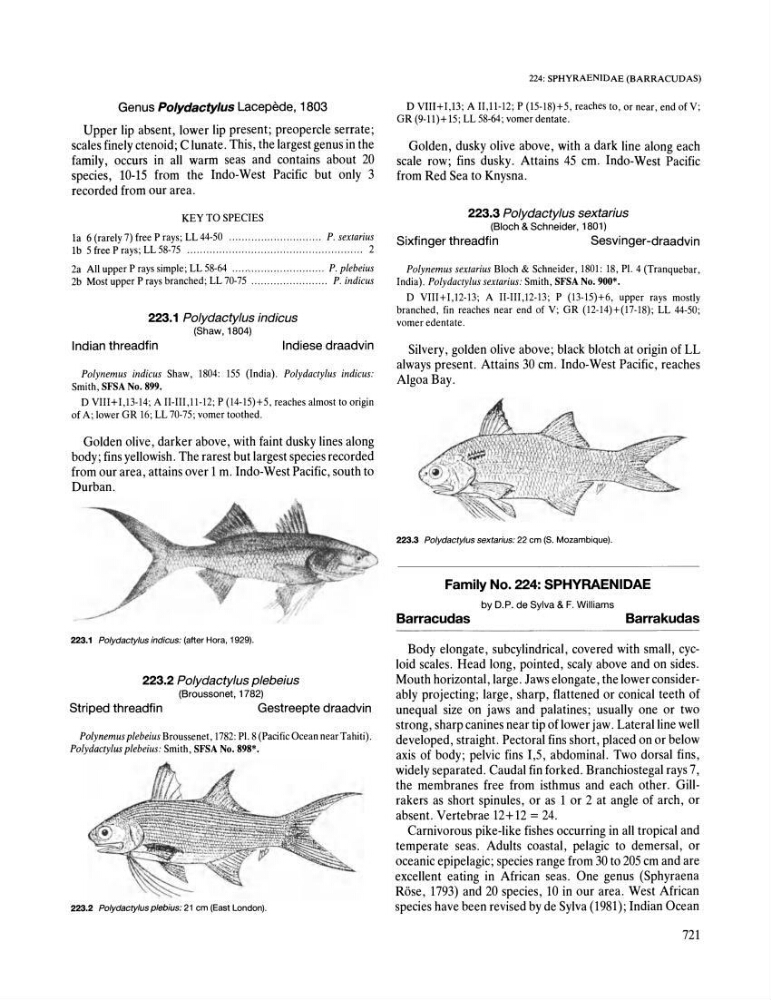
223.3 Polydactylus sextarius
(Bloch & Schneider, 1801)
Sixfinger threadfin
Sesvinger-draadvin
Polynemus sextarius Bloch & Schneider, 1801: 18, PI. 4 (Tranquebar,
India). Polydactylus sextarius: Smith, SFSA No. 900*.
o VIII+I,12-13; A II-III,12-13; P (13-15)+6, upper rays mostly
branched, fin reaches near end of V; GR (12-14)+(17-18); LL 44-50;
vomer edentate.
Silvery, golden olive above; black blotch at origin of LL
always present. Attains 30 cm. Indo-West Pacific, reaches
Algoa Bay.
223.3 Polydactylus sextarius: 22 em (S. Mozambique).
Family No. 224: SPHYRAENIDAE
by D.P. de Sylva & F. Williams
Barracudas
Barrakudas
Body elongate, subcylindrical, covered with small, cycloid scales. Head long, pointed, scaly above and on sides.
Mouth horizontal, large. Jaws elongate, the lower considerably projecting; large, sharp, flattened or conical teeth of
unequal size on jaws and palatines; usually one or two
strong, sharp canines near tip oflower jaw. Lateral line well
developed, straight. Pectoral fins short, placed on or below
axis of body; pelvic fins 1,5, abdominal. Two dorsal fins,
widely separated. Caudal fin forked. Branchiostegal rays 7,
the membranes free from isthmus and each other. Gillrakers as short spinules, or as 1 or 2 at angle of arch, or
absent. Vertebrae 12+ 12 = 24.
Carnivorous pike-like fishes occurring in all tropical and
temperate seas. Adults coastal, pelagic to demersal, or
oceanic epipelagic; species range from 30 to 205 cm and are
excellent eating in African seas. One genus (Sphyraena
Rose, 1793) and 20 species, 10 in our area. West African
species have been revised by de Sylva (1981); Indian Ocean
721
Upper lip absent, lower lip present; preopercle serrate;
scales finely ctenoid; C lunate. This, the largest genus in the
family, occurs in all warm seas and contains about 20
species, 10-15 from the Indo-West Pacific but only 3
recorded from our area.
KEY TO SPECIES
la 6 (rarely 7) free Prays; LL 44-50 ............................. P. sextarius
Ib 5 free Prays; LL 58-75 ....................................................... 2
2a All upper P rays simple; LL 58-64 .............................. P. plebeius
2b Most upper P rays branched; LL 70-75 ........................ P. indicus
223.1 Polydactylus indicus
(Shaw, 1804)
Indian threadfin
Indiese draadvin
Polynemus indicus Shaw, 1804: 155 (India). Polydactylus indicus:
Smith, SFSA No. 899.
o VIII+I,13-14; A II-III,U-12; P (14-15)+5, reaches almost to origin
of A; lower GR 16; LL 70-75; vomer toothed.
Golden olive, darker above, with faint dusky lines along
body; fins yellowish. The rarest but largest species recorded
from our area, attains over 1 m. Indo-West Pacific, south to
Durban.
223.1 Polydactylus indicus: (after Hora, 1929).
223.2 Polydactylus plebeius
(Broussonet, 1782)
Striped threadfin
Gestreepte draadvin
Polynemus plebeius Broussenet, 1782: PI. 8 (Pacific Ocean near Tahiti).
Polydactylus plebeius: Smith, SFSA No. 898*.
223.2 Polydactylus plebius: 21 em (East London).
224: SPHYRAENIDAE (BARRACUDAS)
o VIII+I,13; A 11,11-12; P (15-18)+5, reaches to, or near, end of V;
GR (9-11)+ 15; LL 58-64; vomer dentate.
Golden, dusky olive above, with a dark line along each
scale row; fins dusky. Attains 45 cm. Indo-West Pacific
from Red Sea to Knysna.
223.3 Polydactylus sextarius
(Bloch & Schneider, 1801)
Sixfinger threadfin
Sesvinger-draadvin
Polynemus sextarius Bloch & Schneider, 1801: 18, PI. 4 (Tranquebar,
India). Polydactylus sextarius: Smith, SFSA No. 900*.
o VIII+I,12-13; A II-III,12-13; P (13-15)+6, upper rays mostly
branched, fin reaches near end of V; GR (12-14)+(17-18); LL 44-50;
vomer edentate.
Silvery, golden olive above; black blotch at origin of LL
always present. Attains 30 cm. Indo-West Pacific, reaches
Algoa Bay.
223.3 Polydactylus sextarius: 22 em (S. Mozambique).
Family No. 224: SPHYRAENIDAE
by D.P. de Sylva & F. Williams
Barracudas
Barrakudas
Body elongate, subcylindrical, covered with small, cycloid scales. Head long, pointed, scaly above and on sides.
Mouth horizontal, large. Jaws elongate, the lower considerably projecting; large, sharp, flattened or conical teeth of
unequal size on jaws and palatines; usually one or two
strong, sharp canines near tip oflower jaw. Lateral line well
developed, straight. Pectoral fins short, placed on or below
axis of body; pelvic fins 1,5, abdominal. Two dorsal fins,
widely separated. Caudal fin forked. Branchiostegal rays 7,
the membranes free from isthmus and each other. Gillrakers as short spinules, or as 1 or 2 at angle of arch, or
absent. Vertebrae 12+ 12 = 24.
Carnivorous pike-like fishes occurring in all tropical and
temperate seas. Adults coastal, pelagic to demersal, or
oceanic epipelagic; species range from 30 to 205 cm and are
excellent eating in African seas. One genus (Sphyraena
Rose, 1793) and 20 species, 10 in our area. West African
species have been revised by de Sylva (1981); Indian Ocean
721