

222: MUGILIDAE (MULLETS)
on palatines , but vomer and tongue dentate; preorbital margin scaly ,
bent , the notch and serrations become obscured with growth.
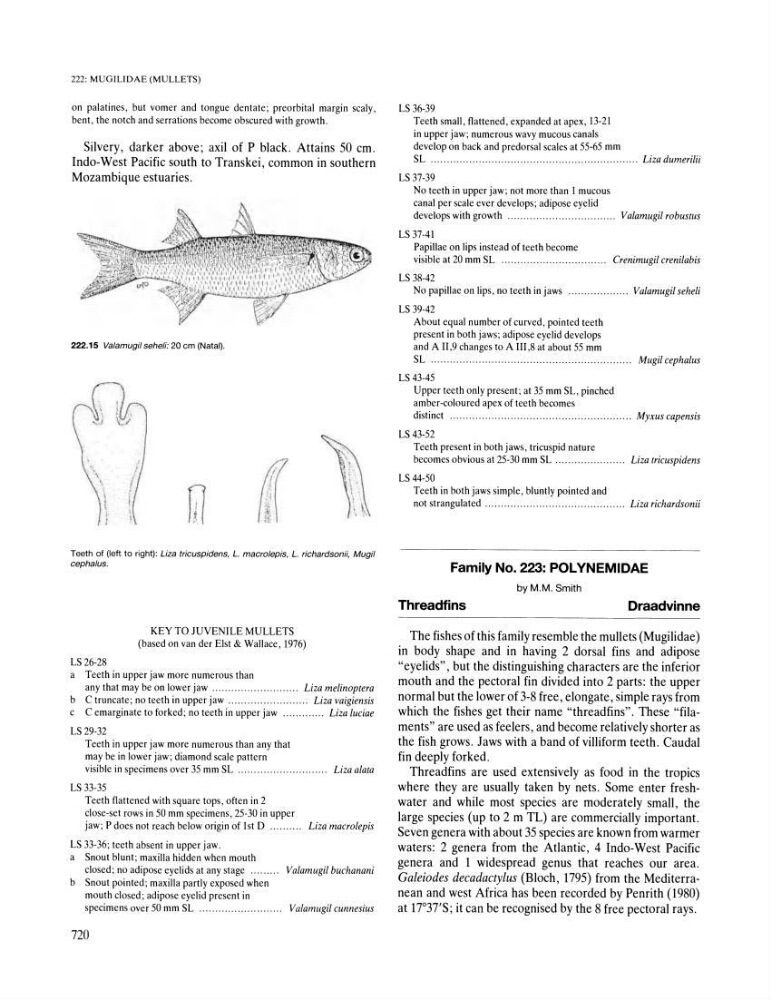
Silvery, darker above; axil of P black . Attains 50 cm.
Indo-West Pacific south to Transkei, common in southern
Mozambique estuaries.
222.15 Valamugil seheli: 20 em (Natal).
Teeth of (left to right): Liza tricuspidens, L. macrolepis, L. richardsonii, Mugi/
cepha/us.
LS 26-28
KEY TO JUVENILE MULLETS
(based on van der Elst & Wallace, 1976)
a Teeth in upper jaw more numerous than
any that may be on lower jaw ............... ....... ..... Liza melinoptera
b C truncate; no teeth in upper jaw ............ ............. Liza vaigiensis
c C emarginate to forked; no teeth in upper jaw ............. Liza luciae
LS 29-32
Teeth in upper jaw more numerous than any that
may be in lower jaw; diamond scale pattern
visible in specimens over 35 mm SL ............. .. ... .......... Liza alata
LS 33-35
Teeth flattened with square tops, often in 2
close-set rows in 50 mm specimens, 25-30 in upper
jaw; P does not reach below origin of 1st 0
Liza macrolepis
LS 33-36; teeth absent in upper jaw.
a Snout blunt; maxilla hidden when mouth
closed; no adipose eyelids at any stage ... .. Valamugil buchanani
b Snout pointed; maxilla partly exposed when
mouth closed; adipose eyelid present in
specimens over 50 mm SL
.. Valamllgil cunnesius
720
LS 36-39
Teeth small , flattened, expanded at apex , 13-21
in upper jaw; numerous wavy mucous canals
develop on back and predorsal scales at 55-65 mm
SL ................................. ..... .. ..... ............. .... ... Liza dumerilii
LS 37-39
No teeth in upper jaw; not more than 1 mucous
canal per scale ever develops; adipose eyelid
develops with growth ...................... .... ........ Valamugil robustus
LS 37-41
Papillae on lips instead of teeth become
visible at 20 mm SL .......... ............. ..... ..... Crenimugil crenilabis
LS 38-42
No papillae on lips, no teeth in jaws ... ...... .... ...... Valamugil seheli
LS 39-42
About equal number of curved, pointed teeth
present in both jaws; adipose eyelid develops
and A 11,9 changes to A III ,8 at about 55 mm
SL .... ................ ..... ...... ............................... Mugil cephalus
LS 43-45
Upper teeth only present; at 35 mm SL, pinched
amber-coloured apex of teeth becomes
distinct ................................................ ..... ... . Myxus capensis
LS 43-52
Teeth present in both jaws, tricuspid nature
becomes obvious at 25-30 mm SL ...................... Liza tricuspidens
LS 44-50
Teeth in both jaws simple, bluntly pointed and
not strangulated .... ............ ........... ... ... ........... Liza richardsonii
Family No. 223: POL YNEMIDAE
by M.M. Smith
Threadfins
Draadvinne
The fishes of this family resemble the mullets (Mugilidae)
in body shape and in having 2 dorsal fins and adipose
"eyelids", but the distinguishing characters are the inferior
mouth and the pectoral fin divided into 2 parts: the upper
normal but the lower of 3-8 free, elongate, simple rays from
which the fishes get their name "threadfins". These "filaments" are used as feelers, and become relatively shorter as
the fish grows. Jaws with a band of villi form teeth. Caudal
fin deeply forked.
Threadfins are used extensively as food in the tropics
where they are usually taken by nets. Some enter freshwater and while most species are moderately small , the
large species (up to 2 m TL) are commercially important.
Seven genera with about 35 species are known from warmer
waters: 2 genera from the Atlantic, 4 Indo-West Pacific
genera and 1 widespread genus that reaches our area.
Galeiodes decadactylus (Bloch, 1795) from the Mediterranean and west Africa has been recorded by Penrith (1980)
at 17°37'S; it can be recognised by the 8 free pectoral rays.
on palatines , but vomer and tongue dentate; preorbital margin scaly ,
bent , the notch and serrations become obscured with growth.
Silvery, darker above; axil of P black . Attains 50 cm.
Indo-West Pacific south to Transkei, common in southern
Mozambique estuaries.
222.15 Valamugil seheli: 20 em (Natal).
Teeth of (left to right): Liza tricuspidens, L. macrolepis, L. richardsonii, Mugi/
cepha/us.
LS 26-28
KEY TO JUVENILE MULLETS
(based on van der Elst & Wallace, 1976)
a Teeth in upper jaw more numerous than
any that may be on lower jaw ............... ....... ..... Liza melinoptera
b C truncate; no teeth in upper jaw ............ ............. Liza vaigiensis
c C emarginate to forked; no teeth in upper jaw ............. Liza luciae
LS 29-32
Teeth in upper jaw more numerous than any that
may be in lower jaw; diamond scale pattern
visible in specimens over 35 mm SL ............. .. ... .......... Liza alata
LS 33-35
Teeth flattened with square tops, often in 2
close-set rows in 50 mm specimens, 25-30 in upper
jaw; P does not reach below origin of 1st 0
Liza macrolepis
LS 33-36; teeth absent in upper jaw.
a Snout blunt; maxilla hidden when mouth
closed; no adipose eyelids at any stage ... .. Valamugil buchanani
b Snout pointed; maxilla partly exposed when
mouth closed; adipose eyelid present in
specimens over 50 mm SL
.. Valamllgil cunnesius
720
LS 36-39
Teeth small , flattened, expanded at apex , 13-21
in upper jaw; numerous wavy mucous canals
develop on back and predorsal scales at 55-65 mm
SL ................................. ..... .. ..... ............. .... ... Liza dumerilii
LS 37-39
No teeth in upper jaw; not more than 1 mucous
canal per scale ever develops; adipose eyelid
develops with growth ...................... .... ........ Valamugil robustus
LS 37-41
Papillae on lips instead of teeth become
visible at 20 mm SL .......... ............. ..... ..... Crenimugil crenilabis
LS 38-42
No papillae on lips, no teeth in jaws ... ...... .... ...... Valamugil seheli
LS 39-42
About equal number of curved, pointed teeth
present in both jaws; adipose eyelid develops
and A 11,9 changes to A III ,8 at about 55 mm
SL .... ................ ..... ...... ............................... Mugil cephalus
LS 43-45
Upper teeth only present; at 35 mm SL, pinched
amber-coloured apex of teeth becomes
distinct ................................................ ..... ... . Myxus capensis
LS 43-52
Teeth present in both jaws, tricuspid nature
becomes obvious at 25-30 mm SL ...................... Liza tricuspidens
LS 44-50
Teeth in both jaws simple, bluntly pointed and
not strangulated .... ............ ........... ... ... ........... Liza richardsonii
Family No. 223: POL YNEMIDAE
by M.M. Smith
Threadfins
Draadvinne
The fishes of this family resemble the mullets (Mugilidae)
in body shape and in having 2 dorsal fins and adipose
"eyelids", but the distinguishing characters are the inferior
mouth and the pectoral fin divided into 2 parts: the upper
normal but the lower of 3-8 free, elongate, simple rays from
which the fishes get their name "threadfins". These "filaments" are used as feelers, and become relatively shorter as
the fish grows. Jaws with a band of villi form teeth. Caudal
fin deeply forked.
Threadfins are used extensively as food in the tropics
where they are usually taken by nets. Some enter freshwater and while most species are moderately small , the
large species (up to 2 m TL) are commercially important.
Seven genera with about 35 species are known from warmer
waters: 2 genera from the Atlantic, 4 Indo-West Pacific
genera and 1 widespread genus that reaches our area.
Galeiodes decadactylus (Bloch, 1795) from the Mediterranean and west Africa has been recorded by Penrith (1980)
at 17°37'S; it can be recognised by the 8 free pectoral rays.