

221: SCARIDAE (PARROTFISHES)
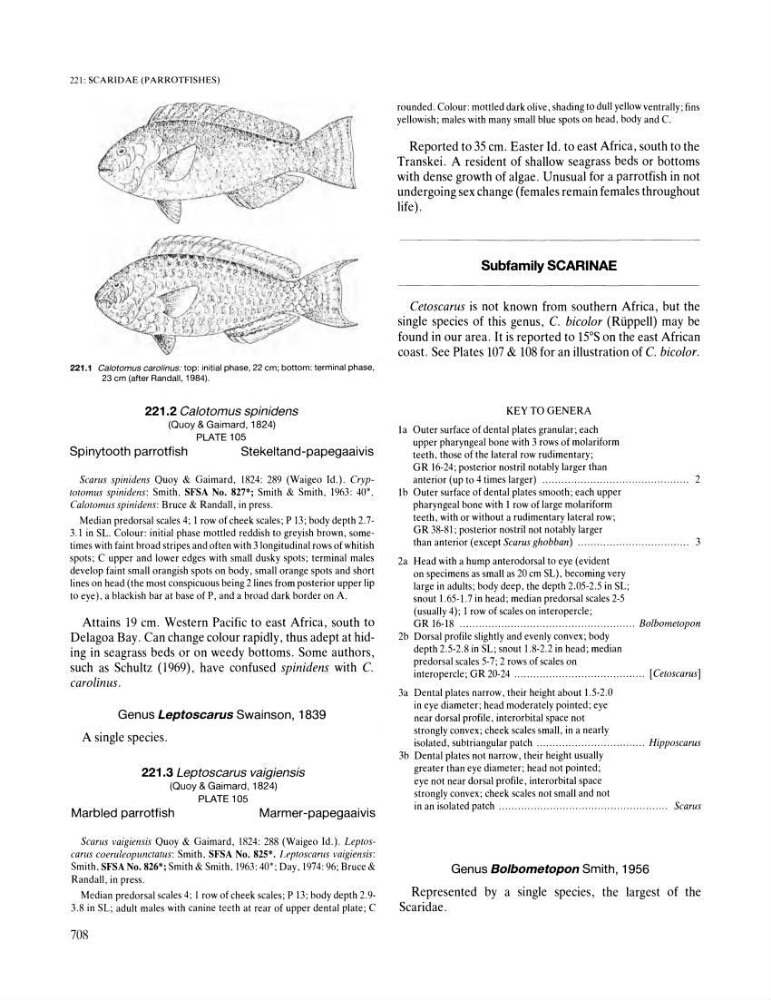
221.1 Calotomus carolinus: top: initial phase, 22 em; bottom: terminal phase,
23 em (after Randall, 1984).
221.2 Calotomus spinidens
(Quay & Gaimard, 1824)
PLATE 105
Spinytooth parrotfish
Stekeltand-papegaaivis
Scarus spinidens Quoy & Gaimard, 1824: 289 (Waigeo Id.). Cryp·
IOtomus spillidells: Smith, SFSA No. 827*; Smith & Smith, 1963: 40*.
Calotomus spillidells: Bruce & Randall, in press.
Median predorsal scales 4; 1 row of cheek scales; P 13; body depth 2.7·
3.1 in SL. Colour: initial phase mottled reddish to greyish brown, sometimes with faint broad stripes and often with 3 longitudinal rows of whitish
spots; C upper and lower edges with small dusky spots; terminal males
develop faint small orangish spots on body, small orange spots and short
lines on head (the most conspicuous being 2 lines from posterior upper lip
to eye), a blackish bar at base of P, and a broad dark border on A.
Attains 19 cm. Western Pacific to east Africa, south to
Delagoa Bay. Can change colour rapidly, thus adept at hiding in seagrass beds or on weedy bottoms. Some authors,
such as Schultz (1969), have confused spinidens with C.
carolinus.
Genus Leptoscarus Swainson, 1839
A single species.
221.3 Leptoscarus vaigiensis
(Quay & Gaimard, 1824)
PLATE 105
Marbled parrotfish
Marmer-papegaaivis
Scarus vaigiellsis Quoy & Gaimard, 1824: 288 (Waigeo Id.). Leptoscarus coeruleopwlctatus: Smith. SFSA No. 825*. teptoscarus vaigiellsis:
Smith, SFSA No. 826*; Smith & Smith. 1963: 40*; Day, 1974: 96; Bruce &
Randall, in press.
Median predorsal scales 4; 1 row of cheek scales; P 13; body depth 2.93.8 in SL; adult males with canine teeth at rear of upper dental plate; C
708
rounded. Colour: mottled dark olive, shading to dull yellow ventrally; fins
yellowish; males with many small blue spots on head, body and C.
Reported to 35 cm. Easter Id. to east Africa, south to the
Transkei. A resident of shallow seagrass beds or bottoms
with dense growth of algae. Unusual for a parrotfish in not
undergoing sex change (females remain females throughout
life) .
Subfamily SCARINAE
Cetoscarus is not known from southern Africa, but the
single species of this genus, C. bicolor (Ruppell) may be
found in our area. It is reported to lSOS on the east African
coast. See Plates 107 & 108 for an illustration of C. bicolor.
KEY TO GENERA
la Outer surface of dental plates granular; each
upper pharyngeal bone with 3 rows of molariform
teeth, those of the lateral row rudimentary;
GR 16-24; posterior nostril notably larger than
anterior (up to 4 times larger) .............................................. 2
Ib Outer surface of dental plates smooth; each upper
pharyngeal bone with 1 row of large molariform
teeth, with or without a rudimentary lateral row;
GR 38-81; posterior nostril not notably larger
than anterior (except Scarus ghobban) ................................... 3
2a Head with a hump anterodorsal to eye (evident
on specimens as small as 20 cm SL), becoming very
large in adults; body deep, the depth 2.05-2.5 in SL;
snout 1.65-1.7 in head; median predorsal scales 2-5
(usually 4); 1 row of scales on interopercle;
GR 16-18 ....................................................... Bolbometopon
2b Dorsal profile slightly and evenly convex; body
depth 2.5-2.8 in SL; snout 1.8-2.2 in head; median
predorsal scales 5-7; 2 rows of scales on
interopercle; GR 20-24 ......................................... [Cetoscarus]
3a Dental plates narrow, their height about 1.5-2.0
in eye diameter; head moderately pointed; eye
near dorsal profile, interorbital space not
strongly convex; cheek scales small, in a nearly
isolated, subtriangular patch .................................. Hipposcarus
3b Dental plates not narrow, their height usually
greater than eye diameter; head not pointed;
eye not near dorsal profile, interorbital space
strongly convex; cheek scales not small and not
in an isolated patch ............................................. ........ Scarus
Genus Bolbometopon Smith, 1956
Represented by a single species, the largest of the
Scaridae.
221.1 Calotomus carolinus: top: initial phase, 22 em; bottom: terminal phase,
23 em (after Randall, 1984).
221.2 Calotomus spinidens
(Quay & Gaimard, 1824)
PLATE 105
Spinytooth parrotfish
Stekeltand-papegaaivis
Scarus spinidens Quoy & Gaimard, 1824: 289 (Waigeo Id.). Cryp·
IOtomus spillidells: Smith, SFSA No. 827*; Smith & Smith, 1963: 40*.
Calotomus spillidells: Bruce & Randall, in press.
Median predorsal scales 4; 1 row of cheek scales; P 13; body depth 2.7·
3.1 in SL. Colour: initial phase mottled reddish to greyish brown, sometimes with faint broad stripes and often with 3 longitudinal rows of whitish
spots; C upper and lower edges with small dusky spots; terminal males
develop faint small orangish spots on body, small orange spots and short
lines on head (the most conspicuous being 2 lines from posterior upper lip
to eye), a blackish bar at base of P, and a broad dark border on A.
Attains 19 cm. Western Pacific to east Africa, south to
Delagoa Bay. Can change colour rapidly, thus adept at hiding in seagrass beds or on weedy bottoms. Some authors,
such as Schultz (1969), have confused spinidens with C.
carolinus.
Genus Leptoscarus Swainson, 1839
A single species.
221.3 Leptoscarus vaigiensis
(Quay & Gaimard, 1824)
PLATE 105
Marbled parrotfish
Marmer-papegaaivis
Scarus vaigiellsis Quoy & Gaimard, 1824: 288 (Waigeo Id.). Leptoscarus coeruleopwlctatus: Smith. SFSA No. 825*. teptoscarus vaigiellsis:
Smith, SFSA No. 826*; Smith & Smith. 1963: 40*; Day, 1974: 96; Bruce &
Randall, in press.
Median predorsal scales 4; 1 row of cheek scales; P 13; body depth 2.93.8 in SL; adult males with canine teeth at rear of upper dental plate; C
708
rounded. Colour: mottled dark olive, shading to dull yellow ventrally; fins
yellowish; males with many small blue spots on head, body and C.
Reported to 35 cm. Easter Id. to east Africa, south to the
Transkei. A resident of shallow seagrass beds or bottoms
with dense growth of algae. Unusual for a parrotfish in not
undergoing sex change (females remain females throughout
life) .
Subfamily SCARINAE
Cetoscarus is not known from southern Africa, but the
single species of this genus, C. bicolor (Ruppell) may be
found in our area. It is reported to lSOS on the east African
coast. See Plates 107 & 108 for an illustration of C. bicolor.
KEY TO GENERA
la Outer surface of dental plates granular; each
upper pharyngeal bone with 3 rows of molariform
teeth, those of the lateral row rudimentary;
GR 16-24; posterior nostril notably larger than
anterior (up to 4 times larger) .............................................. 2
Ib Outer surface of dental plates smooth; each upper
pharyngeal bone with 1 row of large molariform
teeth, with or without a rudimentary lateral row;
GR 38-81; posterior nostril not notably larger
than anterior (except Scarus ghobban) ................................... 3
2a Head with a hump anterodorsal to eye (evident
on specimens as small as 20 cm SL), becoming very
large in adults; body deep, the depth 2.05-2.5 in SL;
snout 1.65-1.7 in head; median predorsal scales 2-5
(usually 4); 1 row of scales on interopercle;
GR 16-18 ....................................................... Bolbometopon
2b Dorsal profile slightly and evenly convex; body
depth 2.5-2.8 in SL; snout 1.8-2.2 in head; median
predorsal scales 5-7; 2 rows of scales on
interopercle; GR 20-24 ......................................... [Cetoscarus]
3a Dental plates narrow, their height about 1.5-2.0
in eye diameter; head moderately pointed; eye
near dorsal profile, interorbital space not
strongly convex; cheek scales small, in a nearly
isolated, subtriangular patch .................................. Hipposcarus
3b Dental plates not narrow, their height usually
greater than eye diameter; head not pointed;
eye not near dorsal profile, interorbital space
strongly convex; cheek scales not small and not
in an isolated patch ............................................. ........ Scarus
Genus Bolbometopon Smith, 1956
Represented by a single species, the largest of the
Scaridae.