

those of lateral line with arborescent tubes; lateral line following contour of back to below rear of dorsal fin, then
dropping one scale row and continuing midlaterally on
caudal peduncle, the number of pored scales usually 18+6;
head naked except for scales on cheek. Fins naked, though
median fins may have a basal row of scales. Mouth small,
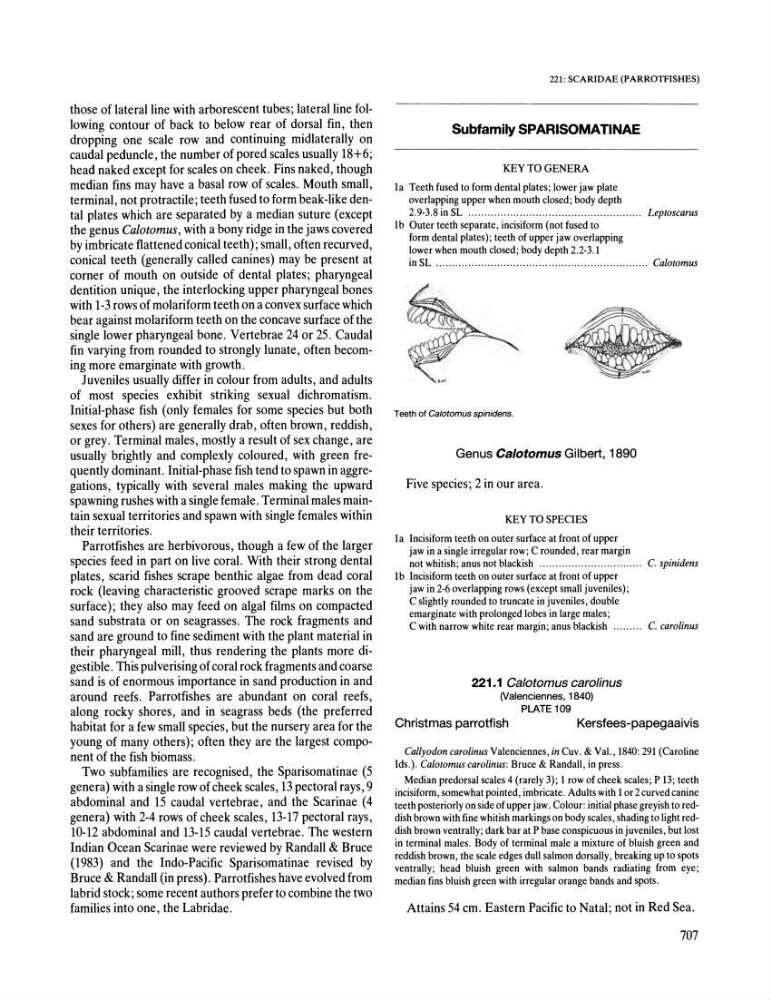
terminal, not protractile; teeth fused to form beak-like dental plates which are separated by a median suture (except
the genus Calotomus, with a bony ridge in the jaws covered
by imbricate flattened conical teeth); small, often recurved,
conical teeth (generally called canines) may be present at
corner of mouth on outside of dental plates; pharyngeal
dentition unique, the interlocking upper pharyngeal bones
with 1-3 rows of molariform teeth on a convex surface which
bear against molariform teeth on the concave surface of the
single lower pharyngeal bone. Vertebrae 24 or 25. Caudal
fin varying from rounded to strongly lunate, often becoming more emarginate with growth.
Juveniles usually differ in colour from adults, and adults
of most species exhibit striking sexual dichromatism.
Initial-phase fish (only females for some species but both
sexes for others) are generally drab, often brown, reddish,
or grey. Terminal males, mostly a result of sex change, are
usually brightly and complexly coloured, with green frequently dominant. Initial-phase fish tend to spawn in aggregations, typically with several males making the upward
spawning rushes with a single female. Terminal males maintain sexual territories and spawn with single females within
their territories.
Parrotfishes are herbivorous, though a few of the larger
species feed in part on live coral. With their strong dental
plates, scarid fishes scrape benthic algae from dead coral
rock (leaving characteristic grooved scrape marks on the
surface); they also may feed on algal films on compacted
sand substrata or on seagrasses. The rock fragments and
sand are ground to fine sediment with the plant material in
their pharyngeal mill, thus rendering the plants more digestible. This pulverising of coral rock fragments and coarse
sand is of enormous importance in sand production in and
around reefs. Parrotfishes are abundant on coral reefs,
along rocky shores, and in seagrass beds (the preferred
habitat for a few small species, but the nursery area for the
young of many others); often they are the largest component of the fish biomass.
Two subfamilies are recognised, the Sparisomatinae (5
genera) with a single row of cheek scales, 13 pectoral rays, 9
abdominal and 15 caudal vertebrae, and the Scarinae (4
genera) with 2-4 rows of cheek scales, 13-17 pectoral rays,
10-12 abdominal and 13-15 caudal vertebrae. The western
Indian Ocean Scarinae were reviewed by Randall & Bruce
(1983) and the Indo-Pacific Sparisomatinae revised by
Bruce & Randall (in press). Parrotfishes have evolved from
labrid stock; some recent authors prefer to combine the two
families into one, the Labridae.
221: SCARIDAE (PARROTFISHES)
Subfamily SPARISOMATINAE
KEY TO GENERA
1a Teeth fused to form dental plates; lower jaw plate
overlapping upper when mouth closed; body depth
2.9-3.8 in SL ...................................................... Leptoscarus
1 b Outer teeth separate, incisiform (not fused to
form dental plates); teeth of upper jaw overlapping
lower when mouth closed; body depth 2.2-3.1
in SL .................................................................. Calotomus
Teeth of Calotomus spinidens.
Genus Caiotomu5 Gilbert, 1890
Five species; 2 in our area.
KEY TO SPECIES
1a Incisiform teeth on outer surface at front of upper
jaw in a single irregular row; C rounded, rear margin
not whitish; anus not blackish ................................ C. spinidens
1 b Incisiform teeth on outer surface at front of upper
jaw in 2-6 overlapping rows (except small juveniles);
C slightly rounded to truncate in juveniles, double
emarginate with prolonged lobes in large males;
C with narrow white rear margin; anus blackish ......... C. carolinus
221.1 Calotomus carolinus
(Valenciennes, 1840)
PLATE 109
Christmas parrotfish
Kersfees-papegaaivis
Callyodon carolinus Valenciennes, in Cuv. & Val., 1840: 291 (Caroline
Ids.). Calotomus carolinus: Bruce & Randall, in press.
Median predorsal scales 4 (rarely 3); 1 row of cheek scales; P 13; teeth
incisiform, somewhat pointed, imbricate. Adults with 1 or 2 curved canine
teeth posteriorly on side of upper jaw. Colour: initial phase greyish to reddish brown with fine whitish markings on body scales, shading to light reddish brown ventrally; dark bar at P base conspicuous in juveniles, but lost
in terminal males. Body of terminal male a mixture of bluish green and
reddish brown, the scale edges dull salmon dorsally, breaking up to spots
ventrally; head bluish green with salmon bands radiating from eye;
median fins bluish green with irregular orange bands and spots.
Attains 54 cm. Eastern Pacific to Natal; not in Red Sea.
707
dropping one scale row and continuing midlaterally on
caudal peduncle, the number of pored scales usually 18+6;
head naked except for scales on cheek. Fins naked, though
median fins may have a basal row of scales. Mouth small,
terminal, not protractile; teeth fused to form beak-like dental plates which are separated by a median suture (except
the genus Calotomus, with a bony ridge in the jaws covered
by imbricate flattened conical teeth); small, often recurved,
conical teeth (generally called canines) may be present at
corner of mouth on outside of dental plates; pharyngeal
dentition unique, the interlocking upper pharyngeal bones
with 1-3 rows of molariform teeth on a convex surface which
bear against molariform teeth on the concave surface of the
single lower pharyngeal bone. Vertebrae 24 or 25. Caudal
fin varying from rounded to strongly lunate, often becoming more emarginate with growth.
Juveniles usually differ in colour from adults, and adults
of most species exhibit striking sexual dichromatism.
Initial-phase fish (only females for some species but both
sexes for others) are generally drab, often brown, reddish,
or grey. Terminal males, mostly a result of sex change, are
usually brightly and complexly coloured, with green frequently dominant. Initial-phase fish tend to spawn in aggregations, typically with several males making the upward
spawning rushes with a single female. Terminal males maintain sexual territories and spawn with single females within
their territories.
Parrotfishes are herbivorous, though a few of the larger
species feed in part on live coral. With their strong dental
plates, scarid fishes scrape benthic algae from dead coral
rock (leaving characteristic grooved scrape marks on the
surface); they also may feed on algal films on compacted
sand substrata or on seagrasses. The rock fragments and
sand are ground to fine sediment with the plant material in
their pharyngeal mill, thus rendering the plants more digestible. This pulverising of coral rock fragments and coarse
sand is of enormous importance in sand production in and
around reefs. Parrotfishes are abundant on coral reefs,
along rocky shores, and in seagrass beds (the preferred
habitat for a few small species, but the nursery area for the
young of many others); often they are the largest component of the fish biomass.
Two subfamilies are recognised, the Sparisomatinae (5
genera) with a single row of cheek scales, 13 pectoral rays, 9
abdominal and 15 caudal vertebrae, and the Scarinae (4
genera) with 2-4 rows of cheek scales, 13-17 pectoral rays,
10-12 abdominal and 13-15 caudal vertebrae. The western
Indian Ocean Scarinae were reviewed by Randall & Bruce
(1983) and the Indo-Pacific Sparisomatinae revised by
Bruce & Randall (in press). Parrotfishes have evolved from
labrid stock; some recent authors prefer to combine the two
families into one, the Labridae.
221: SCARIDAE (PARROTFISHES)
Subfamily SPARISOMATINAE
KEY TO GENERA
1a Teeth fused to form dental plates; lower jaw plate
overlapping upper when mouth closed; body depth
2.9-3.8 in SL ...................................................... Leptoscarus
1 b Outer teeth separate, incisiform (not fused to
form dental plates); teeth of upper jaw overlapping
lower when mouth closed; body depth 2.2-3.1
in SL .................................................................. Calotomus
Teeth of Calotomus spinidens.
Genus Caiotomu5 Gilbert, 1890
Five species; 2 in our area.
KEY TO SPECIES
1a Incisiform teeth on outer surface at front of upper
jaw in a single irregular row; C rounded, rear margin
not whitish; anus not blackish ................................ C. spinidens
1 b Incisiform teeth on outer surface at front of upper
jaw in 2-6 overlapping rows (except small juveniles);
C slightly rounded to truncate in juveniles, double
emarginate with prolonged lobes in large males;
C with narrow white rear margin; anus blackish ......... C. carolinus
221.1 Calotomus carolinus
(Valenciennes, 1840)
PLATE 109
Christmas parrotfish
Kersfees-papegaaivis
Callyodon carolinus Valenciennes, in Cuv. & Val., 1840: 291 (Caroline
Ids.). Calotomus carolinus: Bruce & Randall, in press.
Median predorsal scales 4 (rarely 3); 1 row of cheek scales; P 13; teeth
incisiform, somewhat pointed, imbricate. Adults with 1 or 2 curved canine
teeth posteriorly on side of upper jaw. Colour: initial phase greyish to reddish brown with fine whitish markings on body scales, shading to light reddish brown ventrally; dark bar at P base conspicuous in juveniles, but lost
in terminal males. Body of terminal male a mixture of bluish green and
reddish brown, the scale edges dull salmon dorsally, breaking up to spots
ventrally; head bluish green with salmon bands radiating from eye;
median fins bluish green with irregular orange bands and spots.
Attains 54 cm. Eastern Pacific to Natal; not in Red Sea.
707