

220: LABRIDAE (WRASSES)
1 b First 2 D spines not notably longer than other
D spines , joined by membrane to rest of fin ;
colour not as in la .. .. ................. .. .................. ..... ......... .... .. 2
2a Deep notch between 2nd and 3rd D spines; about
8 vertical rows of small scales on cheek extending
to below mouth ; females with a diffuse blackish
blotch between P tip and LL and a red-orange dot
on many scales of body; males with a less distinct
blackish spot and a series of about 5 red spots
behind eye and along front of LL ............ ...... .... X. pentadactylus
2b No notch between 2nd and 3rd D spines; a diagonal
row of small scales from behind to below eye
(sometimes a few scales form a 2nd row) ; no
blackish spot on side of body (instead a red bar
on side of adults); a vertical light blue line on
each body scale .. .. .. .................. .. .. ...... .. .. ...... .. ..... X. novacula
220.66 Xyrichtys novacula
(linnaeus, 1758)
Pearly razorfish
Perel-skeermesvis
Coryphaena novacula Linnaeus , 1758: 262 (Mediterranean Sea).
Coryphaena psittacus Linnaeus, 1766 (Charleston, South Carolina).
Xyrichthys argentimaculata Steindachner, 1861: 134 (Cape of Good
Hope). Hemipteronotus novacula: Randall , 1965: 489.
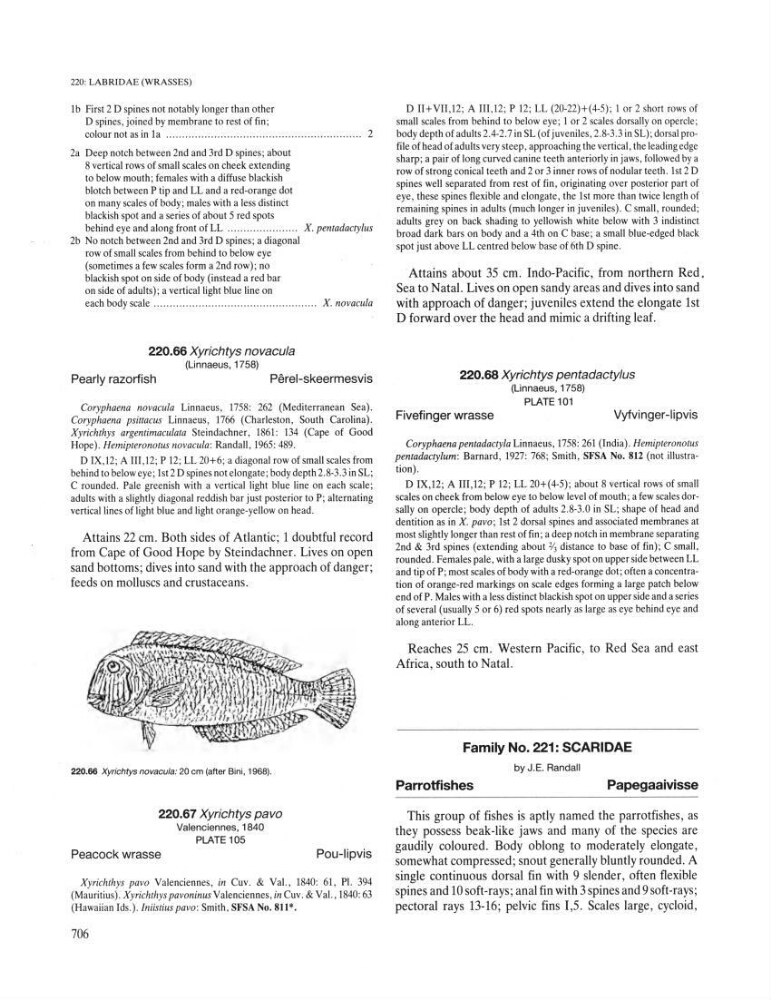
D IX,12; A III,12 ; P 12; LL 20+6; a diagonal row of small scales from
behind to below eye; 1st 2 D spines not elongate; body depth 2.8-3.3 in SL;
C rounded. Pale greenish with a vertical light blue line on each scale ;
adults with a slightly diagonal reddish bar just posterior to P; alternating
vertical lines of light blue and light orange-yellow on head.
Attains 22 cm. Both sides of Atlantic; 1 doubtful record
from Cape of Good Hope by Steindachner. Lives on open
sand bottoms ; dives into sand with the approach of danger;
feeds on molluscs and crustaceans.
220.66 Xyrichtys novacula: 20 em (after Bini, 1968).
220.67 Xyrichtys pavo
Valenciennes, 1840
PLATE 105
Peacock wrasse
Pou-lipvis
Xyrichthys pavo Valenciennes, in Cuv. & Val. , 1840: 61, PI. 394
(Mauritius). Xyrichthys pavoninus Valenciennes, in Cuv. & Val. , 1840: 63
(Hawaiian Ids.). Iniistius pavo: Smith , SFSA No. 811*.
706
D II+VII,12; A III ,12; P 12; LL (20-22)+(4-5) ; 1 or 2 short rows of
small scales from behind to below eye ; 1 or 2 scales dorsally on opercle ;
body depth of adults 2.4-2.7 in SL (of juveniles, 2.8-3.3 in SL) ; dorsal profile of head of adults very steep, approaching the vertical, the leading edge
sharp; a pair of long curved canine teeth anteriorly in jaws, followed by a
row of strong conical teeth and 2 or 3 inner rows of nodular teeth. 1st 2 D
spines well separated from rest of fin, originating over posterior part of
eye, these spines flexible and elongate, the 1st more than twice length of
remaining spines in adults (much longer in juveniles). C small, rounded ;
adults grey on back shading to yellowish white below with 3 indistinct
broad dark bars on body and a 4th on C base ; a small blue-edged black
spot just above LL centred below base of 6th D spine.
Attains about 35 cm. Indo-Pacific, from northern Red.
Sea to Natal. Lives on open sandy areas and dives into sand
with approach of danger; juveniles extend the elongate 1st
D forward over the head and mimic a drifting leaf.
220.68 Xyrichtys pentadactylus
(linnaeus, 1758)
PLATE 101
Fivefinger wrasse
Vyfvinger-lipvis
Coryphaena pentadactyla Linnaeus , 1758: 261 (India). Hemipteronotus
pentadactylum: Barnard, 1927: 768; Smith , SFSA No. 812 (not illustration) .
D IX,12; A III,12; P 12; LL 20+(4-5) ; about 8 vertical rows of small
scales on cheek from below eye to below level of mouth; a few scales dorsally on opercle; body depth of adults 2.8-3.0 in SL; shape of head and
dentition as in X. pavo; 1st 2 dorsal spines and associated membranes at
most slightly longer than rest offin; a deep notch in membrane separating
2nd & 3rd spines (extending about 2/ 3 distance to base of fin) ; C small,
rounded. Females pale, with a large dusky spot on upper side between LL
and tip of P; most scales of body with a red-orange dot; often a concentration of orange-red markings on scale edges forming a large patch below
end of P. Males with a less distinct blackish spot on upper side and a series
of several (usually 5 or 6) red spots nearly as large as eye behind eye and
along anterior LL.
Reaches 25 cm. Western Pacific, to Red Sea and east
Africa, south to Natal.
Family No. 221: SCARIDAE
by J.E. Randall
Parrotfishes
Papegaaivisse
This group of fishes is aptly named the parrotfishes, as
they possess beak-like jaws and many of the species are
gaudily coloured. Body oblong to moderately elongate,
somewhat compressed; snout generally bluntly rounded. A
single continuous dorsal fin with 9 slender, often flexible
spines and 10 soft-rays; anal fin with 3 spines and 9 soft-rays;
pectoral rays 13-16; pelvic fins 1,5. Scales large, cycloid,
1 b First 2 D spines not notably longer than other
D spines , joined by membrane to rest of fin ;
colour not as in la .. .. ................. .. .................. ..... ......... .... .. 2
2a Deep notch between 2nd and 3rd D spines; about
8 vertical rows of small scales on cheek extending
to below mouth ; females with a diffuse blackish
blotch between P tip and LL and a red-orange dot
on many scales of body; males with a less distinct
blackish spot and a series of about 5 red spots
behind eye and along front of LL ............ ...... .... X. pentadactylus
2b No notch between 2nd and 3rd D spines; a diagonal
row of small scales from behind to below eye
(sometimes a few scales form a 2nd row) ; no
blackish spot on side of body (instead a red bar
on side of adults); a vertical light blue line on
each body scale .. .. .. .................. .. .. ...... .. .. ...... .. ..... X. novacula
220.66 Xyrichtys novacula
(linnaeus, 1758)
Pearly razorfish
Perel-skeermesvis
Coryphaena novacula Linnaeus , 1758: 262 (Mediterranean Sea).
Coryphaena psittacus Linnaeus, 1766 (Charleston, South Carolina).
Xyrichthys argentimaculata Steindachner, 1861: 134 (Cape of Good
Hope). Hemipteronotus novacula: Randall , 1965: 489.
D IX,12; A III,12 ; P 12; LL 20+6; a diagonal row of small scales from
behind to below eye; 1st 2 D spines not elongate; body depth 2.8-3.3 in SL;
C rounded. Pale greenish with a vertical light blue line on each scale ;
adults with a slightly diagonal reddish bar just posterior to P; alternating
vertical lines of light blue and light orange-yellow on head.
Attains 22 cm. Both sides of Atlantic; 1 doubtful record
from Cape of Good Hope by Steindachner. Lives on open
sand bottoms ; dives into sand with the approach of danger;
feeds on molluscs and crustaceans.
220.66 Xyrichtys novacula: 20 em (after Bini, 1968).
220.67 Xyrichtys pavo
Valenciennes, 1840
PLATE 105
Peacock wrasse
Pou-lipvis
Xyrichthys pavo Valenciennes, in Cuv. & Val. , 1840: 61, PI. 394
(Mauritius). Xyrichthys pavoninus Valenciennes, in Cuv. & Val. , 1840: 63
(Hawaiian Ids.). Iniistius pavo: Smith , SFSA No. 811*.
706
D II+VII,12; A III ,12; P 12; LL (20-22)+(4-5) ; 1 or 2 short rows of
small scales from behind to below eye ; 1 or 2 scales dorsally on opercle ;
body depth of adults 2.4-2.7 in SL (of juveniles, 2.8-3.3 in SL) ; dorsal profile of head of adults very steep, approaching the vertical, the leading edge
sharp; a pair of long curved canine teeth anteriorly in jaws, followed by a
row of strong conical teeth and 2 or 3 inner rows of nodular teeth. 1st 2 D
spines well separated from rest of fin, originating over posterior part of
eye, these spines flexible and elongate, the 1st more than twice length of
remaining spines in adults (much longer in juveniles). C small, rounded ;
adults grey on back shading to yellowish white below with 3 indistinct
broad dark bars on body and a 4th on C base ; a small blue-edged black
spot just above LL centred below base of 6th D spine.
Attains about 35 cm. Indo-Pacific, from northern Red.
Sea to Natal. Lives on open sandy areas and dives into sand
with approach of danger; juveniles extend the elongate 1st
D forward over the head and mimic a drifting leaf.
220.68 Xyrichtys pentadactylus
(linnaeus, 1758)
PLATE 101
Fivefinger wrasse
Vyfvinger-lipvis
Coryphaena pentadactyla Linnaeus , 1758: 261 (India). Hemipteronotus
pentadactylum: Barnard, 1927: 768; Smith , SFSA No. 812 (not illustration) .
D IX,12; A III,12; P 12; LL 20+(4-5) ; about 8 vertical rows of small
scales on cheek from below eye to below level of mouth; a few scales dorsally on opercle; body depth of adults 2.8-3.0 in SL; shape of head and
dentition as in X. pavo; 1st 2 dorsal spines and associated membranes at
most slightly longer than rest offin; a deep notch in membrane separating
2nd & 3rd spines (extending about 2/ 3 distance to base of fin) ; C small,
rounded. Females pale, with a large dusky spot on upper side between LL
and tip of P; most scales of body with a red-orange dot; often a concentration of orange-red markings on scale edges forming a large patch below
end of P. Males with a less distinct blackish spot on upper side and a series
of several (usually 5 or 6) red spots nearly as large as eye behind eye and
along anterior LL.
Reaches 25 cm. Western Pacific, to Red Sea and east
Africa, south to Natal.
Family No. 221: SCARIDAE
by J.E. Randall
Parrotfishes
Papegaaivisse
This group of fishes is aptly named the parrotfishes, as
they possess beak-like jaws and many of the species are
gaudily coloured. Body oblong to moderately elongate,
somewhat compressed; snout generally bluntly rounded. A
single continuous dorsal fin with 9 slender, often flexible
spines and 10 soft-rays; anal fin with 3 spines and 9 soft-rays;
pectoral rays 13-16; pelvic fins 1,5. Scales large, cycloid,