

221.4 Bolbometopon muricatum
(Valenciennes, 1840)
PLATE 106
Humphead parrotfish
Ramkop-papegaaivis
Scarus muricatus Valenciemies, in Cuv. & VaL, 1840: 208, PI. 402
(Java). Callyodon muricatus: Smith, 1953: 621 *. Bolbometopon
muricatus Smith, 1956: 8*; 1959: 269*, 278*; 1962: 509; Smith & Smith,
1963: 40*; Smith, 1965: 33*. Bolbometopon muricatum Randall & Bruce,
1983: 6. *
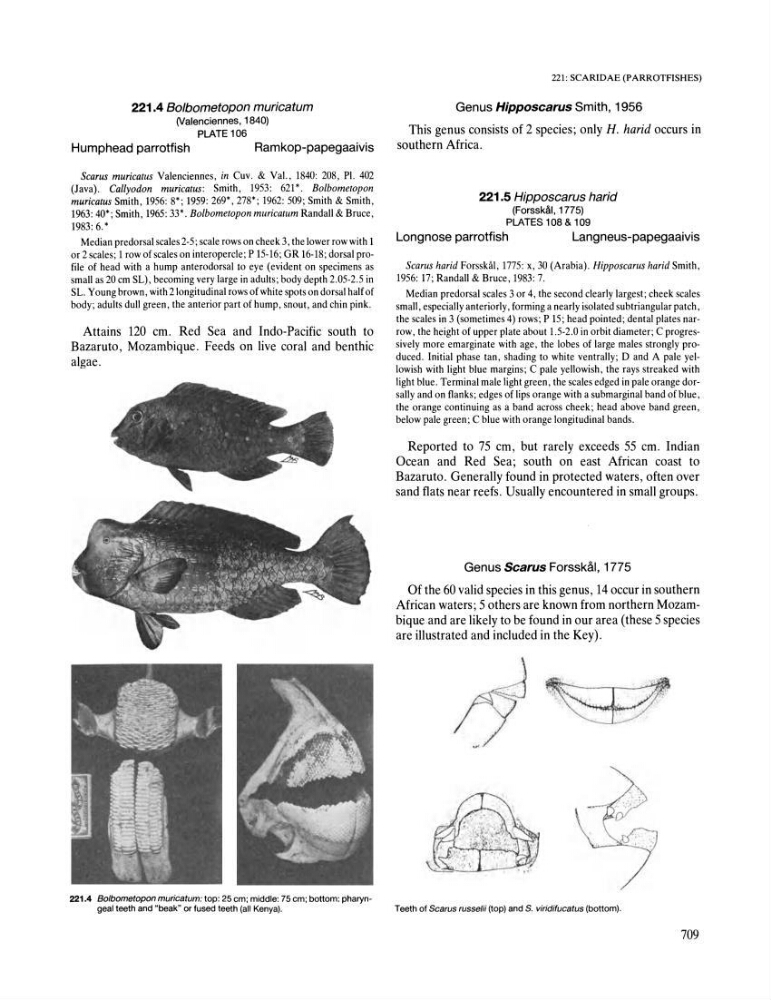
Median pre dorsal scales 2-5; scale rows on cheek 3, the lower row with 1
or 2 scales; 1 row of scales on interopercle; P 15-16; GR 16-18; dorsal profile of head with a hump anterodorsal to eye (evident on specimens as
small as 20 cm SL), becoming very large in adults; body depth 2.05-2.5 in
SL. Young brown, with 2 longitudinal rows of white spots on dorsal half of
body; adults dull green, the anterior part of hump, snout, and chin pink.
Attains 120 cm. Red Sea and Indo-Pacific south to
Bazaruto, Mozambique. Feeds on live coral and benthic
algae.
221.4 Bolbometopon muricatum: top: 25 em; middle: 75 em; bottom: pharyngeal teeth and "beak" or fused teeth (all Kenya).
221: SCARIDAE (PARROTFISHES)
Genus Hipposcarus Smith, 1956
This genus consists of 2 species; only H. harid occurs in
southern Africa.
221.5 Hipposcarus harid
(Forsskal, 1775)
PLATES 108 & 109
Longnose parrotfish
Langneus-papegaaivis
Scarus harid Forsskal, 1775: x, 30 (Arabia). Hipposcarus harid Smith,
1956: 17; Randall & Bruce, 1983: 7.
Median predorsal scales 3 or 4, the second clearly largest; cheek scales
small, especially anteriorly, forming a nearly isolated subtriangular patch,
the scales in 3 (sometimes 4) rows; P 15; head pointed; dental plates narrow, the height of upper plate about 1.5-2.0 in orbit diameter; C progressively more emarginate with age, the lobes of large males strongly produced. Initial phase tan, shading to white ventrally; 0 and A pale yellowish with light blue margins; C pale yellowish, the rays streaked with
light blue. Terminal male light green, the scales edged in pale orange dorsally and on flanks; edges of lips orange with a submarginal band of blue,
the orange continuing as a band across cheek; head above band green,
below pale green; C blue with orange longitudinal bands.
Reported to 75 cm, but rarely exceeds 55 cm. Indian
Ocean and Red Sea; south on east African coast to
Bazaruto. Generally found in protected waters, often over
sand fiats near reefs. Usually encountered in small groups.
Genus Scarus Forsskal, 1775
Of the 60 valid species in this genus, 14 occur in southern
African waters; 5 others are known from northern Mozambiqueand are likely to be found in our area (these 5 species
are illustrated and included in the Key).
Teeth of Scarus russelii (top) and S. viridifucatus (bottom).
709
(Valenciennes, 1840)
PLATE 106
Humphead parrotfish
Ramkop-papegaaivis
Scarus muricatus Valenciemies, in Cuv. & VaL, 1840: 208, PI. 402
(Java). Callyodon muricatus: Smith, 1953: 621 *. Bolbometopon
muricatus Smith, 1956: 8*; 1959: 269*, 278*; 1962: 509; Smith & Smith,
1963: 40*; Smith, 1965: 33*. Bolbometopon muricatum Randall & Bruce,
1983: 6. *
Median pre dorsal scales 2-5; scale rows on cheek 3, the lower row with 1
or 2 scales; 1 row of scales on interopercle; P 15-16; GR 16-18; dorsal profile of head with a hump anterodorsal to eye (evident on specimens as
small as 20 cm SL), becoming very large in adults; body depth 2.05-2.5 in
SL. Young brown, with 2 longitudinal rows of white spots on dorsal half of
body; adults dull green, the anterior part of hump, snout, and chin pink.
Attains 120 cm. Red Sea and Indo-Pacific south to
Bazaruto, Mozambique. Feeds on live coral and benthic
algae.
221.4 Bolbometopon muricatum: top: 25 em; middle: 75 em; bottom: pharyngeal teeth and "beak" or fused teeth (all Kenya).
221: SCARIDAE (PARROTFISHES)
Genus Hipposcarus Smith, 1956
This genus consists of 2 species; only H. harid occurs in
southern Africa.
221.5 Hipposcarus harid
(Forsskal, 1775)
PLATES 108 & 109
Longnose parrotfish
Langneus-papegaaivis
Scarus harid Forsskal, 1775: x, 30 (Arabia). Hipposcarus harid Smith,
1956: 17; Randall & Bruce, 1983: 7.
Median predorsal scales 3 or 4, the second clearly largest; cheek scales
small, especially anteriorly, forming a nearly isolated subtriangular patch,
the scales in 3 (sometimes 4) rows; P 15; head pointed; dental plates narrow, the height of upper plate about 1.5-2.0 in orbit diameter; C progressively more emarginate with age, the lobes of large males strongly produced. Initial phase tan, shading to white ventrally; 0 and A pale yellowish with light blue margins; C pale yellowish, the rays streaked with
light blue. Terminal male light green, the scales edged in pale orange dorsally and on flanks; edges of lips orange with a submarginal band of blue,
the orange continuing as a band across cheek; head above band green,
below pale green; C blue with orange longitudinal bands.
Reported to 75 cm, but rarely exceeds 55 cm. Indian
Ocean and Red Sea; south on east African coast to
Bazaruto. Generally found in protected waters, often over
sand fiats near reefs. Usually encountered in small groups.
Genus Scarus Forsskal, 1775
Of the 60 valid species in this genus, 14 occur in southern
African waters; 5 others are known from northern Mozambiqueand are likely to be found in our area (these 5 species
are illustrated and included in the Key).
Teeth of Scarus russelii (top) and S. viridifucatus (bottom).
709