

220: LABRIDAE (WRASSES)
220.40 Labroides bicolor
Fowler & Bean, 1928
PLATES 98 & 100
Bicoloured cleaner wrasse Tweekleur-skoonmakertjie
Labroides bicolor Fowler & Bean, 1928: 224, PI. 18 (Philippines); Randall, 1958: 334*; Smith, 1980: 181.
D IX,ll; A m,lO; P 13; LL 26 (+2 on C base), bent downward below
rear of D; body depth 3.7-4.5 in SL; cheek and opercle scaled, rest of head
naked; lips and dentition as in L. dimidiatus; P short; C slightly rounded.
Females dark grey to blackish with a black lateral stripe anteriorly, whitish
to yellowish posteriorly, with curved submarginal band in hind part of C.
Males with head deep blue, body black anteriorly, becoming yellow posteriorly; C with a subterminal black crescent, green anterior and posterior
to this marking. Juveniles largely black with narrow bright yellow stripe
on back which continues dorsally onto head.
Attains 14 cm; Indo-Pacific south to Natal. Food habits as
in L. dimidiatus, but more inclined to rove in quest of host
fishes.
220.41 Labroides dimidiatus
(Valenciennes, 1839)
PLATE 100
Bluestreak cleaner wrasse Bloustreep-skoonmakertjie
Cossyphus dimidiatus Valenciennes, in Cuv. & Val., 1839: 136
(Mauritius) (on Labrus latovitlatus (non Lacepede): Riippell, 1835; Gulf
of Suez). Fissilabrus dimidiatus: Smith, SFSA No. 805*. Labroides
dimidil,ltus: Randall, 1958: 329*; van der Elst, 1981: 191 *.
D IX,II; A m,lO; P 13; LL 50-52 (+2 on C base), bent downward beneath posterior part of D; body depth 4.1-4.7; small scales on cheek and
operculum, the rest of head naked; lips thick, the lower strongly bilobed; a
single pair of curved canine teeth anteriorly in each jaw and a canine posteriorly on upper jaw; sides of jaws with several rows of small teeth; V
small; C truncate to slightly rounded. Adults light blue, shading to pale
yellowish or white anteriorly, with a black stripe from snout through eye
to rear edge of C, this stripe progressively broader posteriorly. Juveniles
largely black with a narrow bright blue stripe on back which continues
onto dorsal part of head.
Attains 11.5 cm. Indo-Pacific; south to Algoa Bay. Feeds
mainly on crustacean ectoparasites and mucus of other
fishes, even entering the mouths and gill chambers of some
of the larger host fishes. Establishes "cleaning" stations on
the reef to which host fishes come for its services.
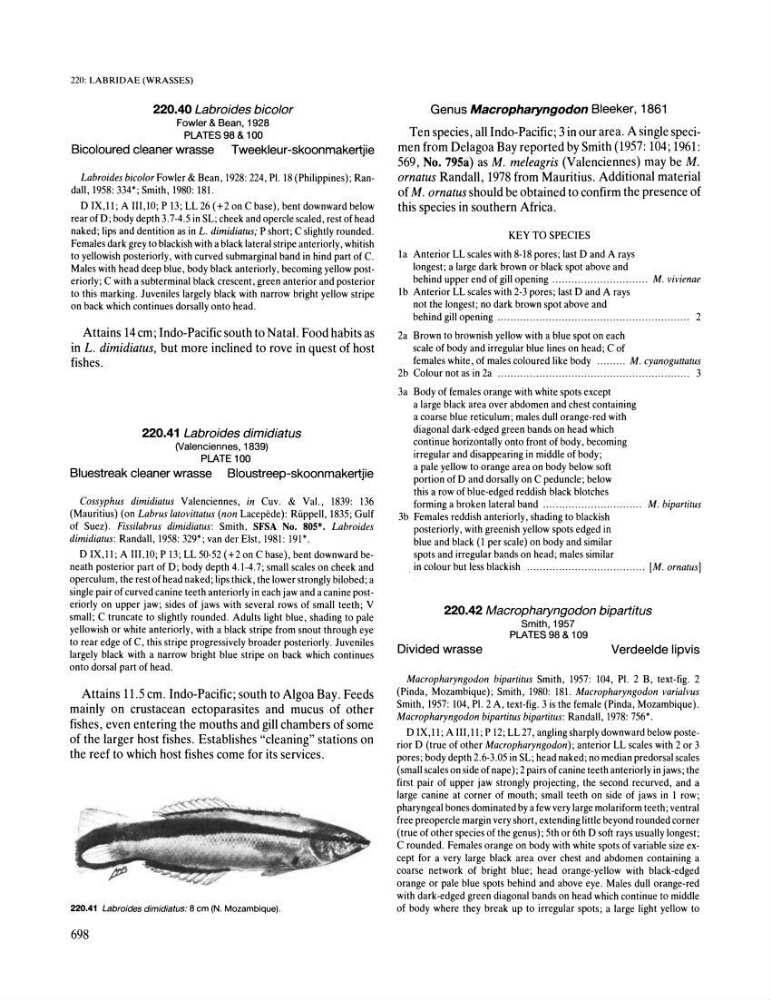
220.41 Labroides dimidiatus: 8 cm (N. Mozambique).
698
Genus Macropharyngodon Bleeker, 1861
Ten species, all Indo-Pacific; 3 in our area. A single specimen from Delagoa Bay reported by Smith (1957: 104; 1961:
569, No. 79Sa) as M. meleagris (Valenciennes) may be M.
ornatus Randall, 1978 from Mauritius. Additional material
of M. ornatus should be obtained to confirm the presence of
this species in southern Africa.
KEY TO SPECIES
la Anterior LL scales with 8-18 pores; last D and A rays
longest; a large dark brown or black spot above and
behind upper end of gill opening .............................. M. vivienae
Ib Anterior LL scales with 2-3 pores; last D and A rays
not the longest; no dark brown spot above and
behind gill opening ............................................................ 2
2a Brown to brownish yellow with a blue spot on each
scale of body and irregular blue lines on head; C of
females white, of males coloured like body ......... M. cyanoguttatus
2b Colour not as in 2a ............................................................ 3
3a Body of females orange with white spots except
a large black area over abdomen and chest containing
a coarse blue reticulum; males dull orange-red with
diagonal dark-edged green bands on head which
continue horizontally onto front of body, becoming
irregular and disappearing in middle of body;
a pale yellow to orange area on body below soft
portion of D and dorsally on C peduncle; below
this a row of blue-edged reddish black blotches
forming a broken lateral band ............................... M. bipartitus
3b Females reddish anteriorly, shading to blackish
posteriorly, with greenish yellow spots edged in
blue and black (1 per scale) on body and similar
spots and irregular bands on head; males similar
in colour but less blackish ..................................... [M. ornatus]
220.42 Macropharyngodon bipartitus
Smith,1957
PLATES 98 & 109
Divided wrasse
Verdeelde lipvis
Macropharyngodon bipartitus Smith, 1957: 104, PI. 2 B, text-fig. 2
(Pinda, Mozambique); Smith, 1980: 181. Macropharyngodon varialvus
Smith, 1957: 104, PI. 2 A, text-fig. 3 is the female (Pinda, Mozambique).
Macropharyngodon bipartitus bipartitus: Randall, 1978: 756*.
D IX,ll; A m,ll; P 12; LL27, angling sharply downward below posterior D (true of other Macropharyngodon); anterior LL scales with 2 or 3
pores; body depth 2.6-3.05 in SL; head naked; no median predorsal scales
(small scales on side of nape); 2 pairs of canine teeth anteriorly injaws; the
first pair of upper jaw strongly projecting, the second recurved, and a
large canine at corner of mouth; small teeth on side of jaws in 1 row;
pharyngeal bones dominated by a few very large molariform teeth; ventral
free preopercle margin very short, extending little beyond rounded corner
(true of other species of the genus); 5th or 6th D soft rays usually longest;
C rounded. Females orange on body with white spots of variable size except for a very large black area over chest and abdomen containing a
coarse network of bright blue; head orange-yellow with black-edged
orange or pale blue spots behind and above eye. Males dull orange-red
with dark-edged green diagonal bands on head which continue to middle
of body where they break up to irregular spots; a large light yellow to
220.40 Labroides bicolor
Fowler & Bean, 1928
PLATES 98 & 100
Bicoloured cleaner wrasse Tweekleur-skoonmakertjie
Labroides bicolor Fowler & Bean, 1928: 224, PI. 18 (Philippines); Randall, 1958: 334*; Smith, 1980: 181.
D IX,ll; A m,lO; P 13; LL 26 (+2 on C base), bent downward below
rear of D; body depth 3.7-4.5 in SL; cheek and opercle scaled, rest of head
naked; lips and dentition as in L. dimidiatus; P short; C slightly rounded.
Females dark grey to blackish with a black lateral stripe anteriorly, whitish
to yellowish posteriorly, with curved submarginal band in hind part of C.
Males with head deep blue, body black anteriorly, becoming yellow posteriorly; C with a subterminal black crescent, green anterior and posterior
to this marking. Juveniles largely black with narrow bright yellow stripe
on back which continues dorsally onto head.
Attains 14 cm; Indo-Pacific south to Natal. Food habits as
in L. dimidiatus, but more inclined to rove in quest of host
fishes.
220.41 Labroides dimidiatus
(Valenciennes, 1839)
PLATE 100
Bluestreak cleaner wrasse Bloustreep-skoonmakertjie
Cossyphus dimidiatus Valenciennes, in Cuv. & Val., 1839: 136
(Mauritius) (on Labrus latovitlatus (non Lacepede): Riippell, 1835; Gulf
of Suez). Fissilabrus dimidiatus: Smith, SFSA No. 805*. Labroides
dimidil,ltus: Randall, 1958: 329*; van der Elst, 1981: 191 *.
D IX,II; A m,lO; P 13; LL 50-52 (+2 on C base), bent downward beneath posterior part of D; body depth 4.1-4.7; small scales on cheek and
operculum, the rest of head naked; lips thick, the lower strongly bilobed; a
single pair of curved canine teeth anteriorly in each jaw and a canine posteriorly on upper jaw; sides of jaws with several rows of small teeth; V
small; C truncate to slightly rounded. Adults light blue, shading to pale
yellowish or white anteriorly, with a black stripe from snout through eye
to rear edge of C, this stripe progressively broader posteriorly. Juveniles
largely black with a narrow bright blue stripe on back which continues
onto dorsal part of head.
Attains 11.5 cm. Indo-Pacific; south to Algoa Bay. Feeds
mainly on crustacean ectoparasites and mucus of other
fishes, even entering the mouths and gill chambers of some
of the larger host fishes. Establishes "cleaning" stations on
the reef to which host fishes come for its services.
220.41 Labroides dimidiatus: 8 cm (N. Mozambique).
698
Genus Macropharyngodon Bleeker, 1861
Ten species, all Indo-Pacific; 3 in our area. A single specimen from Delagoa Bay reported by Smith (1957: 104; 1961:
569, No. 79Sa) as M. meleagris (Valenciennes) may be M.
ornatus Randall, 1978 from Mauritius. Additional material
of M. ornatus should be obtained to confirm the presence of
this species in southern Africa.
KEY TO SPECIES
la Anterior LL scales with 8-18 pores; last D and A rays
longest; a large dark brown or black spot above and
behind upper end of gill opening .............................. M. vivienae
Ib Anterior LL scales with 2-3 pores; last D and A rays
not the longest; no dark brown spot above and
behind gill opening ............................................................ 2
2a Brown to brownish yellow with a blue spot on each
scale of body and irregular blue lines on head; C of
females white, of males coloured like body ......... M. cyanoguttatus
2b Colour not as in 2a ............................................................ 3
3a Body of females orange with white spots except
a large black area over abdomen and chest containing
a coarse blue reticulum; males dull orange-red with
diagonal dark-edged green bands on head which
continue horizontally onto front of body, becoming
irregular and disappearing in middle of body;
a pale yellow to orange area on body below soft
portion of D and dorsally on C peduncle; below
this a row of blue-edged reddish black blotches
forming a broken lateral band ............................... M. bipartitus
3b Females reddish anteriorly, shading to blackish
posteriorly, with greenish yellow spots edged in
blue and black (1 per scale) on body and similar
spots and irregular bands on head; males similar
in colour but less blackish ..................................... [M. ornatus]
220.42 Macropharyngodon bipartitus
Smith,1957
PLATES 98 & 109
Divided wrasse
Verdeelde lipvis
Macropharyngodon bipartitus Smith, 1957: 104, PI. 2 B, text-fig. 2
(Pinda, Mozambique); Smith, 1980: 181. Macropharyngodon varialvus
Smith, 1957: 104, PI. 2 A, text-fig. 3 is the female (Pinda, Mozambique).
Macropharyngodon bipartitus bipartitus: Randall, 1978: 756*.
D IX,ll; A m,ll; P 12; LL27, angling sharply downward below posterior D (true of other Macropharyngodon); anterior LL scales with 2 or 3
pores; body depth 2.6-3.05 in SL; head naked; no median predorsal scales
(small scales on side of nape); 2 pairs of canine teeth anteriorly injaws; the
first pair of upper jaw strongly projecting, the second recurved, and a
large canine at corner of mouth; small teeth on side of jaws in 1 row;
pharyngeal bones dominated by a few very large molariform teeth; ventral
free preopercle margin very short, extending little beyond rounded corner
(true of other species of the genus); 5th or 6th D soft rays usually longest;
C rounded. Females orange on body with white spots of variable size except for a very large black area over chest and abdomen containing a
coarse network of bright blue; head orange-yellow with black-edged
orange or pale blue spots behind and above eye. Males dull orange-red
with dark-edged green diagonal bands on head which continue to middle
of body where they break up to irregular spots; a large light yellow to