

orange area beneath soft portion of D and onto C peduncle; a series of
blue-edged dark reddish blotches forming an irregular band posterolaterally on body.
Reaches about 11 cm. Western Indian Ocean, south to
Natal. The Red Sea population has been named a different
subspecies, M. b. marisrubri Randall, 1978, based on fewer
GR and a more spotted colour pattern on the body of the
male.
220.43 Macropharyngodon cyanoguttatus
Randall,1978
PLATE 109
Bluespotted wrasse
Blouspikkel-lipvis
Macropharyngodon cyanoguttatus Randall, 1978: 746,749, Fig. 3 C, D
(Mauritius); Smith, 1980: 181.
D IX,ll; A m,ll; P 12; LL 27, the anterior scales with 2 or 3 pores;
body depth 2.6-2.9 in SL; head naked; no median predorsal scales; dentition as in M. bipartitus; 7th to 9th D soft rays longest. Body of females
brown with a round blue spot on each scale; snout, dorsal part of head and
nape yellow, the rest of head brownish yellow with irregular dark-edged
blue bands; unscaled part of C white. Body and C of males brownish yellow with dark-edged blue spots; head dull orange-yellow with dark-edged
blue bands forming a reticulum.
Largest specimen, 11.5 cm. Known only from Mauritius,
Reunion and the north coast of Natal.
220.44 Macropharyngodon vivienae
Randall, 1978
PLATE 109
Madagascar wrasse
Madagaskar-lipvis
Macropharyngodon vivienae Randall, 1978: 746,764, Fig. 6 (Madagascar); Smith, 1980: 181.
D IX,ll; A m,ll; P 12; LL 27, the anterior scales with 8-12 pores; body
depth 2.8-2.9 in SL; head naked; no median predorsal scales; dentition as
in preceding species; last D and A rays longest; C rounded. Females red,
with a large black spot narrowly edged in blue above and behind gill opening; salient colour markings of males are a large black spot in humeral
region containing irregular light blue markings, a bright yellow spot nearly
as large as eye dorsally on opercular flap, and 2 large oval dark red spots,
one above the other, on C base.
Attains at least 11 cm. Known only from Madagascar and
the Natal coast south to Durban.
220.44 Macropharyngodon vivienae: 8.5 em SL male holotype (after Randall,
1978).
220: LABRIDAE (WRASSES)
Genus Novaculichthys Bleeker, 1861
Three Indo-Pacific species, 2 in our area.
KEY TO SPECIES
la P 12; body depth 3.4-3.9 in SL; 1-3 oblique rows of
small scales on cheek; green to brownish yellow,
usually with dark blotches in a midlateral row
on body .................................................... N. macrolepidotus
Ib P 13; body depth 2.8-3.1 in SL; no rows of small
scales on cheek; adults dark grey with a curved
black band beneath basal part of P and a small
orange spot at upper base of fin ............................ N. taeniourus
220.45 Novaculichthys macrolepidotus
(Bloch,1791)
PLATES 100 & 102
Seagrass wrasse
Groen lipvis
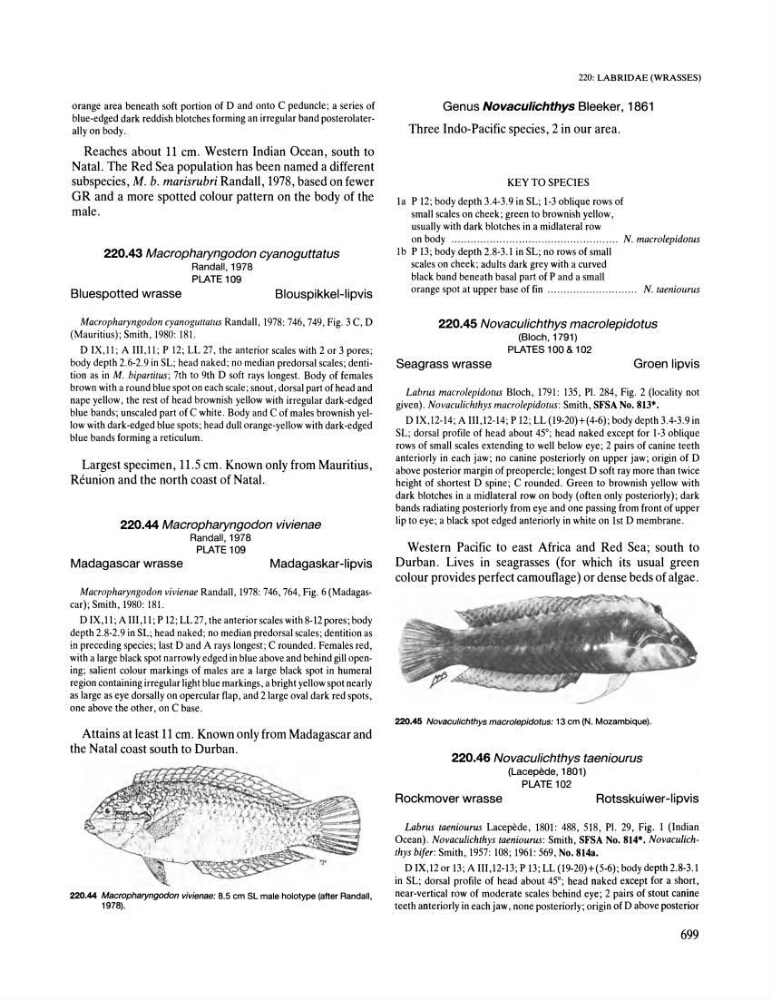
Labrus macrolepidotus Bloch, 1791: 135, PI. 284, Fig. 2 (locality not
given). Novaculichthys macrolepidotus: Smith, SFSA No. 813*.
D IX,12-14; A m,12-14; P 12; LL (19-20)+(4-6); body depth 3.4-3.9 in
SL; dorsal profile of head about 45°; head naked except for 1-3 oblique
rows of small scales extending to well below eye; 2 pairs of canine teeth
anteriorly in each jaw; no canine posteriorly on upper jaw; origin of D
above posterior margin of preopercle; longest D soft ray more than twice
height of shortest D spine; C rounded. Green to brownish yellow with
dark blotches in a midlateral row on body (often only posteriorly); dark
bands radiating posteriorly from eye and one passing from front of upper
lip to eye; a black spot edged anteriorly in white on 1st D membrane.
Western Pacific to east Africa and Red Sea; south to
Durban. Lives in seagrasses (for which its usual green
colour provides perfect camouflage) or dense beds of algae.
220.45 Novaeulichthys macrolepidotus: 13 em (N. Mozambique).
220.46 Novaculichthys taeniourus
(Lacepede, 1801)
PLATE 102
Rockmover wrasse
Rotsskuiwer-lipvis
Labrus taeniourus Lacepede, 1801: 488, 518, PI. 29, Fig. 1 (Indian
Ocean). Novaculichthys taeniourus: Smith, SFSA No. 814*. Novaculichthys biler: Smith, 1957: 108; 1961: 569, No. 814a.
D IX,12 or 13; A 1II,12-13; P 13; LL (19-20)+(5-6); body depth 2.8-3.1
in SL; dorsal profile of head about 45°; head naked except for a short,
near-vertical row of moderate scales behind eye; 2 pairs of stout canine
teeth anteriorly in each jaw, none posteriorly; origin of D above posterior
699
blue-edged dark reddish blotches forming an irregular band posterolaterally on body.
Reaches about 11 cm. Western Indian Ocean, south to
Natal. The Red Sea population has been named a different
subspecies, M. b. marisrubri Randall, 1978, based on fewer
GR and a more spotted colour pattern on the body of the
male.
220.43 Macropharyngodon cyanoguttatus
Randall,1978
PLATE 109
Bluespotted wrasse
Blouspikkel-lipvis
Macropharyngodon cyanoguttatus Randall, 1978: 746,749, Fig. 3 C, D
(Mauritius); Smith, 1980: 181.
D IX,ll; A m,ll; P 12; LL 27, the anterior scales with 2 or 3 pores;
body depth 2.6-2.9 in SL; head naked; no median predorsal scales; dentition as in M. bipartitus; 7th to 9th D soft rays longest. Body of females
brown with a round blue spot on each scale; snout, dorsal part of head and
nape yellow, the rest of head brownish yellow with irregular dark-edged
blue bands; unscaled part of C white. Body and C of males brownish yellow with dark-edged blue spots; head dull orange-yellow with dark-edged
blue bands forming a reticulum.
Largest specimen, 11.5 cm. Known only from Mauritius,
Reunion and the north coast of Natal.
220.44 Macropharyngodon vivienae
Randall, 1978
PLATE 109
Madagascar wrasse
Madagaskar-lipvis
Macropharyngodon vivienae Randall, 1978: 746,764, Fig. 6 (Madagascar); Smith, 1980: 181.
D IX,ll; A m,ll; P 12; LL 27, the anterior scales with 8-12 pores; body
depth 2.8-2.9 in SL; head naked; no median predorsal scales; dentition as
in preceding species; last D and A rays longest; C rounded. Females red,
with a large black spot narrowly edged in blue above and behind gill opening; salient colour markings of males are a large black spot in humeral
region containing irregular light blue markings, a bright yellow spot nearly
as large as eye dorsally on opercular flap, and 2 large oval dark red spots,
one above the other, on C base.
Attains at least 11 cm. Known only from Madagascar and
the Natal coast south to Durban.
220.44 Macropharyngodon vivienae: 8.5 em SL male holotype (after Randall,
1978).
220: LABRIDAE (WRASSES)
Genus Novaculichthys Bleeker, 1861
Three Indo-Pacific species, 2 in our area.
KEY TO SPECIES
la P 12; body depth 3.4-3.9 in SL; 1-3 oblique rows of
small scales on cheek; green to brownish yellow,
usually with dark blotches in a midlateral row
on body .................................................... N. macrolepidotus
Ib P 13; body depth 2.8-3.1 in SL; no rows of small
scales on cheek; adults dark grey with a curved
black band beneath basal part of P and a small
orange spot at upper base of fin ............................ N. taeniourus
220.45 Novaculichthys macrolepidotus
(Bloch,1791)
PLATES 100 & 102
Seagrass wrasse
Groen lipvis
Labrus macrolepidotus Bloch, 1791: 135, PI. 284, Fig. 2 (locality not
given). Novaculichthys macrolepidotus: Smith, SFSA No. 813*.
D IX,12-14; A m,12-14; P 12; LL (19-20)+(4-6); body depth 3.4-3.9 in
SL; dorsal profile of head about 45°; head naked except for 1-3 oblique
rows of small scales extending to well below eye; 2 pairs of canine teeth
anteriorly in each jaw; no canine posteriorly on upper jaw; origin of D
above posterior margin of preopercle; longest D soft ray more than twice
height of shortest D spine; C rounded. Green to brownish yellow with
dark blotches in a midlateral row on body (often only posteriorly); dark
bands radiating posteriorly from eye and one passing from front of upper
lip to eye; a black spot edged anteriorly in white on 1st D membrane.
Western Pacific to east Africa and Red Sea; south to
Durban. Lives in seagrasses (for which its usual green
colour provides perfect camouflage) or dense beds of algae.
220.45 Novaeulichthys macrolepidotus: 13 em (N. Mozambique).
220.46 Novaculichthys taeniourus
(Lacepede, 1801)
PLATE 102
Rockmover wrasse
Rotsskuiwer-lipvis
Labrus taeniourus Lacepede, 1801: 488, 518, PI. 29, Fig. 1 (Indian
Ocean). Novaculichthys taeniourus: Smith, SFSA No. 814*. Novaculichthys biler: Smith, 1957: 108; 1961: 569, No. 814a.
D IX,12 or 13; A 1II,12-13; P 13; LL (19-20)+(5-6); body depth 2.8-3.1
in SL; dorsal profile of head about 45°; head naked except for a short,
near-vertical row of moderate scales behind eye; 2 pairs of stout canine
teeth anteriorly in each jaw, none posteriorly; origin of D above posterior
699