

brittle stars, foraminifera, etc. of very small size, evidently
sorted from the sand within the mouth.
Genus Hologymnosus Lacepede, 1801
Four Indo-Pacific species; 1 undescribed (Randall,
1982); 1 recorded from southern Africa. The wide-ranging
H. annulatus (Lacepede, 1801), (H. semidiscus (Lacepede, .
1801) is a synonym) occurs from the Red Sea and east
Africa to French Polynesia and the Pitcairn Group;
although not yet recorded from southern Africa, it probably
occurs here and is thus included in the Key below.
KEY TO SPECIES
la P 1.65-1.9 in head; C emarginate, maximum C
concavity of large males about 5 in head; juveniles
yellow on back with a reddish line, the lower side
with a very broad dark brown stripe; initial-phase
adults olive brown with dark brown bars on bady
and a whitish crescent posteriorly in C; terminal
males blue-green with purplish red bars on side of
body and without a broad pale bar in P region (pale
bar, if present, centred above origin of A) ............. [H. annulatus]
Ib P 1.9-2.15 in head; C double emarginate, the maximum
C concavity of large males about 11 in head;
juveniles white with 3 narrow orange-red stripes;
initial-phase adults light-coloured with dark bars
and without a conspicuous whitish crescent posteriorly
in C; terminal males light blue-green to light red with
lavender blue bars and a broad pale zone in P region
bordered by purple ................................................ H. doliatus
220.38 Hologymnosus doliatus
(Lacepede,1801)
PLATE 98
Ringed wrasse
Geringde lipvis
Labrus doliatus Lacepede, 1801: 429,473, PI. 6, Fig. 3 (Indian Ocean).
Hologymnosus fasciatus Lacepede, 1801: 556, 557, PI. 1, Fig. 3 (Indian
Ocean). Hologymnosus semidiscus (non Lacepede): Smith, SFSA No.
810*. Hologymnosus doliatus: Smith, 1980: 181; Randall, 1982: 16*.
D IX,12; A m,12; P 13; LL 97-112, d'eflected sharply downward below
9th D soft ray; GR 18-22; body elongate, the depth 3.7-5.4 in SL (larger individuals deeper bodied); head naked; jaws with 2 pairs of canine teeth
anteriorly, the 1st pair largest and more projecting; no canine tooth at
corner of mouth; C of juveniles and small initial-phase fish rounded, becoming double emarginate in large adults, the maximum C concavity in
large males about 11 in head. Juveniles white with 3 narrow orange-red
stripes. Initial phase pale greenish, bluish or pinkish with 20-23 orangish
brown bars on body. Terminal males light blue-green to light red with
lavender blue bars and a pale zone in pectoral region of body bordered by
purple; head blue to blue-green with irregular pink to orange bands.
Largest examined, 38 cm; recorded to 50 cm. Central
Pacific to east Africa, south to southern Natal. Feeds
mainly on fishes and crustaceans.
220: LABRIDAE (WRASSES)
Genus Labrichthys Bleeker, 1854
A single Indo-Pacific species (Randall & Springer, 1973).
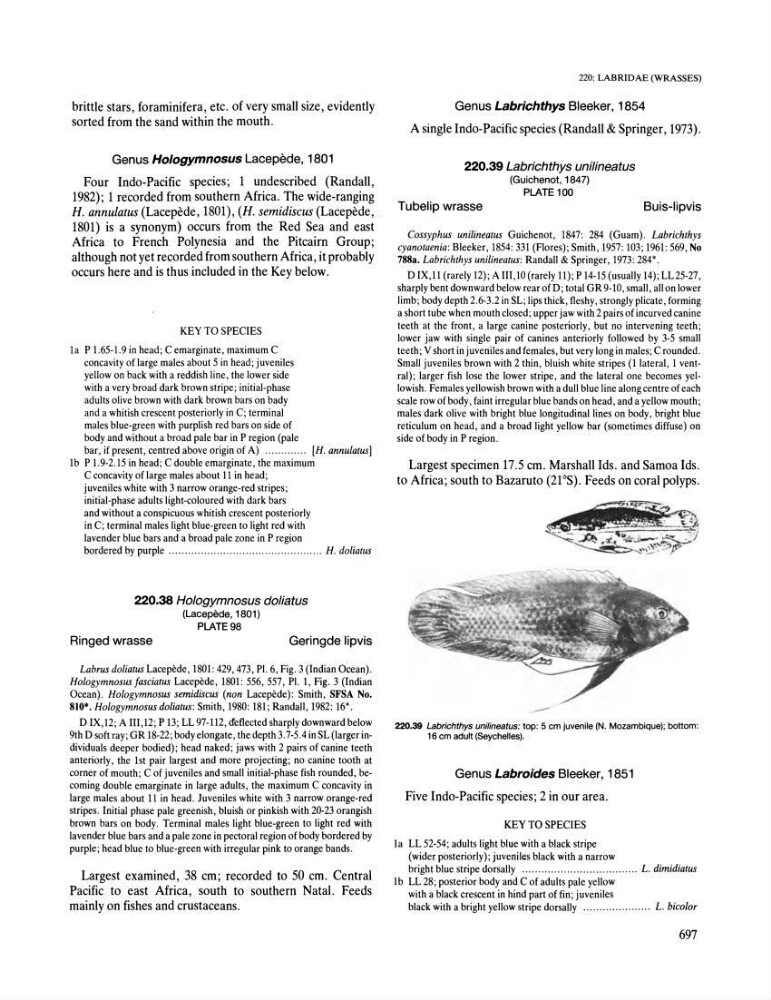
220.39 Labrichthys unilineatus
(Guichenot,1847)
PLATE 100
Tubelip wrasse
Buis-lipvis
Cossyphus unilineatus Guichenot, 1847: 284 (Guam). Labrichthys
cyanotaenia: Bleeker, 1854: 331 (Flores); Smith, 1957: 103; 1961: 569, No
7883. Labrichthys unilineatus: Randall & Springer, 1973: 284*.
D IX,l1 (rarely 12); A III, 10 (rarely 11); P 14-15 (usually 14); LL25-27,
sharply bent downward below rearofD; total GR 9-10, small, all on lower
limb; body depth 2.6-3.2 in SL; lips thick, fleshy, strongly plicate, forming
a short tube when mouth closed; upper jaw with 2 pairs of in curved canine
teeth at the front, a large canine posteriorly, but no intervening teeth;
lower jaw with single pair of canines anteriorly followed by 3-5 small
teeth; V short in juveniles and females, but very long in males; C rounded.
Small juveniles brown with 2 thin, bluish white stripes (I lateral, 1 ventral); larger fish lose the lower stripe, and the lateral one becomes yellowish. Females yellowish brown with a dull blue line along centre of each
scale row of body, faint irregular blue bands on head, and a yellow mouth;
males dark olive with bright blue longitudinal lines on body, bright blue
reticulum on head, and a broad light yellow bar (sometimes diffuse) on
side of body in P region.
Largest specimen 17.5 cm. Marshall Ids. and Samoa Ids.
to Africa; south to Bazaruto (21°S). Feeds on coral polyps.
. . -
220.39 Labrichthys unilineatus: top: 5 em juvenile (N. Mozambique); bottom:
16 em adult (Seychelles).
Genus Labroides Bleeker, 1851
Five Indo-Pacific species; 2 in our area.
KEY TO SPECIES
la LL 52-54; adults light blue with a black stripe
(wider posteriorly); juveniles black with a narrow
bright blue stripe dorsally .................................... L. dimidiatus
Ib LL 28; posterior body and C of adults pale yellow
with a black crescent in hind part of fin; juveniles
black with a bright yellow stripe dorsally ..................... L. bieolor
697
sorted from the sand within the mouth.
Genus Hologymnosus Lacepede, 1801
Four Indo-Pacific species; 1 undescribed (Randall,
1982); 1 recorded from southern Africa. The wide-ranging
H. annulatus (Lacepede, 1801), (H. semidiscus (Lacepede, .
1801) is a synonym) occurs from the Red Sea and east
Africa to French Polynesia and the Pitcairn Group;
although not yet recorded from southern Africa, it probably
occurs here and is thus included in the Key below.
KEY TO SPECIES
la P 1.65-1.9 in head; C emarginate, maximum C
concavity of large males about 5 in head; juveniles
yellow on back with a reddish line, the lower side
with a very broad dark brown stripe; initial-phase
adults olive brown with dark brown bars on bady
and a whitish crescent posteriorly in C; terminal
males blue-green with purplish red bars on side of
body and without a broad pale bar in P region (pale
bar, if present, centred above origin of A) ............. [H. annulatus]
Ib P 1.9-2.15 in head; C double emarginate, the maximum
C concavity of large males about 11 in head;
juveniles white with 3 narrow orange-red stripes;
initial-phase adults light-coloured with dark bars
and without a conspicuous whitish crescent posteriorly
in C; terminal males light blue-green to light red with
lavender blue bars and a broad pale zone in P region
bordered by purple ................................................ H. doliatus
220.38 Hologymnosus doliatus
(Lacepede,1801)
PLATE 98
Ringed wrasse
Geringde lipvis
Labrus doliatus Lacepede, 1801: 429,473, PI. 6, Fig. 3 (Indian Ocean).
Hologymnosus fasciatus Lacepede, 1801: 556, 557, PI. 1, Fig. 3 (Indian
Ocean). Hologymnosus semidiscus (non Lacepede): Smith, SFSA No.
810*. Hologymnosus doliatus: Smith, 1980: 181; Randall, 1982: 16*.
D IX,12; A m,12; P 13; LL 97-112, d'eflected sharply downward below
9th D soft ray; GR 18-22; body elongate, the depth 3.7-5.4 in SL (larger individuals deeper bodied); head naked; jaws with 2 pairs of canine teeth
anteriorly, the 1st pair largest and more projecting; no canine tooth at
corner of mouth; C of juveniles and small initial-phase fish rounded, becoming double emarginate in large adults, the maximum C concavity in
large males about 11 in head. Juveniles white with 3 narrow orange-red
stripes. Initial phase pale greenish, bluish or pinkish with 20-23 orangish
brown bars on body. Terminal males light blue-green to light red with
lavender blue bars and a pale zone in pectoral region of body bordered by
purple; head blue to blue-green with irregular pink to orange bands.
Largest examined, 38 cm; recorded to 50 cm. Central
Pacific to east Africa, south to southern Natal. Feeds
mainly on fishes and crustaceans.
220: LABRIDAE (WRASSES)
Genus Labrichthys Bleeker, 1854
A single Indo-Pacific species (Randall & Springer, 1973).
220.39 Labrichthys unilineatus
(Guichenot,1847)
PLATE 100
Tubelip wrasse
Buis-lipvis
Cossyphus unilineatus Guichenot, 1847: 284 (Guam). Labrichthys
cyanotaenia: Bleeker, 1854: 331 (Flores); Smith, 1957: 103; 1961: 569, No
7883. Labrichthys unilineatus: Randall & Springer, 1973: 284*.
D IX,l1 (rarely 12); A III, 10 (rarely 11); P 14-15 (usually 14); LL25-27,
sharply bent downward below rearofD; total GR 9-10, small, all on lower
limb; body depth 2.6-3.2 in SL; lips thick, fleshy, strongly plicate, forming
a short tube when mouth closed; upper jaw with 2 pairs of in curved canine
teeth at the front, a large canine posteriorly, but no intervening teeth;
lower jaw with single pair of canines anteriorly followed by 3-5 small
teeth; V short in juveniles and females, but very long in males; C rounded.
Small juveniles brown with 2 thin, bluish white stripes (I lateral, 1 ventral); larger fish lose the lower stripe, and the lateral one becomes yellowish. Females yellowish brown with a dull blue line along centre of each
scale row of body, faint irregular blue bands on head, and a yellow mouth;
males dark olive with bright blue longitudinal lines on body, bright blue
reticulum on head, and a broad light yellow bar (sometimes diffuse) on
side of body in P region.
Largest specimen 17.5 cm. Marshall Ids. and Samoa Ids.
to Africa; south to Bazaruto (21°S). Feeds on coral polyps.
. . -
220.39 Labrichthys unilineatus: top: 5 em juvenile (N. Mozambique); bottom:
16 em adult (Seychelles).
Genus Labroides Bleeker, 1851
Five Indo-Pacific species; 2 in our area.
KEY TO SPECIES
la LL 52-54; adults light blue with a black stripe
(wider posteriorly); juveniles black with a narrow
bright blue stripe dorsally .................................... L. dimidiatus
Ib LL 28; posterior body and C of adults pale yellow
with a black crescent in hind part of fin; juveniles
black with a bright yellow stripe dorsally ..................... L. bieolor
697