

220: LABRIDAE (WRASSES)
Halichoeres kawarin (non Bleeker): Smith, SFSA No. 792a*. Halichoeres
nebulosus: Kuiter & Randall, 1981: 15*; Randall & Smith, 1982: 10*,
D IX,11; (rarely 12); A III,! 1; P 14 (rarely 13 or 15); LL 27, anterior
scales with 1-3 pores; GR 17-21; head naked; narrow median zone of nape
naked except for a few embedded scales anterior to D; scales on side of
nape not reaching posterior edge of eye; suborbital pores 10-14; Vof
males nearly or just reaching anus. Females with large irregular interconnected dark bars on body (broadest and darkest dorsally), a large light red
area on abdomen containing 2 or more white lines; a vertically elongate
small black spot behind eye, a larger but less distinct one on opercle, a
small one anteriorly on D and a large yellow-edged one anteriorly in outer
part of soft portion offin. Males primarily green, the red area on abdomen
reduced or absent, the black spots less defined or absent except one on
opercle.
Maximum length 11 cm. Indo-West Pacific; entire coast
of east Africa to Algoa Bay. A common inshore species;
juveniles live in sandy areas, adults on exposed rocky
bottoms.
220.35 Halichoeres scapularis
(Bennett, 1831)
PLATES 97 & 99
Zigzag sandwrasse
Sigsag-sandlipvis
Julis scapularis Bennett, 1831: 167 (Mauritius). Halichoeres scapularis:
Smith, SFSA No. 795*; Randall & Smith, 1982: 5*.
D IX, 11; A III, 11; P 14; LL 26, anterior scales with 1 pore; GR 17-21;
head naked except for a patch of 9-12 small scales dorsally on opercle; no
median naked zone on nape, the scales extending forward to rear edge of
eyes; suborbital pores 9-1l. Initial-phase adults with a dark brown stripe
from eye along upper side (where often zigzag) to upper C base; body
above stripe greenish, below white. Terminal males retain the zigzag
stripe on body, though broader and suffused with pink; ground colour
green with blue-edged pale pink spots following scale rows on sides; head
green with irregular blue-edged pink bands and spots.
Maximum length nearly 20 cm. Indo-West Pacific,
common from Red Sea (where terminal males differ slightly
in colour) to Natal. Typically found in bays or lagoons on
sand, rubble or seagrass substrata near reefs or rocky areas.
Genus Hemigymnus Gunther, 1861
Two Indo-Pacific species; both found in our area.
KEY TO SPECIES
la Body black with 5 narrow white bars; total GR 22-24 ... H. fasciatus
1 b Body pale anteriorly, blackish behind a line
between origins ofD and A; total GR 26-29 ............ H. melapterus
220.36 Hemigymnus fasciatus
(Bloch, 1792)
PLATE 98
Barred thicklip
Balk-dikbek
Labrus fasciatus Bloch, 1792: 6, PI. 290 (Japan). Hemigymnus fasciatus:
Smith, SFSA No. 787*.
696
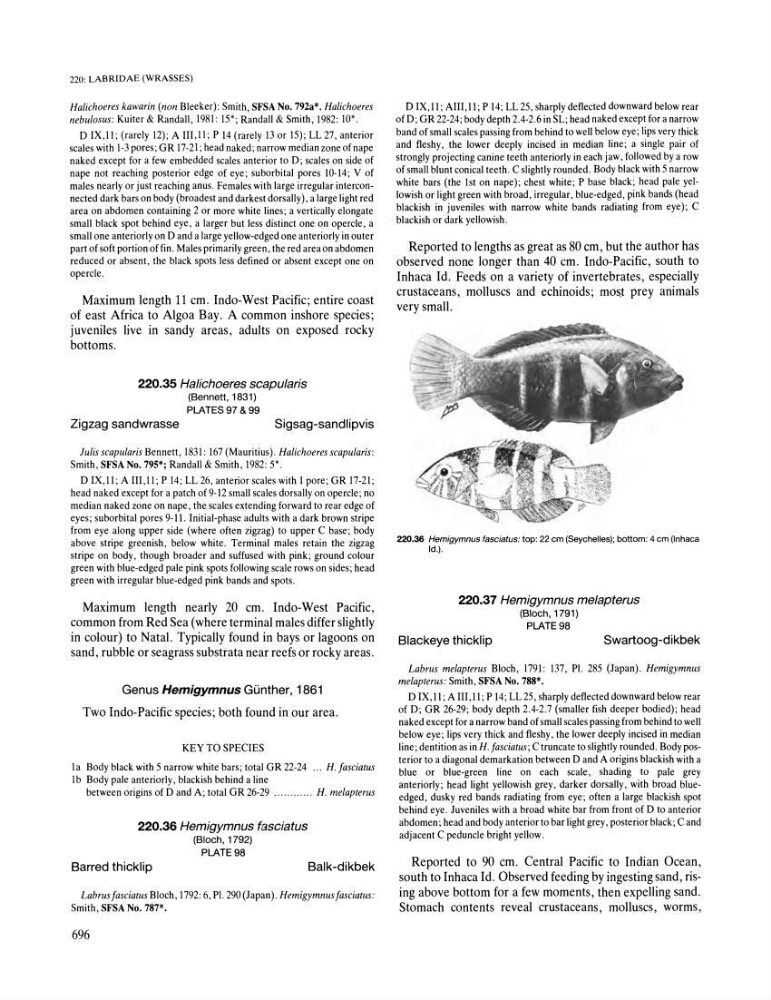
D IX,l1; AIII,11; P 14; LL 25, sharply deflected downward below rear
ofD; GR22-24; body depth 2.4-2.6 in SL; head naked except for a narrow
band of small scales passing from behind to well below eye; lips very thick
and fleshy, the lower deeply incised in median line; a single pair of
strongly projecting canine teeth anteriorly in each jaw, followed by a row
of small blunt conical teeth. C slightly rounded. Body black with 5 narrow
white bars (the 1st on nape); chest white; P base black; head pale yellowish or light green with broad, irregular, blue-edged, pink bands (head
blackish in juveniles with narrow white bands radiating from eye); C
blackish or dark yellowish.
Reported to lengths as great as 80 cm, but the author has
observed none longer than 40 cm. Indo-Pacific, south to
Inhaca Id. Feeds on a variety of invertebrates, especially
crustaceans, molluscs and echinoids; mos.t prey animals
very small.
220.36 Hemigymnus fasciatus: top: 22 em (Seychelles); bottom: 4 em (Inhaca
Id.).
220.37 Hemigymnus melapterus
(Bloch,1791)
PLATE 98
Blackeye thicklip
Swartoog-dikbek
Labrus melapterus Bloch, 1791: 137, PI. 285 (Japan). Hemigymnus
melapterus: Smith, SFSA No. 788*.
D IX,l1; A III,11; P 14; LL 25, sharply deflected downward below rear
of D; GR 26-29; body depth 2.4-2.7 (smaller fish deeper bodied); head
naked except for a narrow band of small scales passing from behind to well
below eye; lips very thick and fleshy, the lower deeply incised in median
line; dentition as in H. fasciatus; C truncate to slightly rounded. Body posterior to a diagonal demarkation between D and A origins blackish with a
blue or blue-green line on each scale, shading to pale grey
anteriorly; head light yellowish grey, darker dorsally, with broad blueedged, dusky red bands radiating from eye; often a large blackish spot
behind eye. Juveniles with a broad white bar from front of D to anterior
abdomen; head and body anterior to bar light grey, posterior black; C and
adjacent C peduncle bright yellow.
Reported to 90 cm. Central Pacific to Indian Ocean,
south to Inhaca Id. Observed feeding by ingesting sand, rising above bottom for a few moments, then expelling sand.
Stomach contents reveal crustaceans, molluscs, worms,
Halichoeres kawarin (non Bleeker): Smith, SFSA No. 792a*. Halichoeres
nebulosus: Kuiter & Randall, 1981: 15*; Randall & Smith, 1982: 10*,
D IX,11; (rarely 12); A III,! 1; P 14 (rarely 13 or 15); LL 27, anterior
scales with 1-3 pores; GR 17-21; head naked; narrow median zone of nape
naked except for a few embedded scales anterior to D; scales on side of
nape not reaching posterior edge of eye; suborbital pores 10-14; Vof
males nearly or just reaching anus. Females with large irregular interconnected dark bars on body (broadest and darkest dorsally), a large light red
area on abdomen containing 2 or more white lines; a vertically elongate
small black spot behind eye, a larger but less distinct one on opercle, a
small one anteriorly on D and a large yellow-edged one anteriorly in outer
part of soft portion offin. Males primarily green, the red area on abdomen
reduced or absent, the black spots less defined or absent except one on
opercle.
Maximum length 11 cm. Indo-West Pacific; entire coast
of east Africa to Algoa Bay. A common inshore species;
juveniles live in sandy areas, adults on exposed rocky
bottoms.
220.35 Halichoeres scapularis
(Bennett, 1831)
PLATES 97 & 99
Zigzag sandwrasse
Sigsag-sandlipvis
Julis scapularis Bennett, 1831: 167 (Mauritius). Halichoeres scapularis:
Smith, SFSA No. 795*; Randall & Smith, 1982: 5*.
D IX, 11; A III, 11; P 14; LL 26, anterior scales with 1 pore; GR 17-21;
head naked except for a patch of 9-12 small scales dorsally on opercle; no
median naked zone on nape, the scales extending forward to rear edge of
eyes; suborbital pores 9-1l. Initial-phase adults with a dark brown stripe
from eye along upper side (where often zigzag) to upper C base; body
above stripe greenish, below white. Terminal males retain the zigzag
stripe on body, though broader and suffused with pink; ground colour
green with blue-edged pale pink spots following scale rows on sides; head
green with irregular blue-edged pink bands and spots.
Maximum length nearly 20 cm. Indo-West Pacific,
common from Red Sea (where terminal males differ slightly
in colour) to Natal. Typically found in bays or lagoons on
sand, rubble or seagrass substrata near reefs or rocky areas.
Genus Hemigymnus Gunther, 1861
Two Indo-Pacific species; both found in our area.
KEY TO SPECIES
la Body black with 5 narrow white bars; total GR 22-24 ... H. fasciatus
1 b Body pale anteriorly, blackish behind a line
between origins ofD and A; total GR 26-29 ............ H. melapterus
220.36 Hemigymnus fasciatus
(Bloch, 1792)
PLATE 98
Barred thicklip
Balk-dikbek
Labrus fasciatus Bloch, 1792: 6, PI. 290 (Japan). Hemigymnus fasciatus:
Smith, SFSA No. 787*.
696
D IX,l1; AIII,11; P 14; LL 25, sharply deflected downward below rear
ofD; GR22-24; body depth 2.4-2.6 in SL; head naked except for a narrow
band of small scales passing from behind to well below eye; lips very thick
and fleshy, the lower deeply incised in median line; a single pair of
strongly projecting canine teeth anteriorly in each jaw, followed by a row
of small blunt conical teeth. C slightly rounded. Body black with 5 narrow
white bars (the 1st on nape); chest white; P base black; head pale yellowish or light green with broad, irregular, blue-edged, pink bands (head
blackish in juveniles with narrow white bands radiating from eye); C
blackish or dark yellowish.
Reported to lengths as great as 80 cm, but the author has
observed none longer than 40 cm. Indo-Pacific, south to
Inhaca Id. Feeds on a variety of invertebrates, especially
crustaceans, molluscs and echinoids; mos.t prey animals
very small.
220.36 Hemigymnus fasciatus: top: 22 em (Seychelles); bottom: 4 em (Inhaca
Id.).
220.37 Hemigymnus melapterus
(Bloch,1791)
PLATE 98
Blackeye thicklip
Swartoog-dikbek
Labrus melapterus Bloch, 1791: 137, PI. 285 (Japan). Hemigymnus
melapterus: Smith, SFSA No. 788*.
D IX,l1; A III,11; P 14; LL 25, sharply deflected downward below rear
of D; GR 26-29; body depth 2.4-2.7 (smaller fish deeper bodied); head
naked except for a narrow band of small scales passing from behind to well
below eye; lips very thick and fleshy, the lower deeply incised in median
line; dentition as in H. fasciatus; C truncate to slightly rounded. Body posterior to a diagonal demarkation between D and A origins blackish with a
blue or blue-green line on each scale, shading to pale grey
anteriorly; head light yellowish grey, darker dorsally, with broad blueedged, dusky red bands radiating from eye; often a large blackish spot
behind eye. Juveniles with a broad white bar from front of D to anterior
abdomen; head and body anterior to bar light grey, posterior black; C and
adjacent C peduncle bright yellow.
Reported to 90 cm. Central Pacific to Indian Ocean,
south to Inhaca Id. Observed feeding by ingesting sand, rising above bottom for a few moments, then expelling sand.
Stomach contents reveal crustaceans, molluscs, worms,